A city built around a crossing

What makes Howrah interesting to visit is precisely this layered character. It is a working city, full of commuters, ferries, temple bells and riverside movement, and at the same time it offers a handful of clear heritage anchors that help a first-time visitor make sense of the place. This guide keeps the focus tight on what the evidence supports: the bridge itself, the railway story, a couple of named religious sites, and a few practical notes about moving around.
Weather and seasonal context
Howrah sits in a part of India where the climate can feel distinctly humid for much of the year, and visitors often describe the air as soft and heavy rather than dry or cool. Lighter clothing, a refillable water bottle and a willingness to slow down between sights tend to make the day more pleasant than rushing from one stop to the next.
Because the published sources for this guide are oriented toward general city information rather than a specific travel window, it is more useful to treat the weather advice as gentle guidance rather than as a hard forecast. The honest approach is to check a live forecast close to your trip, pack for warm and humid conditions as a sensible default, and build in shaded rest stops.
For many travellers, the practical rhythm of Howrah is shaped more by the bridges and the trains than by the calendar. Mornings can feel calmer around the ghats, while the area around the bridge and the station grows busier as the day progresses. If you prefer a quieter experience, an early start is usually more rewarding than a late one.
The icon you came for
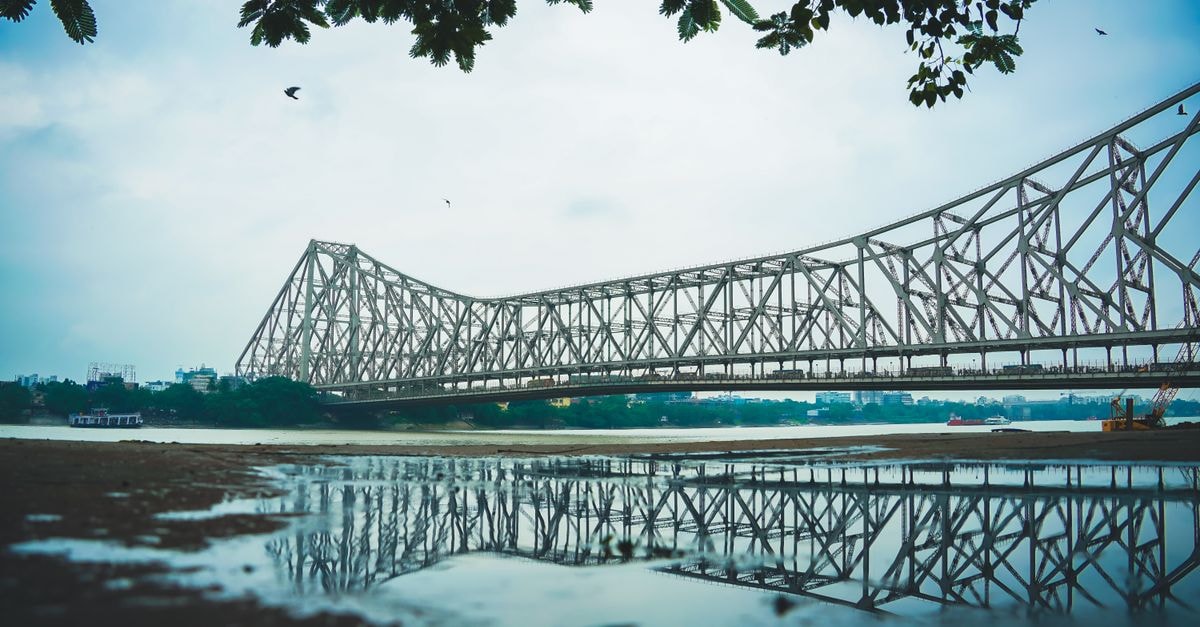
Most visitors experience the bridge as a crossing rather than as a stop. That is by design: it is a working piece of infrastructure, not a pedestrian promenade. The pleasure is in pausing at either end, taking in the view, and then either walking a short stretch of the riverside or catching a ferry for a different angle from the water. District materials describe it as the iconic cantilever Howrah Bridge, the sixth-longest bridge of its kind in the world, with an overall length of 2150 ft and a single span of 1500 ft.
Railways as living heritage
Howrah's second great claim to attention is its railway history. District materials note that a museum in the city was established in 2006 to display the history of railways in the eastern part of India. For travellers interested in how the subcontinent moved and changed in the nineteenth and twentieth centuries, that museum offers a focused way to understand the region beyond its more famous temples and bridges.
The surrounding area is shaped by the railway in less obvious ways too. The approach to the bridge is coloured by the long platforms, the constant arrival and departure announcements, and the steady flow of passengers. Even if you do not step into the museum, spending a little time around the station precinct gives a strong sense of how central rail travel is to everyday life here.
Temples worth knowing about
Religious sites in Howrah are often quiet, locally significant places rather than large tourist draws, and the district website lists a few of them under its tourist places. One is the Bangeshwar Mahadev Temple in Salkia, described in district sources as one of the most popular temples of Lord Shiva in the region. It is the kind of site that gives a visitor a glimpse of the everyday devotional rhythm of the city, especially during morning and evening hours.
A second site mentioned in the same district materials is the Narayan, also referred to as Sridhar, temple, situated at Patihal village in Jagatballavpur. For travellers with time and an interest in stepping outside the immediate riverside core, this offers a more rural setting and a chance to see a different side of the district. As with any religious site, modest dress and quiet behaviour are appropriate, and these places remain active places of worship rather than purely sightseeing stops.
Getting around
Howrah sits very close to Kolkata, and most of the practical advice for getting to and from the city relates to that closeness. District-level travel guidance points to the Esplanade Bus Stand in Kolkata as the major inter-state terminal, located roughly five kilometres from Howrah. That detail is useful for travellers arriving by long-distance bus, since it frames the last leg of the journey as a short hop rather than a difficult transfer.
Rail remains the most common way to arrive for visitors from elsewhere in India, with Howrah's own station acting as one of the busiest termini in the country. Once in the city, local transport includes taxis, auto-rickshaws and app-based cabs, along with walking in the more compact riverside areas. Ferries are also a defining part of the experience and worth treating as transport and sightseeing at the same time.
Because the published guides are not dated and do not pin down current timetables, fares or service availability, the safest approach is to confirm schedules and prices through official channels on the day, rather than rely on a guidebook written for a different travel window. What stays true regardless of season is the basic shape of the network: the bridge for road traffic, the railway for long-distance and commuter trains, the buses for road connections, and the river crossings for ferries.
A few honest notes before you go
A travel guide earns its value by being honest about what it does and does not know. This guide is built around the bridge, the railway museum, two named temples and a small number of practical transport details drawn from the Howrah District tourism pages and related city sources. It does not attempt to rank restaurants, list ticket prices, or recommend day trips, because the evidence available does not support those additions, and generic assumptions would only weaken the guide.
Treat this as a framework rather than a finished itinerary. Confirm opening hours for the railway museum and any specific temple you plan to visit, check current transport options, and keep an eye on the weather forecast in the days before you travel. Factual travel conditions can change, and official channels should always be checked before departure. With those small steps, Howrah offers a rich and unhurried experience, anchored by one of the great bridges of the world and the steady, working pulse of the city around it.
Share this article
TOOLS FOR THIS PLAN
Make the Howrah plan measurable
Choose a tool only when it answers the next question in your trip. Your values stay in the browser, and each tool offers a route back to this planning context.