Catch up on the essentials
- If you crave a roguelite where you can break the intended meta by stacking unusual skills, Shape of Dreams is a strong pickup at this discount, especially if you have friends to queue with.
- LORT is a worthwhile pick if you have a regular squad and tolerate Early Access jank, because the build-stacking loop shines brightest in groups.
- If you enjoy Balatro-style number-go-up roguelikes and want a dice twist with real strategic depth, Dicevaders is a strong pickup at $13.49, though players sensitive to grinding or visual monotony should temper expectations.
Selected from this article · 2026-10-01
Read on for the full picture01Shape of Dreams: a build-crafting roguelite where solo runs and 4-player co-op keep reshaping each attempt

STEAM DEAL · 30% OFF
Shape of Dreams
If you crave a roguelite where you can break the intended meta by stacking unusual skills, Shape of Dreams is a strong pickup at this discount, especially if you have friends to queue with. Solo players still get a complete, demanding experience, though you'll need patience for repeated runs and uneven balance spikes.
Game highlights
Builds that mutate every run
Eight Travelers each start with a distinct combat identity, and the Memories (skills) plus Essences (skill augments) system lets you remap almost any character into a wildly different role. Players routinely turn a rifle user into a minigun build or a sword character into an omnislashing anime protagonist, and the Deja Vu starter option lets you kick off a run with a chosen Memory or Essence to chase a specific fantasy. Looping back through biomes instead of fighting the final boss escalates loot and difficulty, pushing your creation to its limits.
MOBA-style combat, solo or in a squad
Movement is ability-driven with WASD, mouse, or full controller support, and enemy telegraphs reward dodging, positioning, and aim rather than spam. Co-op supports up to four players, and Traveler's abilities can be traded mid-run, so team compositions produce skill-shot combos and synergies a solo run can't replicate. Several players noted they bought extra copies specifically to play with friends, and the group loop is where the design feels most distinctive.
Difficulty and modifiers that change the rules
Four difficulty tiers and Lucid Dream modifiers force fresh tactical reads each attempt, so a build that steamrolls Normal can struggle once you toggle harder settings. Easy mode leans into power-fantasy pacing while hard mode asks you to earn every power-up, which makes the difficulty curve genuinely meaningful rather than cosmetic. Boss encounters are called out as well-designed and varied enough to require different approaches each loop.
Respectful progression and session handling
There are no microtransactions, and unlocks come from in-game challenges plus the Stardust metaprogression currency earned by playing, not buying. Co-op runs can be paused, resumed the next day with the same squad, and even survive a crash with progress intact, which removes a lot of friction that normally punishes group roguelite sessions. A recent patch also eased earlier grind pain points around earning Stardust.
Solo play holds up without a party
The same build-crafting and combat depth translate cleanly to single-player runs, with reviewers describing it as deeply fun even without a group. Several players reported it as their main way to play, and the in-run decisions remain the core draw when matchmaking isn't an option.
What players are saying
What keeps coming up positively
- Build variety and the ability to break characters into unexpected roles keep runs feeling fresh across hundreds of hours.
- Co-op with friends is repeatedly called exceptional, including mid-run skill trading and forgiving session save/load handling.
- Difficulty options create a genuine gap between relaxing power-fantasy play and demanding mastery runs.
- Art style, animations, and soundtrack get consistent praise as standout presentation for an indie roguelite.
Where the friction shows
- Balance becomes uneven once you identify overpowered skill combos, with some strategies trivializing boss fights and entire biomes.
- Long-term content thins out fast; players who unlock everything report little left to chase beyond personal challenge.
- Co-op and single-player save files share a slot, so host progression can be wiped when switching modes, which frustrates mixed playstyles.
- Story and narrative context are thin, leaving world-building and motivation mostly absent for players who want a driven campaign.
Is it worth buying?
At $17.49 against a $24.99 regular price (30% off), the discount is modest but fair for a roguelite with this much build experimentation and solid co-op infrastructure. It's a clean buy if build-crafting depth and group runs are your priority; if you mainly play solo or are sensitive to balance swings, the cheaper end of recent Steam sales may be worth waiting for.
Price checked 2026-10-01:$17.49,down from $24.99(30% off)。Player-fit tags
Good fit
- Players who enjoy theorycrafting unusual skill combinations and rerolling for the perfect run.
- Groups of up to four friends who want a roguelite with forgiving save and rejoin systems.
- Roguelite fans who like difficulty toggles ranging from power-fantasy to punishing mastery.
- Solo players comfortable with repeated runs and self-driven progression rather than narrative hooks.
- Anyone who likes MOBA-style skill-shot combat in a faster, low-toxicity package.
Probably not for you
- Players who want a strong story, lore, or campaign to follow between runs.
- Anyone put off by balance outliers where certain builds trivialize most encounters.
- Players who prefer cozy, low-pressure pacing, since harder difficulties and timers demand focus.
- Groups that need fully separate solo and co-op save files without losing progress.
02LORT co-op roguelite rewards squad runs with wild stacking builds and chaotic fantasy boss fights
STEAM DEAL · 30% OFF
LORT
LORT is a worthwhile pick if you have a regular squad and tolerate Early Access jank, because the build-stacking loop shines brightest in groups. Solo players should wait, as balance and progression friction are sharper without teammates carrying the run.
Game highlights
Eight-player co-op built around shared chaos
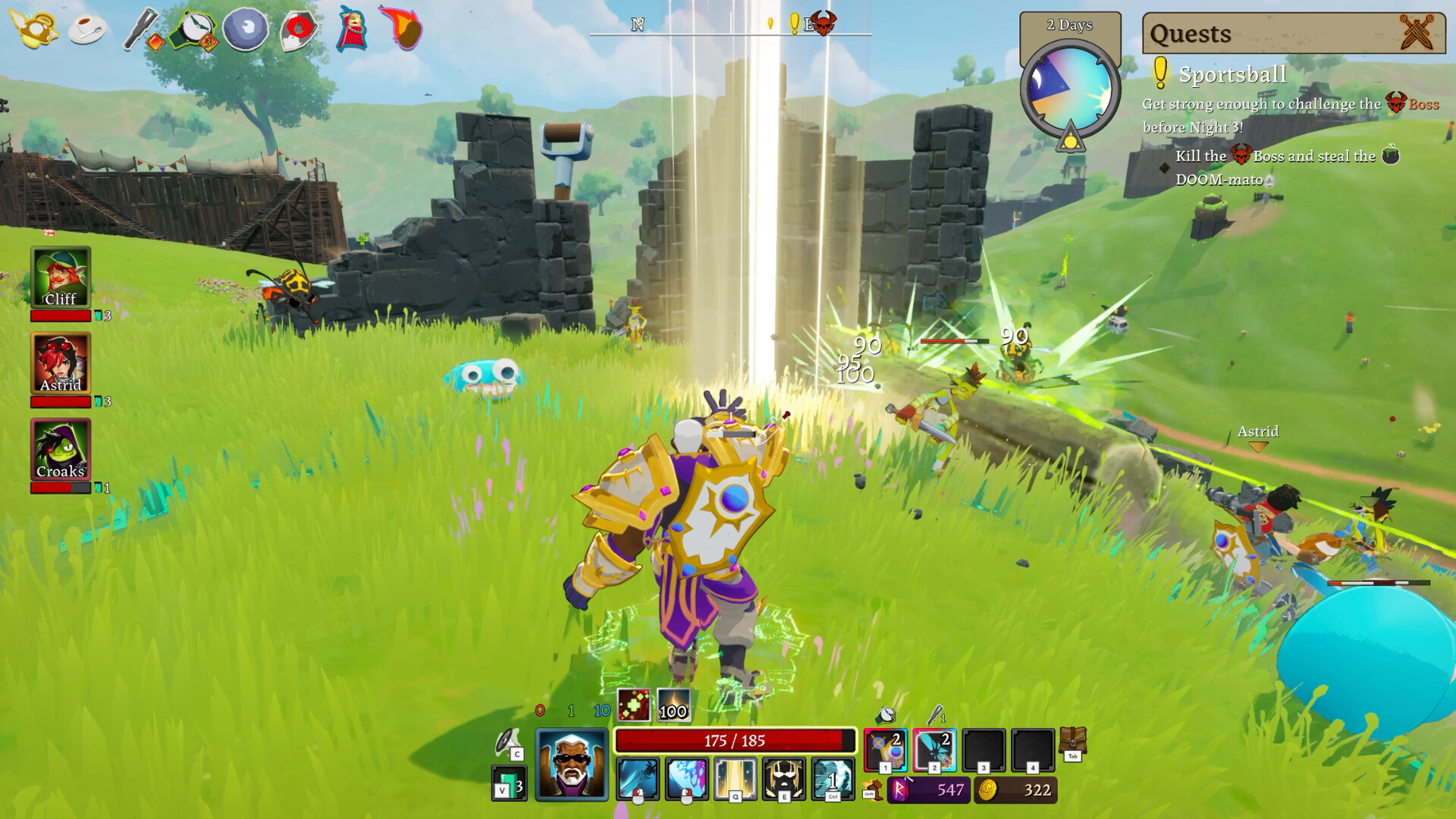
LORT officially supports 1–8 players in online co-op and is framed around reviving homies, blowing the tooter to rally friends, and watching the run escalate from manageable to overwhelming. Multiplayer is clearly the intended way to play, and reviewers consistently describe squad sessions as the most fun version of the game. Full controller support, Steam Cloud, and Family Sharing are also part of the package.
Huge power-up pool for build experimentation
The store description lists over 100 power-ups such as Nah's Barrier, Boomer's Blessing, Trophy of Swole, and Cool Comfy Shorts that stack onto your character as you clear quests. Weapons like swords, wands, bows, and guns are swappable mid-run, and players compare the loot generosity favorably against Risk of Rain 2. This is the core replayability hook for groups that like rolling absurd stat monsters.
Quest and ingredient choices shape each run
According to the official description, you pick ingredients and quests during a run, which in turn decides which bizarre enemies, cursed locations, and weirdo bosses appear. Bosses are pitched as hard-hitting encounters you learn through repetition rather than brute force, reinforcing the roguelite mastery loop. Reviewers who cleared runs treat that learning process as a feature, not a flaw.
Early Access state is obvious and unfiltered
LORT launched into Early Access on January 21, 2026, with only three playable characters despite supporting eight players, and the developer Big Distraction is still iterating. Save-and-quit mid-run, mid-run chest abundance, and a forgiving drop rate are highlighted as player-friendly touches, while balance and content depth are still rough. Treat it as an ongoing project rather than a finished roguelite.
What players are saying
What keeps coming up positively
- Squad sessions turn into hilarious highlight reels as one teammate accidentally becomes god-tier while everyone else crawls on the floor.
- Loot generosity and mid-run saves make it easier to actually finish a run with friends compared to Risk of Rain 2.
- Boss design rewards learning patterns, and players who stick with it describe the moment a run finally clicks as genuinely satisfying.
Where the friction shows
- Solo play feels undercooked, with multiple reviewers calling difficulty scaling brutal without a full team.
- Item scaling is widely seen as flat, leaving characters feeling weak even after stacking gear, and synergies are rarely obvious.
- Melee, ranged, and magic characters are perceived as wildly unbalanced, with magic trivializing encounters while melee struggles to stay in range.
- Early Access content is thin for the price, with only three heroes, limited weapon variety, and progression that loops back into grind.
Is it worth buying?
At $10.49 with a 30% discount off the $14.99 regular price, LORT is a fair co-op pickup if your group already wants another roguelite to rotate in. If you mostly play alone or you want a polished build-crafting sandbox on day one, the friction around solo scaling and balance means you are effectively paying Early Access prices for Early Access depth.
Price checked 2026-10-01:$10.49,down from $14.99(30% off)。Player-fit tags
Good fit
- Squads of 3–8 friends who want a chaotic weekly roguelite night
- Players who enjoy Risk of Rain 2-style loot stacking and revive-your-homie loops
- Roguelite fans willing to learn bosses through repeated failures
- Controller players looking for a low-commitment couch-or-online co-op session
- Groups who specifically want overpowered build moments as the main payoff
Probably not for you
- Solo players without a reliable group, since scaling and boss fights are repeatedly called punishing alone
- Players who want deep item synergies on the level of Risk of Rain 2's ATG plus Ukulele combos
- Anyone expecting a balanced class roster, since magic currently overshadows melee and ranged
- Players who want a finished, content-rich roguelite rather than an Early Access project
- Anyone who dislikes mid-run grind, because chests are frequently described as too expensive before late-stage scaling kicks in
03Dicevaders: dice-placement roguelike deckbuilder rewarding build variety, pivots, and Balatro-style broken combos for replayability-focused players

STEAM DEAL · 10% OFF
Dicevaders
If you enjoy Balatro-style number-go-up roguelikes and want a dice twist with real strategic depth, Dicevaders is a strong pickup at $13.49, though players sensitive to grinding or visual monotony should temper expectations. Worth considering for build-crafting fans, less so for those wanting spectacle or pure StarVaders-like clarity.
Game highlights
Dice Manipulation as Core Strategy
Rather than leaving outcomes to chance, the game hands players Chrono to reroll dice and restock shops, plus a Budge resource to nudge throws toward specific values. Official descriptions and reviews both frame this as converting bad rolls into chain reactions, with multiple players calling the manipulation layer the system's strongest hook. Aligning pairs, triples, or quadruples unlocks escalating combos, making dice positioning a tactical choice rather than a coin flip.
Commander, Unit, and Artifact Build Variety
Each commander arrives with specialized synergies and XP scaling paths, layered with unique perks and artifacts that meaningfully reshape runs. Official text emphasizes that switching commanders changes strategic approach, and reviewer evidence backs up the claim that runs feel distinct enough to chase across many commanders. The artifact and unit pool combined with perk selection produces visible build divergence between attempts.
Pivoting Encouraged Over Single-Build Tunneling
Unlike number-go-up games that funnel you toward one stacking synergy, Dicevaders is designed so broad builds and mid-run pivots stay viable. Player evidence specifically calls out that the game rewards adapting strategy on the fly rather than locking into a single mayonnaise-style combo, keeping individual runs more dynamic. This design choice directly extends replayability and softens the grind feeling some roguelikes inherit.
Turn-Based Grid Placement With StarVaders DNA
Combat unfolds on a grid where each turn you acquire units, artifacts, Budge, and Chrono, then place invaders to maximize scoring. The setting and mechanics tie into the StarVaders universe, including pilot enemies with disruptive abilities, which gives the game a recognizable strategic backbone. Difficulty scales in a way multiple reviewers describe as approachable yet demanding.
Quick Runs Suited to Short Sessions
Runs are structured to stay short and readable, with options like Playable at Your Own Pace and Save Anytime supporting drop-in play. Reviewers with substantial playtime describe sessions as easy to pick up and abandon, similar to the developer's prior work. Adjustable difficulty and full controller support make it accessible for varied play contexts.
What players are saying
What keeps coming up positively
- Build variety across commanders, units, and artifacts is consistently praised as a major reason to keep replaying runs.
- The Chrono and Budge dice-manipulation system is highlighted as transforming dice rolls into genuinely strategic decisions rather than pure luck.
- Pivoting mid-run is repeatedly called out as a refreshing alternative to single-synergy stacking games like Balatro.
- Difficulty scaling is described as approachable for newcomers while still escalating meaningfully for experienced players.
Where the friction shows
- Several reviewers report that the constant layering of modifiers creates an overwhelming first impression and unclear optimal plays.
- Some players describe the experience as visually static and repetitive, noting long stretches spent staring at a single screen with limited spectacle.
- A subset of players who expected StarVaders-like clarity felt the strategic ceiling depends heavily on RNG from upgrade and unit drops.
- Fans seeking traditional tactical combat found the number-go-up loop underwhelming compared to more action-oriented roguelikes.
Is it worth buying?
At $13.49 (10% off the $14.99 regular price), Dicevaders is a reasonable mid-range buy for players already inclined toward dice or deckbuilder roguelikes. There is no indication this is the lowest historical price, so waiting for a deeper discount is reasonable if you want maximum value. The launch pricing is fair but not urgent, especially given the mixed feedback on onboarding clarity and visual variety.
Price checked 2026-10-01:$13.49,down from $14.99(10% off)。Player-fit tags
Good fit
- Players who enjoy Balatro-style number-go-up roguelikes and want a dice-manipulation twist
- Build-crafting fans who like pivoting strategies mid-run rather than locking into one synergy
- Short-session roguelike players who want quick, save-anytime runs
- Fans of the developer's StarVaders universe looking for a related but distinct experience
- Strategy players who enjoy optimizing placement and resource allocation on a turn-based grid
Probably not for you
- Players who dislike grinding for upgrades or relying on RNG-driven progression
- Anyone expecting fast-paced combat or visually dynamic action on screen
- Roguelike newcomers sensitive to complex modifier systems and unclear early-game decision points
- Players seeking cooperative or multiplayer experiences, as the game is single-player only
- Those who prefer cozy, low-pressure wind-down sessions over demanding strategic execution
04Ultrapool review: a Balatro-style roguelike where pool balls become your deck and combos get wonderfully weird

STEAM DEAL · 20% OFF
Ultrapool
If the idea of stacking pool balls with strange effects into a deckbuilder appeals to you, Ultrapool is a charming, snack-sized roguelike that hits hard in short bursts. It is not a deep simulation, and it shows its mobile origins on PC, so treat it like a $9.59 impulse purchase rather than a 40-hour commitment.
Game highlights
Pool mechanics turned into a scoring engine
The official pitch leans into the simple hook: pocket balls, bank score, spend money at the bar. Developer Icedrop Games frames Ultrapool as a pool riff on Balatro and Super Auto Pets, with limited shots per round and escalating point targets across a 10-round run. The accessible core means you can break the table open with well-timed combos once you understand ball order and multipliers.
Wacky ball effects and cocktail mixing
Each ball carries an unusual ability, and the cocktail bar literally mixes any two balls into something new. The official description highlights examples like a ghost ball that reappears, a chicken that lays egg balls, and even Earth itself, all leaning into the absurd roguelike humor. This is where the build variety actually lives, and players who enjoy discovering strange synergies will get the most out of it.
Multiple ball sets for replayability
Different ball sets ship with the game, and reviewers describe them as having genuinely distinct playstyles rather than reskins. Combined with snack modifiers and the mixing bar, runs can feel meaningfully different depending on which set you build around. It is a tighter offering than Balatro but follows the same one-more-run loop.
Tactile, arcade-y presentation
Visuals are bright and colorful, the ball physics read clearly, and sound effects land well according to long-time demo players. Several reviewers specifically praised the satisfying moment of nailing a combo, which is the entire selling point of the genre. A hidden code even unlocks every ball set from the main menu if you want to sample everything quickly.
What players are saying
What keeps coming up positively
- Fans of Balatro and similar roguelike deckbuilders repeatedly call out the satisfying combo moments and the one-more-run compulsion.
- Long-time demo players report very high playtime and describe it as a favorite roguelite deckbuilder, suggesting strong early engagement.
- Players appreciate that each ball set feels mechanically distinct, giving runs a different flavor rather than just cosmetic swaps.
- The ball physics, clear board readability, and punchy sound effects get consistent positive mentions.
Where the friction shows
- Several PC buyers complain the game feels built for mobile portrait mode, with no table rotation for fullscreen play and noticeable lack of polish like missing music.
- Multiple negative reviews describe late-game runs as feeling heavily RNG-dependent, where getting big hole multipliers becomes mandatory and otherwise turns the game into a restart simulator.
- Players report bugs such as inputs not registering consistently and achievements not working as expected at launch.
- Some users find controller support awkward on Steam Deck and dislike that trackpad aiming feels too sensitive for precise shot alignment.
Is it worth buying?
At $9.59 against a $11.99 regular price, the 20% discount makes Ultrapool an easy pickup if Balatro-style roguelikes are already in your rotation and you enjoy lighter, shorter runs. At full price the value questions get louder, since several players feel 5 to 7 hours of content is thin. If you own or plan to buy the mobile version, factor in the lack of cross-save before double-dipping.
Price checked 2026-10-01:$9.59,down from $11.99(20% off)。Player-fit tags
Good fit
- Balatro and Super Auto Pets fans looking for a fresh, low-stakes roguelike spin between longer sessions
- Players who enjoy discovering weird ball synergies and reading patch notes-style ability text to plan combos
- Short-session players who want a 10-round run loop that can be paused and resumed at any time
- Steam Deck owners willing to use the trackpad and tweak sensitivity for aiming precision
- Build-variety hunters who like trying multiple ball sets to find one that clicks
Probably not for you
- Anyone expecting a serious pool sim, since this is a scoring roguelike first and a billiards game second
- Hardcore grinder players who want 40+ hours of progression, since most runs finish within a few hours
- Controller-only players on PC, since reviews flag rough controller and trackpad aiming
- Players who dislike RNG-heavy late runs where high multipliers can feel mandatory to clear targets
- Buyers who want a fully polished PC-first experience, given recurring complaints about mobile-port artifacts and launch bugs
Share this article