Catch up on the essentials
- Siege of Damascus: The Rashidun Arabs under Khalid ibn al-Walid capture Damascus from the Byzantine Empire.
- End of the Siege of Marienburg: The State of the Teutonic Order repulses the joint Polish—Lithuanian forces.
- Imperial-Spanish forces under the count of Tilly and Gonzalo Fernández de Córdoba capture Heidelberg, the capital of the Palatinate during the Thirty Years' War.
Selected from this article · 2026-09-19
Read on for the full pictureSeptember 19, 634 CE · Syria · The eastern wall is breached tonight.

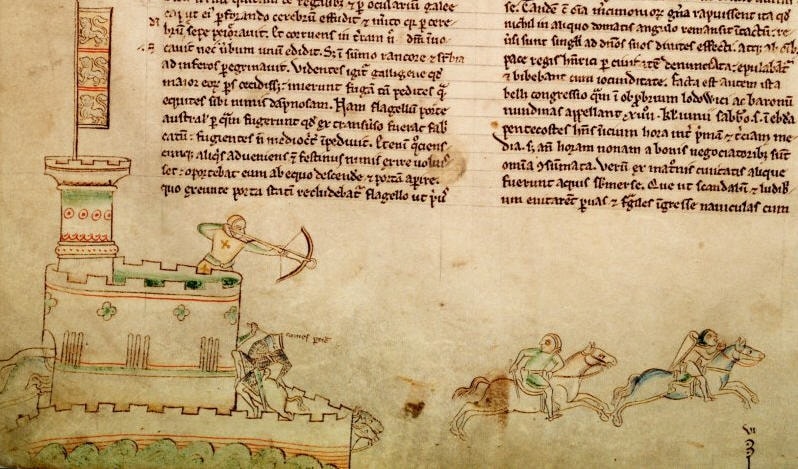
In Syria, Siege of Damascus (634) is unfolding. Siege of Damascus: The Rashidun Arabs under Khalid ibn al-Walid capture Damascus from the Byzantine Empire.
I am a baker in my shop near the eastern quarter, kneading dough as the city falls around me. For nearly a month the Rashidun forces under Khalid ibn al-Walid have pressed our walls, their engines thudding in the dark each night. Bread has grown short, and word comes now that the garrison commander Thomas has already begun surrender talks at the Jabiyah gate with Abu Ubayda ibn al-Jarrah. A bishop slipped beyond the parapets days ago and showed Khalid where the defenses stood thin, and tonight that weakness is breached. The eastern gate is overrun, the storm parties pouring through, while parley continues at the Jabiyah. I press my palms into the flour. The flour comes away wet, and somewhere a watchman's horn cracks twice in the darkness, and the battering picks up where it left off, the thud of rams on the eastern stone.
September 19, 1410 CE · Poland · After two months, the besiegers withdraw.
In Poland, Siege of Marienburg (1410) is unfolding. End of the Siege of Marienburg: The State of the Teutonic Order repulses the joint Polish—Lithuanian forces.
I am a Teutonic brother-at-arms on the wall walk, watching the last banners of the enemy pulling eastward across the fields. Two full months King Władysław II Jagiełło and Grand Duke Vytautas have kept us closed inside these stones, ever since their victory at Grunwald sent them marching toward our capital. Heinrich von Plauen has moved among us through every bombardment, every sleepless shift, rationing bread and hope with the same steady hand. Today the Polish-Lithuanian camp comes down at last. Our provisions are thin, our outer wards are broken, yet the great castle still stands. A kettle drum beats a slow retreat across the lowlands. The autumn wind carries the sound of horses, distant now, and the smell of their abandoned cookfires fading into the haze.
September 19, 1622 CE · Italy · The Palatinate's capital yields at last.
In Italy, count of Tilly is unfolding. Imperial-Spanish forces under the count of Tilly and Gonzalo Fernández de Córdoba capture Heidelberg, the capital of the Palatinate during the Thirty Years' War.
I am a pikeman in the Imperial-Spanish force, stepping through the open gates of Heidelberg beside Count Tilly and Don Gonzalo Fernández de Córdoba, my boots echoing off the cobbles. Our Catholic League army has been marching since the victory at White Mountain, and now the chief city of the Elector Palatine has bowed to our combined siege. Officers seal the strongrooms while clerks tally weapons and prisoners under their watchful eyes. Townsfolk peer from shuttered windows along our route. Word from the rear tells of a wider quarrel of faiths still grinding on across the Empire, but here at the heart of the Palatinate the matter of this city is settled for the moment. I rest my pike against the bridge rail as a thin autumn rain begins to tap against the stone walls and a fresh standard climbs the citadel staff above our heads.
September 19, 1777 CE · United Kingdom · The British regulars hold the field today.
In United Kingdom, American Revolutionary War is unfolding. American Revolutionary War: British forces win a tactically expensive victory over the Continental Army in the First Battle of Saratoga.
I am a Continental soldier crouched behind a stone wall above the water, my bayonet black with powder as the firing finally slackens. The British regulars have pushed hard through these woods today and forced our line back, tree by tree, fence by fence. Officers move among us with their hats in their hands, the sweat cutting channels through the grime on their faces, and the wounded are carried past on stretchers improvised from muskets and tent cloth. Tactically the Crown has won the field, and the order to withdraw to higher ground is already moving down our line. Somewhere beyond these trees the larger war still churns, colonies and parliaments trading arguments across an ocean, but at this hour I know only the burnt smell in the air and the slow tick of a drummer boy trying to remember the next call. I count my cartridges. The river murmurs below, indifferent.
September 19, 1846 CE · France · The children come down from the mountain.
In France, Marian apparition is unfolding. Two French shepherd children, Mélanie Calvat and Maximin Giraud, experience a Marian apparition on a mountaintop near La Salette, France, now known as Our Lady of La Salette.
I am a neighbor woman, working my kitchen garden below the village when Mélanie Calvat and Maximin Giraud come hurrying down the goat track from the upper slopes, their faces pale and their hands trembling as they clutch at one another. I call out, but they cannot answer clearly at first, only pointing back toward the summit of that mountain above La Salette where they pasture their master's animals each day. They tell me a brightness gathered around them there, a presence they are certain was the Virgin Mary, who spoke to them. Whether miracle or mountain mist, I cannot say, but their small faces carry a weight no child should bear. They beg me to spread the story. I sit them at my table, give them bread, and listen as the candle gutters in the draft from the open door, the evening star sharp above the ridge.
Share this article