Quarterly results and first-ever negative free cash flow

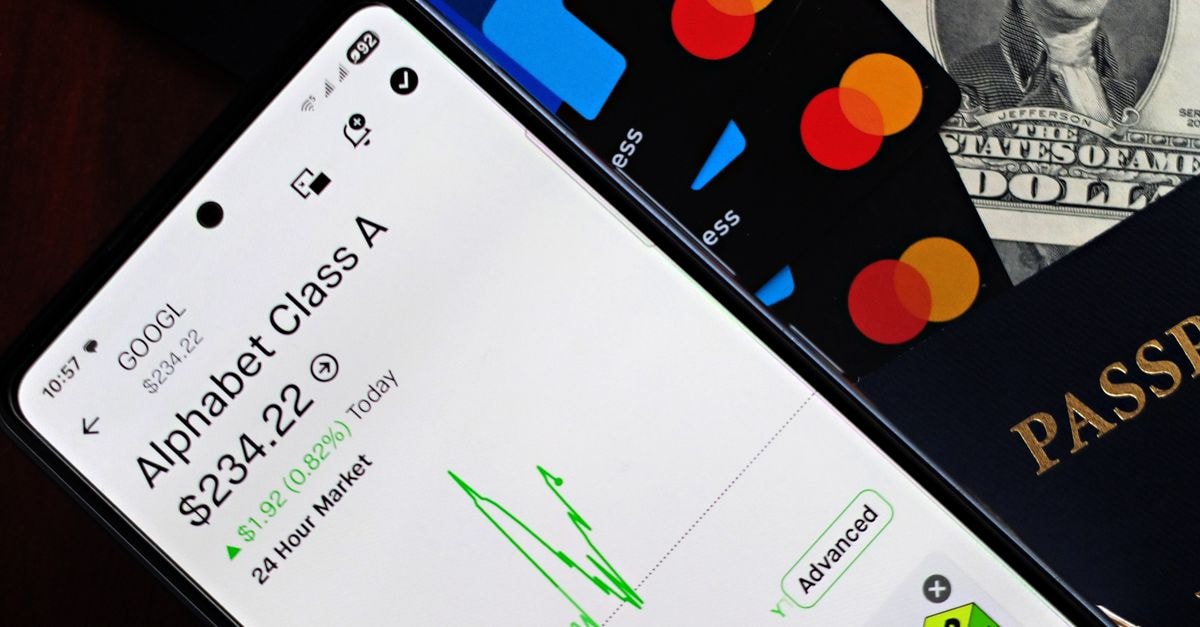
Alphabet, Google's parent company, reported its first quarterly negative free cash flow since it went public in August 2004, with $44.9 billion in AI infrastructure spending outpacing $39.1 billion in cash generated from operations and leaving a $5.9 billion shortfall [Moneywise]. Headline net profit reached a record $112 billion for the quarter, more than four times the roughly $25 billion posted a year earlier, but $99 billion of that figure came from paper gains on Alphabet's stakes in other AI-linked companies, including holdings in SpaceX and Anthropic [IBTimes UK]. On an underlying basis, earnings per share worked out near $2.85, roughly in line with the $2.88 analyst estimate, once the $6.26-per-share contribution from those investment gains is stripped out [Moneywise]. Alphabet shares declined after the report, with one outlet citing a 6.89 percent slide in New York trading and another recording a 4.24 percent drop in after-hours trade, reflecting different sessions [IBTimes UK, Moneywise].
Capital expenditure ramp-up and financing shift
CFO Anat Ashkenazi raised Alphabet's full-year 2026 capital expenditure guidance from a prior $180–190 billion range to $195–205 billion, and warned investors that spending is expected to "increase significantly in 2027" [Moneywise, IBTimes UK]. To fund that build-out, Alphabet raised outside money during the June quarter, selling $49.6 billion in stock, including 6.25 percent preferred shares, and issuing $20.3 billion in bonds, while long-term debt climbed to $98.2 billion from roughly $16 billion a year earlier [Moneywise]. The company also paused share buybacks entirely after repurchasing $13.2 billion in the same quarter a year earlier, leaving the 22-cent quarterly dividend unchanged [Moneywise]. Ashkenazi told analysts that demand for AI compute is running ahead of what Google can build and that investment will continue "as long as we see an attractive return on that investment" [Moneywise].
Revenue growth and cloud backlog
Quarterly revenue rose 24 percent year-on-year to $119.8 billion, the 12th consecutive quarter of double-digit growth, with Search and related advertising up 17 percent to $63.3 billion and YouTube advertising up 13 percent, helped by 1.7 billion viewers of World Cup content [Moneywise]. Google Cloud was the fastest-growing segment, with revenue jumping 82 percent to $24.8 billion, operating profit climbing from $2.8 billion to $8.8 billion, and operating margin widening from 20.7 percent to 35.6 percent; its revenue backlog of signed-but-unbilled work reached $514 billion, of which Alphabet expects to convert more than half into revenue [Moneywise].
Gemini Spark rollout to AI Pro subscribers
Google began extending Gemini Spark, its agentic AI assistant that performs tasks and monitors activity in the background, to subscribers of its $20-per-month Google AI Pro plan in the United States, having previously restricted the feature to the higher-priced AI Ultra tier [CNBCTV18]. The assistant can connect to apps such as Gmail, Calendar, Docs and Keep to gather information, organise it and execute multi-step tasks, and Google added capabilities for editing private and shared Google Docs, Sheets and Slides, reading spreadsheet and slide comments, adding images, and using its Canvas editing tool [CNBCTV18]. Earlier in July, Google extended Spark support to AI Ultra subscribers across all regions where Gemini Apps are available except the European Economic Area, Nigeria, Switzerland and the United Kingdom [CNBCTV18].
EU AI transparency code ahead of August 2 deadline
Google said on July 24, 2026 that it is signing the European Union's Code of Practice on Transparency of AI-Generated Content, building on its 2025 signing of the General-Purpose AI Code of Practice and on its work with the C2PA provenance standard and its own SynthID watermarking [PPC Land]. The code becomes commercially consequential on August 2, 2026 when Article 50 of the EU AI Act takes effect, carrying administrative fines of up to EUR 15 million or 3 percent of total worldwide annual turnover, whichever is higher, for non-compliance [PPC Land]. In its own announcement, Google framed the signature as supporting the responsible use of AI in Europe but warned that layering further obligations onto unsettled technical solutions "could contradict Europe's goals for competitiveness and simplification" [PPC Land]. The latest version of the code requires machine-readable metadata plus an imperceptible watermark for audio, images, video and containerised text circulating online, and obliges signatories to implement an interoperability solution for detection mechanisms by February 2, 2027 [PPC Land].
Share this article