01SWORN review: a 1-4 player co-op Arthurian rogue-like built for friends who embrace repeated failure
STEAM DEAL · 66% OFF
SWORN
SWORN is at its best with a squad of two to four players willing to keep failing and rerolling builds together, because the build variety, blessing combos, and boss grind only stay interesting if you actually have friends online to share the pain. Solo players get a functional Hades-style loop, but the lack of meaningful progression between runs and thin story make it feel like a demo stretched to full price.
Game highlights
1-4 player online co-op in a Camelot setting
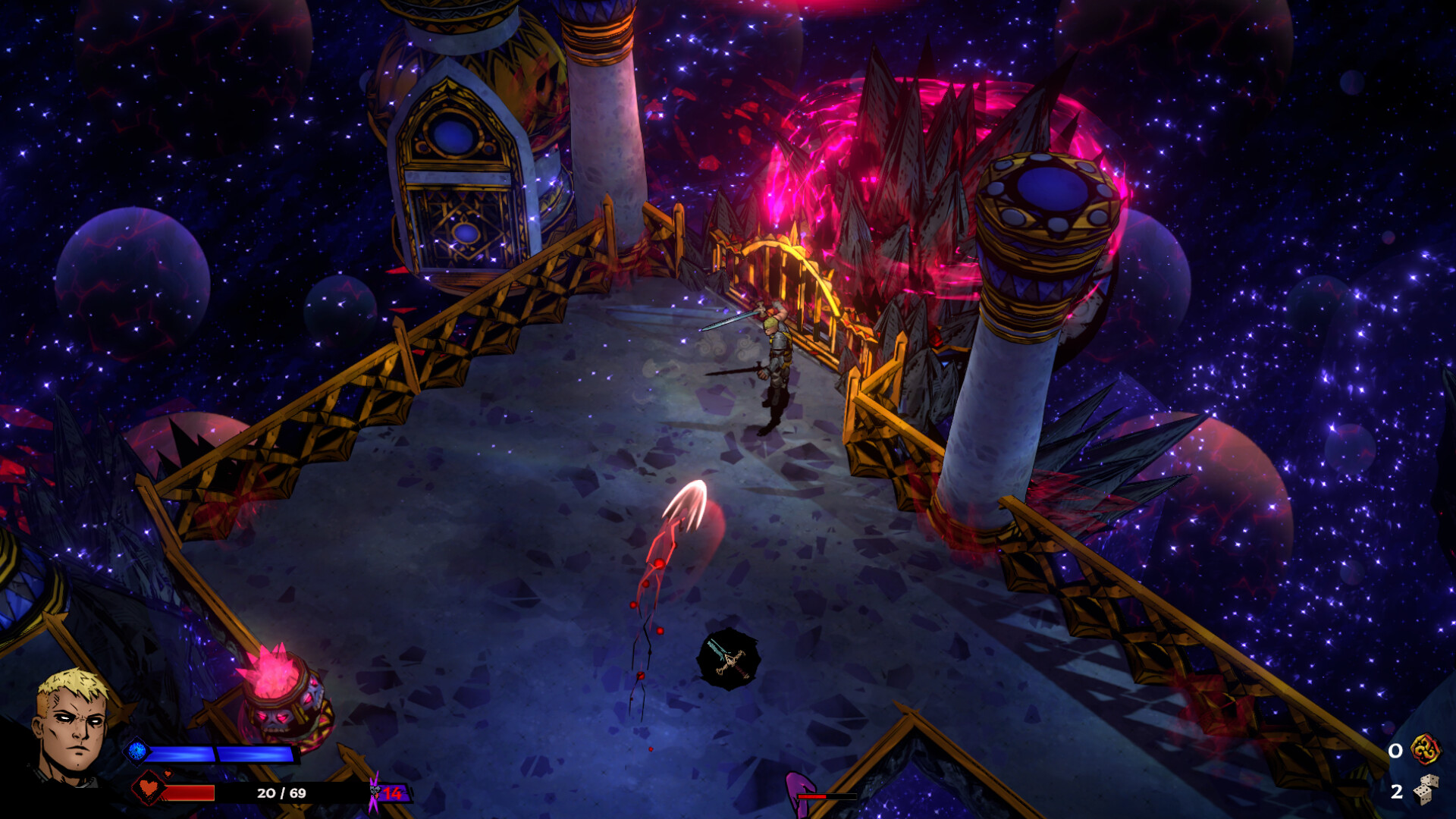
Official store details confirm SWORN supports 1-4 player co-op across online multiplayer, with Steam categories for Co-op, Online Co-op, and full controller support. The Arthurian framing, Fae Lords, and corrupted Knights of the Round Table give the runs a distinct visual identity instead of a generic fantasy backdrop. Players repeatedly say the co-op is the actual hook, especially since four characters with separate weapons and spells let groups specialize into complementary roles.
Build experimentation through 200+ blessings
The store page advertises over 200 unique blessings drawn from figures like Titania and Oberon, and four playable characters each with their own weapons and ability kits. In practice, players describe hundreds of distinct build paths once you start layering blessings, duo boons, and weapon choices across runs. The downside, called out in reviews, is that damage bonuses stack multiplicatively, so off-path builds fall off hard and rerolling into a focused build often feels mandatory.
Mike Mignola-inspired comic art direction
Windwalk Games built the look around American artist Mike Mignola's style, leaning on heavy inks, stark shadows, and a stained-glass palette that holds up in screenshots and gameplay. The art is one of the most consistent positives across reviews, even from players who otherwise pan the game as a Hades copy. It carries the presentation far enough that the environments and bosses still feel readable during chaotic four-player fights.
Roguelike progression tuned around mastery
Runs use a Soulforged knight framing with meta upgrades at the Beacon of Avalore, plus optional Arthur-level challenges for players who want a true skill check. Several reviewers describe the bosses as genuinely difficult, which lines up with the punishing-mastery framing of repeated attempts. That difficulty loop only pays off if you can tolerate save-and-quit restrictions and full-run resets, both of which come up as friction points.
What players are saying
What keeps coming up positively
- The four-character roster and weapon variety make group play feel different every session, especially when friends specialize into tank, ranged, and boon-stacking roles.
- The Mike Mignola-style art direction is widely praised as one of the strongest elements, holding up even during the busiest co-op fights.
- Boss encounters land as a real challenge, and the harder Arthur-tier content gives skilled groups a concrete mastery goal to chase.
- Co-op is repeatedly described as the reason to buy, with several players calling it the best part of an otherwise average package.
Where the friction shows
- Multiplayer stability is a recurring complaint, with crashes on the final boss, disconnects forcing full run restarts, and reports that 1.0 made previously playable runs unreliable.
- There is no real couch co-op despite controller support, and crossplay is advertised but does not actually work for many buyers.
- Save-and-quit is blocked mid-run, so any interruption wastes the entire attempt and makes short play sessions effectively impossible.
- Meta progression and upgrades feel thin compared to the genre leaders, with most unlocks amounting to small percentage stat bumps that do not meaningfully change how a run plays.
Is it worth buying?
At $8.49 against a $24.99 regular price, the 66 percent discount lines up with what most happy buyers say is the right entry point, especially if you mainly want a co-op distraction. Solo players or anyone expecting Hades-level depth and polish will probably feel shortchanged even at this price, so it makes more sense to grab it with at least one friend in mind rather than as a single-player roguelike purchase.
Price checked 2026-08-16:$8.49,down from $24.99(66% off)。Player-fit tags
Good fit
- Groups of 2-4 friends looking for an online co-op action roguelike to run on voice chat
- Players who enjoy rerolling blessing and weapon combos across failed attempts
- Fans of Mignola-style comic art who want a visually distinct Hades-adjacent game
- Squads that enjoy punishing boss fights and grinding out mastery over many runs
Probably not for you
- Solo-only players expecting deep meta progression and a strong narrative between runs
- Anyone wanting short, save-and-quit-friendly sessions, since mid-run saving is disabled
- Couch co-op households, since local multiplayer is not supported
- Players sensitive to multiplayer instability, including disconnects, crashes, and missing crossplay
02Flock of the Seraphim: cute nun-and-angel survivors-like for players who enjoy forgiving roguelite runs with chibi flair

STEAM DEAL · 25% OFF
Flock of the Seraphim
A charming bullet-heaven roguelite that delivers quick 10-minute runs and a distinctive nun-and-angel aesthetic, though it currently leans easy and needs polish. Worth a look at the discounted price if the art style hooks you and you accept light challenge.
Game highlights
Short, snackable run loop
Official details describe horde survival runs designed to reach the boss in roughly 10 minutes, with longer runs available at higher difficulty. Players consistently mention enjoying the game in quick bursts rather than long sessions. It fits cleanly into a 'play one run before bed' rhythm, though that brevity also means progression has to come from repeated attempts.
Keep-what-you-earn angel squad
Each run lets you recruit angels wielding distinct weapons like bows, rifles, and RPGs, and the official description confirms you keep unlocked angels between runs. Angels come with unique passives and stats covering fire rate, reload, damage, pierce, and health recovery. Reviewers highlight the fun of assembling a small squad, even when builds end up skewed toward a few standout options.
Meta-progression through currency and unlocks
Currency earned slaying demons feeds into meta upgrades and angel strengthening outside individual runs, per the store description. More than 20 angel weapon choices are unlockable, with customizable designs. This structure gives short-term goals beyond the standard 'survive 30 minutes' milestone found in similar survivors-likes.
Strong aesthetic identity and sound
The chibi nun-versus-demon art direction and OST are repeatedly singled out by players as the game's strongest hook. Several reviewers describe the animations as a deliberate throwback that fits the concept, and the anime-influenced character designs land for fans of that niche. It's the most consistent across-review praise point, regardless of difficulty opinions.
Controller-friendly, single-player focused
Store categories list full controller support, Steam Cloud, achievements, and family sharing, with no multiplayer features advertised. Playable-without-timed-input design means accessibility for players who dislike twitch reaction checks. Solo is clearly the intended experience.
What players are saying
What keeps coming up positively
- The chibi art style, character designs, and OST are widely described as a standout strength that sells the package on its own
- Quick 10-minute runs work well for short play sessions and give the game a low time-commitment feel
- The core loop of recruiting angels and watching your squad grow is fun, even for players who aren't usually survivors-like fans
- Visible effort and care from a solo developer comes through, with several reviewers saying they want to see where the game goes next
Where the friction shows
- Difficulty is widely seen as too low, with minimal difference between the three Hazard Levels and a lack of challenging achievements
- Enemies frequently clip into floors, walls, stairs, and objects, with several players calling out optimization and polish issues
- Build variety feels shallow, with one weapon (often the rocket launcher) dominating and limited meaningful synergies across the angel roster
- Only three stages are available and post-boss endless modes recycle the same enemy, reducing late-run motivation
Is it worth buying?
At $7.49 (down from $9.99, a 25% discount), the price feels reasonable for what is essentially a small-scale debut release. It's an easy pick for survivors-like fans who care more about aesthetic and short-burst fun than deep difficulty, and a fair impulse buy for anyone drawn to the chibi nun concept. Players expecting deep buildcraft or sustained challenge should temper expectations or wait for content updates before committing full price.
Price checked 2026-08-16:$7.49,down from $9.99(25% off)。Player-fit tags
Good fit
- Players who enjoy Vampire Survivors-style runs and want a fresh visual coat of paint
- Short-session gamers who like completing a run in around 10 minutes rather than hour-long marathons
- Controller-focused players who want full gamepad support and accessible input design
- Fans of chibi, anime-influenced, or nun-themed aesthetics looking for a lighthearted tone
- Solo players who enjoy following a small indie developer's early release and providing feedback through reviews
Probably not for you
- Players seeking high difficulty, punishing execution, or meaningful challenge between runs
- Build-crafting enthusiasts who want deep synergies, multiple viable weapons, and long progression trees
- Anyone bothered by frequent clipping, enemy pathfinding bugs, and rough optimization in current builds
- Multiplayer or co-op players, as the game advertises only single-player features
03Swordcery roguelike ARPG rewards patient players who enjoy mastering dozens of unique spellbound swords across brutal runs

STEAM DEAL · 17% OFF
Swordcery
A polished early-access roguelike with a genuinely fresh sword-collecting hook, Swordcery is worth a look for action-RPG fans who enjoy learning through failure, though the difficulty curve and controller quirks may frustrate more casual players. The 17% discount softens the buy-in while the developer continues to iterate.
Game highlights
Spellbound Swords as the Core Hook
Every blade you collect carries a distinct Swordcery ability like boomerang throws, lightning strikes, hellfire fissures, or icy protective rings, and each Sword Class layers on its own combos and maneuvers. Players repeatedly mention that even swords they normally avoid, like heavy greatswords or titans, end up winning them over once they see the abilities in action. The result is a run-to-run toolkit that nudges you toward experimenting rather than locking into a single build.
Pattern-Heavy Combat That Demands Attention
Encounters are built around recognizing telegraphs, reacting in time, and weaving melee with magical attacks while managing your resources mid-fight. Several reviewers specifically call out that button mashing gets punished, forcing you to think about spacing, timing, and which sword ability to deploy. The early hours feel steep, but reviews describe a satisfying click once combat patterns start to stick.
Deep Build Crafting With Relics and Upgrades
Runs layer in new swords, relics that bend your playstyle, and Sword Class upgrades, with a permanent talent tree and progression system sitting underneath. The upgrade screen gets called detailed and packed with options, and reviewers highlight that finding novel combinations is a major part of the appeal. That said, the same review notes the upgrade UI is clunky to navigate on a controller.
Procedural Runs Across Treacherous Biomes
Procedurally generated dungeons keep each run feeling distinct as you push through multiple biomes toward the boss fights framing the Celestial evil storyline. Players describe the game as addictive in part because the map layouts and weapon drops keep them guessing. Pairing the biome variety with the sword variety gives the loop a longer shelf life than a standard roguelite.
Active Early Access With Clear Dev Responsiveness
Swordcery is in Early Access with full controller support, Steam Achievements, and cloud saves, and multiple long-time followers say the developers have visibly addressed feedback between updates, including balancing room drops and combat. The community touches on a Discord where concerns get heard, which is reassuring given the release is only days old. There is still content and polish owed, but the trajectory reads positive.
What players are saying
What keeps coming up positively
- The sheer variety of swords and their unique magic abilities keeps runs feeling fresh and encourages experimentation across builds.
- Combat has surprising depth, rewarding players who learn patterns and time their abilities rather than spamming attacks.
- The dev team is visibly active and responsive, with multiple reviewers noting meaningful improvements between updates.
- The game's charm, witty flavor text, and creative weapon concepts give it a memorable identity in a crowded roguelite space.
Where the friction shows
- The difficulty curve is steep in the early hours, and players who dislike heavy punishment during the learning phase may bounce off before things click.
- The controller navigation for the upgrade and talent menus is clunky, making permanent progression management feel awkward with a gamepad.
- Some players feel the game still needs additional polish and content, which is expected given the very recent Early Access launch.
- A few early adopters report the early-game sword drops felt uneven, though reviewers note the developers have already begun rebalancing this.
Is it worth buying?
At $14.93 against a $17.99 regular price, the 17% discount trims a bit of risk on an Early Access buy, but the savings are modest so there is no urgency to grab it today. The launch window is extremely fresh, so waiting a patch or two for further balancing and UI cleanups is a reasonable call. If you already love roguelites and the sword-collecting premise hooks you, the current price is fair; if you are on the fence, set a watchlist and wait for a deeper sale or more updates.
Price checked 2026-08-16:$14.93,down from $17.99(17% off)。Player-fit tags
Good fit
- Players who enjoy roguelites like Hades, Dead Cells, or Enter the Gungeon and want a fresh mechanical twist.
- Action-RPG fans who learn best through repeated failure and pattern recognition rather than handholding tutorials.
- Tinkerers who like experimenting with new weapon abilities, relics, and talent tree builds every run.
- Solo players who want a single-player roguelike with controller support and cloud saves.
- Players who follow Early Access titles closely and value developers who actively engage with community feedback.
Probably not for you
- Players who want a forgiving difficulty curve or extensive tutorials before combat pressure ramps up.
- Anyone looking for multiplayer or co-op, since the game is single-player only.
- Buyers expecting a fully polished launch experience, as content and UI refinements are still in progress.
04Assassin's Creed Valhalla review: a massive Viking RPG where mastering patience matters more than reflexes
STEAM DEAL · 75% OFF
Assassin's Creed Valhalla
At 75% off, Valhalla becomes a reasonable buy for players who enjoy methodical Viking raiding across a huge map, though completionists should brace for heavy repetition and padding. Cheap entry, deep commitment required.
Game highlights
Build-your-Eivor Viking progression
You step into the role of Eivor, a Viking raider leading a clan across Dark Ages England with RPG systems that react to dialogue, alliances, and gear choices. Political and combat decisions branch in ways that the developer describes as influencing the world around you. Long-time players highlight that the character writing carries the journey even when mission structure feels loose.
Open-world raiding and exploration
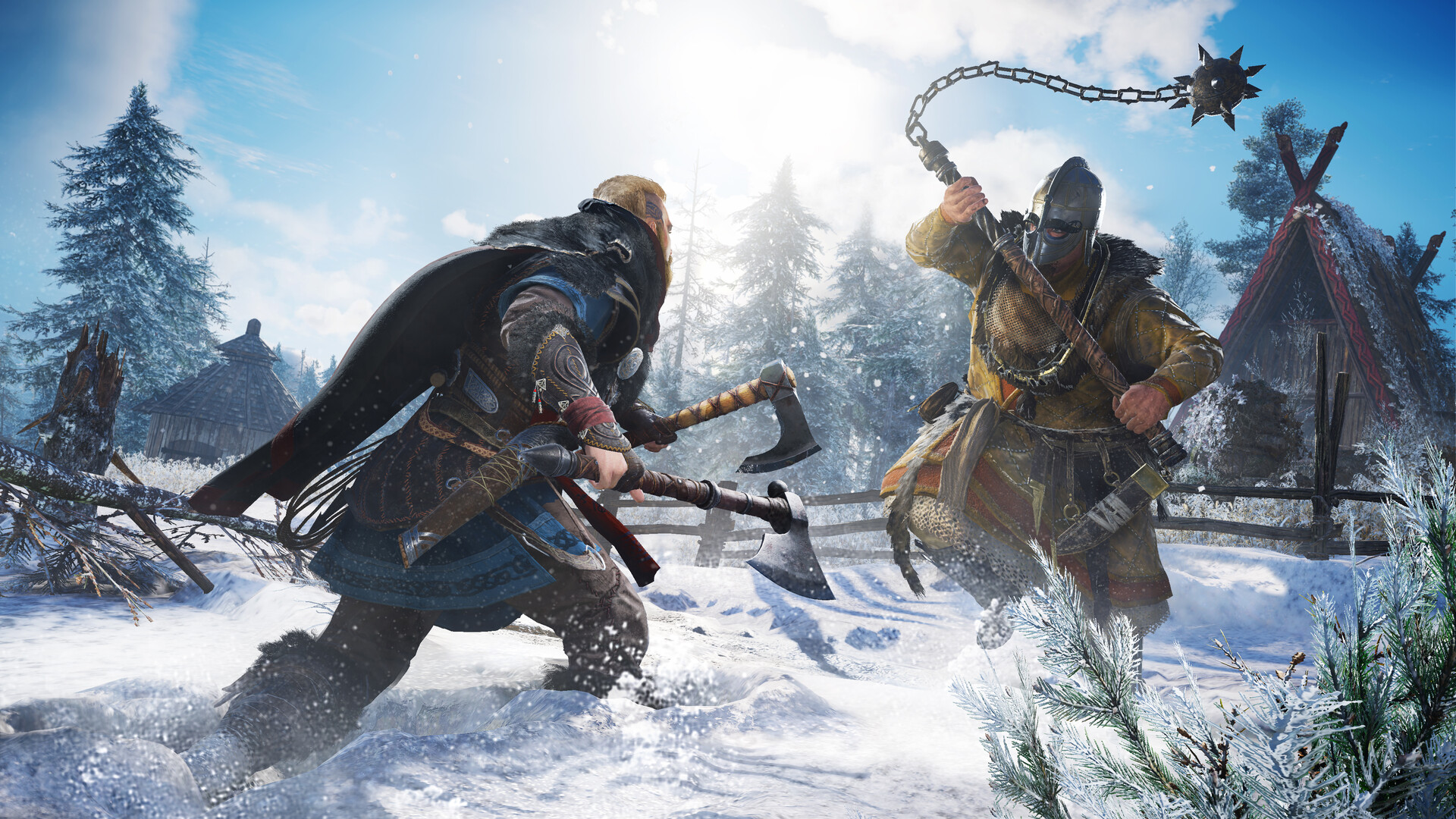
The setting spans Norway's snowy coasts to England's kingdoms, with raids on monasteries and fortresses handled through a brutal melee system using axes, swords, dual-wield combos, and a Hidden Blade. The map is enormous; multiple reviewers with hundreds of hours note you can spend entire playthroughs just clearing caves, tombs, and river raids. Visual design of the wilderness is widely praised as a standout strength.
Settlement building as a side hobby
Beyond main missions you construct and customize buildings such as a barracks, smithy, tattoo parlor, and other structures, recruiting clan members along the way. Reviewers mention the settlement functions as a quiet pacing break between combat arcs. It is decoration-forward rather than management-deep, so it works best as a side activity rather than a city-builder.
Edition and DLC content on offer
The Steam listing offers a Complete Edition bundling the base game, Dawn of Ragnarök, the Season Pass (Wrath of the Druids, The Siege of Paris, Legend of Beowulf quest), and the Berserker Pack of cosmetics, runes, and longship items. Ragnarök and Deluxe tiers give different combinations for players who only want mythology content or just the cosmetic pack. DLCs are widely seen as the most inspired portion of the package.
Combat that rewards learning but grows repetitive
Melee fights emphasize timing, parries, stance swaps, and dismemberment finishers against varied enemy types, which reviewers describe as satisfying once you read patterns. However, several hundred-hour players note combat becomes rote later, and boss encounters lean toward spectacle rather than challenge. Solo-only play is the norm with no cooperative multiplayer modes.
What players are saying
What keeps coming up positively
- The Norse atmosphere, soundtrack, and English/Norwegian landscapes consistently impress players who enjoy slow exploration
- Story arcs in the DLCs and the portrayal of Eivor carry engagement through long stretches of gameplay
- Sense of progression from weak raider to god-tier powers provides clear motivation across the campaign
- Settlement customization and Berserker cosmetics let players personalize their Viking identity
Where the friction shows
- Main campaign runs 80–200+ hours with missions that devolve into fetch and collectible chores
- England's alliance arcs lack cohesion, leaving the central story feeling fragmented and forgettable
- Late-game power leveling and resource gathering introduces grind that many reviewers call unnecessary
- Long playtimes surface repetition in enemy design, raid structure, and puzzle rewards
Is it worth buying?
At $14.99 against a $59.99 regular price (75% off), the Complete Edition stacks up as a fair value for a player with 80+ hours to spare. The base price feels generous given the DLCs bundled in, but only commit if you actually enjoy long Ubisoft open worlds; otherwise wait for a deeper discount or a friend to test it first.
Price checked 2026-08-16:$14.99,down from $59.99(75% off)。Player-fit tags
Good fit
- Players who settle in for 100+ hour Viking sagas and don't mind slow narrative pacing
- Explorers who enjoy clearing every map icon, cave, and riddle across a massive open map
- Fans of weighty melee combat who enjoy learning parry timings and stance swaps
- Roleplayers who like branching dialogue, settlement building, and Norse mythology DLCs
- Patient completionists chasing achievements, cairn puzzles, and river raid mastery
Probably not for you
- Players who want tight 20–30 hour campaigns or focused storytelling
- Anyone allergic to Ubisoft-style map bloat, fetch quests, and collectible checklists
- Series purists expecting classic Assassin's Creed stealth, social blending, or parkour focus
- Multiplayer seekers, since Valhalla is strictly single-player
- Players who burn out on repetitive melee encounters past the 60-hour mark
05Cthulhu's Reach: Devil Reef — punishing co-op roguelite for players who thrive on repeated failure
STEAM DEAL · 10% OFF
Cthulhu's Reach: Devil Reef
A moody Lovecraftian twin-stick roguelite best tackled with a full crew, where sanity curses and hostile runs reward mastery through repeated failure. Solo play is supported but loses much of the chaos that makes the co-op loop memorable.
Game highlights
Sanity-driven run modifier
Spending sanity for incantations is the headline mechanic, and crossing thresholds forces you to pick from curses that alter the next level. There is no reroll option, so each choice you accept narrows the following one. Permanent rewards are granted if you survive, but failing repeatedly pushes the run toward a no-choice Madness state where the game decides for you. It is a deliberate pressure system that punishes reckless play and rewards careful resource planning.
Procedural labyrinths and item pool
Each descent reshapes room layouts, and over 100 collectible items across four rarity tiers change the value of every pickup. Three acts of escalating difficulty are promised, and a Daily Challenge mode seeds a global dungeon so every player tackles the same configuration. Weapon upgrades are persistent, but they are uneven across the arsenal, which forces players to weigh which guns to invest in across many failed runs.
1–4 player online co-op with scaling
Online play supports one to four players, with dungeon scaling so the difficulty adjusts to crew size. Friendly fire is a toggle, and multiple reviews lean toward leaving it on for the chaotic laughs it produces. Host instability is a recurring complaint, with several players reporting crash-on-join issues depending on who hosts the session.
Twin-stick combat with status effects
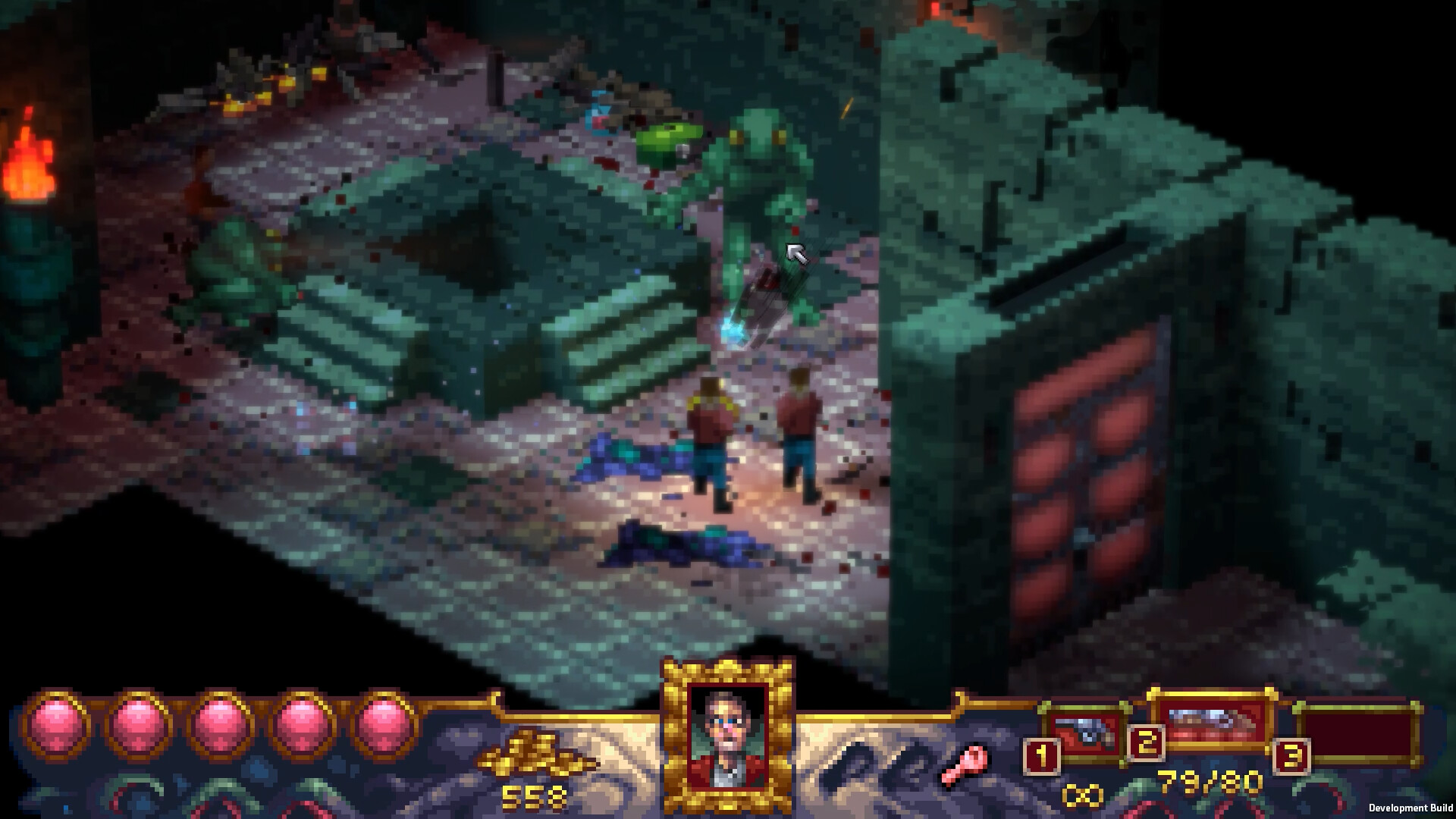
Combat is isometric twin-stick action against eldritch enemies whose attacks inflict bleeding, burning, slowing, or panic. Enemies can swarm in large groups during later stages, and dodging becomes essential against telegraphed ground attacks. The weapons feel distinct: revolvers scale broadly, machine guns lean into stunlock, and shotguns punish melee rushes, which gives each run a different combat identity.
Lovecraftian 1920s setting and custom maps
The 1923 New England aesthetic leans into Innsmouth and Devil Reef imagery, with pixel art that evokes classic dungeon crawlers. A built-in custom map editor lets you author layouts and share them with friends, extending replay value beyond the standard seed. Atmospheric music and ambient sound design carry the mood, even though enemy sound variety is a recurring point of criticism.
What players are saying
What keeps coming up positively
- Co-op chaos with friends consistently lands as the strongest draw, especially when friendly fire is left enabled.
- The sanity mechanic adds meaningful tension, forcing trade-offs that make each run feel different rather than rote.
- Twin-stick controls are responsive and the early-game learning curve is short, so new players get into runs quickly.
- Atmosphere, music, and Lovecraftian flavor earn regular praise, with several players comparing the vibe to classic dungeon crawlers.
Where the friction shows
- Co-op host instability causes frequent crash-on-join sessions, and only certain players can reliably host without disconnecting.
- Enemy variety is thin, with several reviewers noting many foes feel like recolored versions of the same chase or ranged pattern.
- Update-driven balance changes have broken progression for some returning players, locking them out of previously accessible weapons.
- Controller support has been called unplayable by some, particularly on Steam Deck, despite the game being marketed as compatible there.
Is it worth buying?
At $8.99 on a 10% discount against a $9.99 regular price, this sits close to standard pricing rather than a real sale. Early access bugs, host instability, and a thin enemy roster make it a tougher recommendation at full price, and several reviewers explicitly held off until deeper discounts. Worth considering only if you have a reliable co-op group; otherwise wait for a deeper discount or further updates.
Price checked 2026-08-16:$8.99,down from $9.99(10% off)。Player-fit tags
Good fit
- Players who queue up roguelite runs with a regular 3–4 friend group and want shared failure as a bonding mechanic.
- Players who enjoy mastering a small set of weapons across many attempts rather than chasing build diversity.
- Players who like sanity, curse, or morale systems that turn resource spending into a strategic gamble.
- Players who want a short, repeatable co-op session that fits an evening rather than a long campaign.
- Players who enjoy community seeds and Daily Challenge runs and want a daily leaderboard to chase.
Probably not for you
- Players without a stable co-op group, since solo play loses much of the loop's appeal and host crashes fragment sessions.
- Players who expect broad enemy variety, as the bestiary is widely described as thin even after updates.
- Players sensitive to early access instability, including broken progression paths introduced by patches and unreliable Steam Deck controller support.
06Orcs Must Die! Deathtrap punishes mistakes, rewards mastery for four-player co-op squads on a budget
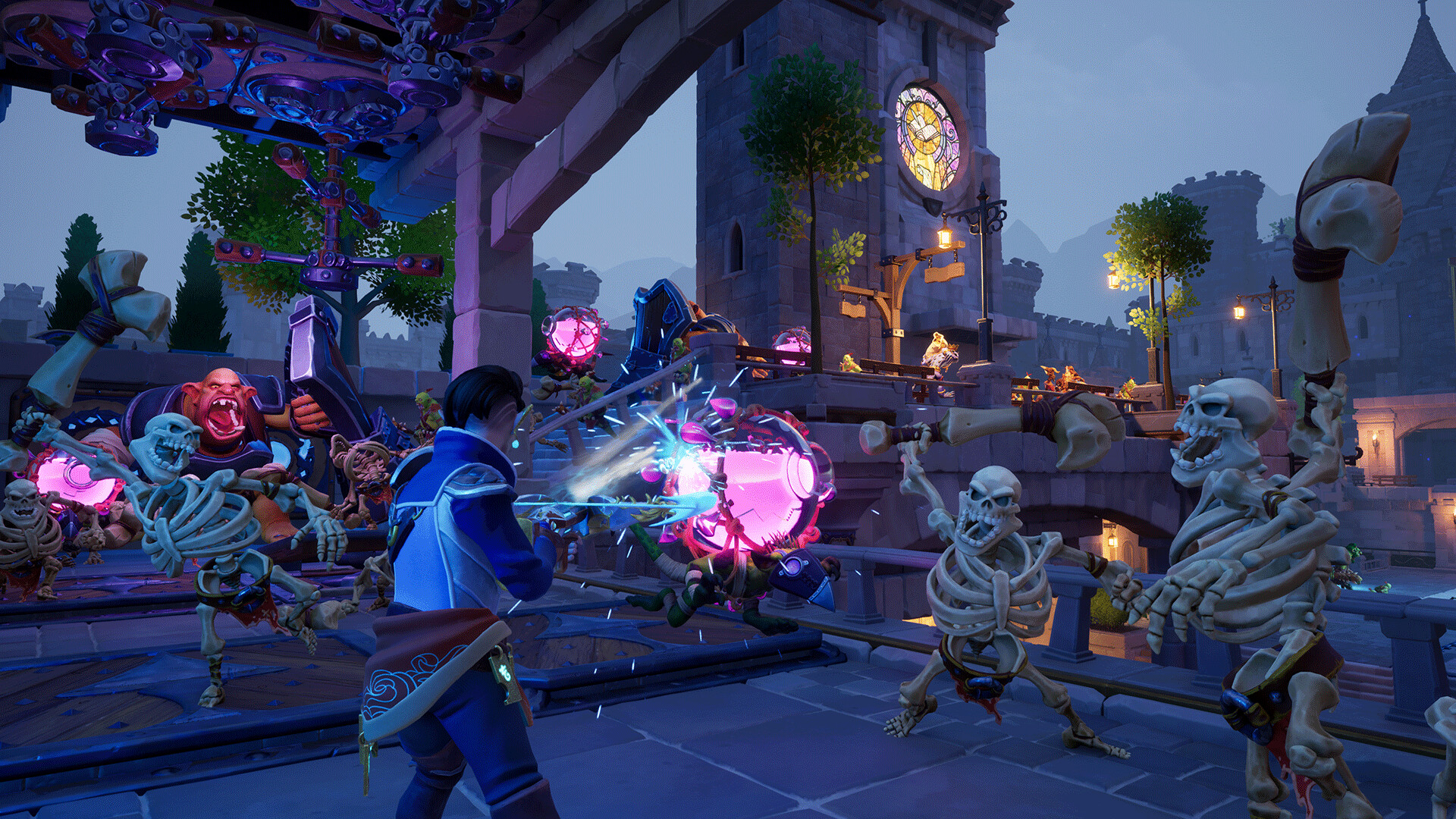
STEAM DEAL · 50% OFF
Orcs Must Die! Deathtrap
Pick this up if you queue up with a reliable squad and accept the roguelite structure as the point, since the trap-vs-orc core loop is satisfying but the grind and solo design friction will burn out single players and bargain hunters expecting a campaign.
Game highlights
Co-op or solo with squad scaling
The official store description confirms support for one to four players online, with the encounter design adjusting to team size. That flexibility is the headline pitch and it lines up with positive player reports about chaos with friends. Solo players still get full progression but map layouts push toward multiple paths, which becomes harder to cover alone.
Roguelite run structure with stacked buffs and debuffs
Each run layers randomized modifiers that change enemy stats, trap behavior, and environmental conditions like weather and time of day. Players accumulate Threads that alter how weapons and traps function, pushing risk-reward decisions between pushing deeper and returning to the hub to power up before a boss. Boss fights cap each run as a deliberate skill check.
Distinct War Mages with trap and weapon kits
The description lists multiple War Mages, each with unique weapons, abilities, traps, and personality, built to support different roles or complement teammates. Choice matters because traps and skills overlap but are not interchangeable, which adds replay value when the squad swaps roles.
Trap physics and combat feedback
Ragdoll, launching, and crushing interactions are central to the selling point, alongside tighter third-person shooting and melee. Players explicitly call out the spectacle of orcs being hurled by traps, which is the immediate dopamine loop when a killzone snaps into place.
Progression gating that nudges repeat runs
Traps, upgrades, and hero power are pushed through the run structure rather than handed out as campaign rewards. That choice keeps individual runs tense, but it also explains the most common player complaint that there is no traditional sense of completion or map mastery.
What players are saying
What keeps coming up positively
- The trap combinations and killbox design remain satisfying when everything clicks, especially with a coordinated team.
- Roguelite modifiers, Threads, and boss encounters keep runs varied enough that short play sessions still feel meaningful.
- Visual spectacle, ragdoll physics, and the soundtrack keep the chaos entertaining even on repeat maps.
- Hero variety and role differentiation give co-op squads room to specialize and experiment with synergies.
Where the friction shows
- Map count is small and once a strategy is solved for a map it can be reused, reducing long-term variety.
- Solo play feels stretched because barricade limits and wide-open layouts make funneling orcs difficult without a squad.
- Co-op stability is fragile, with disconnects and rejoin issues wiping run progress, and there is no LAN fallback.
- Balance issues push players toward a narrow meta of percentage-damage traps while flat-damage options feel useless at higher difficulties.
Is it worth buying?
At $14.99 on a 50 percent discount from the $29.99 regular, the price is reasonable for the co-op crowd who already has a group ready. Players who previously enjoyed OMD3 and want a roguelite twist get the most value. If you mainly play solo, prefer a structured campaign, or are sensitive to grind, wait for a deeper discount or pick up OMD3 first since several reviewers explicitly recommended that instead.
Price checked 2026-08-16:$14.99,down from $29.99(50% off)。Player-fit tags
Good fit
- Three- or four-player co-op groups who queue reliably and have stable connections
- Players who enjoy roguelite structure and randomized modifiers as a feature
- Trap-layout enthusiasts who like experimenting with killboxes and synergies
- Returning OMD fans looking for a chaotic, physics-driven spin on the formula
- Players comfortable restarting failed runs as the core learning loop
Probably not for you
- Solo-only players, since map design and barricade limits are tuned around a squad
- Anyone expecting a traditional campaign with per-map completion goals
- Groups with unstable internet, because disconnects can wipe run progress
- Players who dislike meta pressure forcing a small subset of percentage-damage traps
- Bargain hunters expecting a full content drop at half price given the small map pool
07Rogue Eclipse spaceflight roguelike: arcade dogfighting, brutal boss runs, and ship customization built for players who learn through dying

STEAM DEAL · 10% OFF
Rogue Eclipse
Rogue Eclipse is a slick, controller-friendly space roguelike that rewards repeated runs with tight flight feel and ship upgrades, but thin early-game progression, control-mapping friction, and missing navigation tools make it a better pick for patient arcade diehards than completion-minded explorers. At $17.99 on a 10% discount, it is a fair pickup for fans of the genre who accept trial-and-error mastery as the point.
Game highlights
Approachable arcade spaceflight with a steep mastery curve
Official descriptions call the combat 'easy to learn and difficult to master,' and reviewers consistently echo that loop. Movement and shooting feel fast but accessible from the first run, while boss encounters demand real piloting discipline, pushing players into retries as a deliberate learning mechanic rather than a chore.
Roguelike campaign with on-the-fly ship upgrades
The Steam page lists a narrative-driven roguelike campaign where players upgrade, customize, and personalize their starfighter between runs. Multiple reviewers describe the meta-progression as engaging, though a few note that early unlocks feel cosmetic rather than transformative, meaning the first several attempts can blur together until deeper systems unlock.
Large-scale battles against starfighter swarms and behemoths
Official features highlight fights against swarms, merciless armadas, and colossal enemy warships in destructible environments. Reviewers compare the spectacle favorably to classic arcade space combat, and capital-ship strafing runs are singled out as the most memorable moments, even when individual fights feel swingy or random.
Controller-first design and full controller support
Steam lists full controller support, Steam Cloud, and Remote Play on TV, and players repeatedly recommend a gamepad over mouse and keyboard. Several reviewers warn that default stick-and-trigger mappings feel awkward for boost, brake, and roll combinations, and that controls cannot be remapped, which is a hard blocker for some pilots.
Single-player focus with no multiplayer in scope
Steam categories list only single-player play, with no co-op or PvP mentioned in the official features. Reviewers discuss the experience purely as a solo pursuit, so anyone looking for shared squad flying or online lobbies should look elsewhere before buying.
What players are saying
What keeps coming up positively
- Flight and combat feel fast, fluid, and satisfying, with several players likening the handling to classic arcade space shooters and Armoured Core-style mech games.
- Boss fights and capital-ship encounters are repeatedly described as challenging highlights that reward learning attack patterns through repeated attempts.
- Ship customization between runs gives a sense of personal expression, with weapons like railguns adding tactical variety to combat approaches.
- The retry loop feels rewarding because deaths push players straight into another attempt, reinforcing a learn-by-dying mastery rhythm.
Where the friction shows
- Progression feels thin early on, with some reviewers reporting that unlock notifications appear but do not meaningfully change ship loadouts in the first hours.
- Mouse-and-keyboard controls and the inability to rebind inputs frustrate players, especially when boost, brake, and roll are mapped to shoulders and triggers at the same time.
- Steam Deck performance shows frame drops even in the optimized profile, and audio is described by some players as muffled or bass-heavy rather than punchy.
- Onboarding lacks context: reviewers cite missing sector maps, unclear run length, and story dialogue that appears without setup, leaving new pilots unsure what they are working toward.
Is it worth buying?
At $17.99 (down from $19.99, a 10% discount), the price is reasonable but not a deep cut, so treat it as a genre-fit purchase rather than an impulse buy. If the punishing-mastery loop and arcade dogfighting appeal and you own a controller, this is a solid early-purchase; if you prefer keyboard play, clearer progression, or co-op, waiting for a deeper sale or more patches is the safer move.
Price checked 2026-08-16:$17.99,down from $19.99(10% off)。Player-fit tags
Good fit
- Players who enjoy arcade space shooters and learn boss patterns through repeated deaths rather than memorizing menus
- Controller-equipped pilots who want fast, drifty space combat and customizable starfighters
- Solo roguelike fans comfortable with trial-and-error runs and incremental meta-progression
- Players seeking short-to-medium arcade sessions with clear retry loops and capital-ship spectacle
Probably not for you
- Players who refuse to use a controller, since mouse-and-keyboard handling and the lack of remapping are recurring friction points
- Anyone looking for co-op or multiplayer space combat, since the game ships as single-player only
- Buyers who want clearly telegraphed progression, sector maps, or a strong narrative hook in the opening hours
- Steam Deck owners sensitive to frame drops, since performance dips are reported even in the optimized profile
08Lucky Shot Roguelike FPS Mag-Builder for Aim-Training Roguelike Fans Who Accept Repeated Runs as Mastery
STEAM DEAL · 25% OFF
Lucky Shot
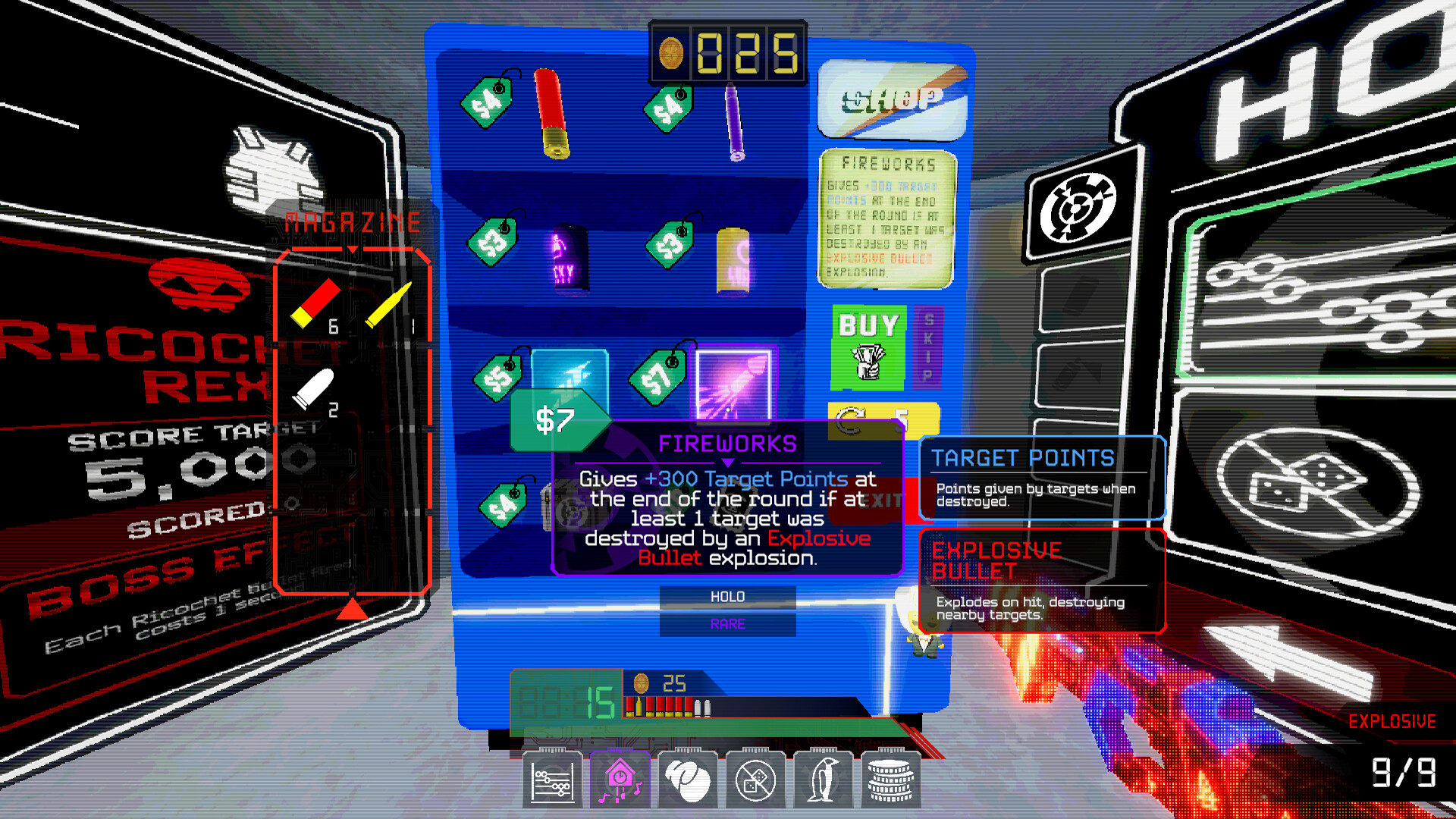
Lucky Shot turns aim practice into a roguelike mag-builder with 150+ Holos, 12 weapons, and built-in co-op and PvP, and at the current 25% discount it is a strong pickup for anyone who likes the Balatro-style loop with bullets. Players who hate repeated runs or want a purely cozy wind-down should pass.
Game highlights
Roguelike Mag-Builder Core
Each run blends precise shooting with buildcrafting: 150+ Holos, multiple special bullet types, 16+ charms that persist, and 15+ energy drinks with side effects stack into wild synergies. Magazine planning matters as much as aim, so deckbuilder instincts translate directly into high-score runs.
Twelve Weapons, Twelve Feel
Weapons are not stat skins. A shotgun ships with explosive rounds while a rifle defaults to guardian rounds, and every weapon shifts how you approach each stage. Mastery means learning reload rhythm and bullet economy, not just clicking heads.
Built-In Co-op and PvP
Online PvP and online co-op ship in the base game, so there is no lobby rule-crafting or lives system to negotiate with friends. Co-op in particular forces tighter execution, since late waves and boss rooms punish lapses in focus.
Eras, Stages, and 15+ Bosses
Stages pay tribute to different eras with their own visual identity and soundtrack, and 15+ boss fights test both your build and your flick-shot. Endless mode pushes modifier reading further, rewarding players who plan a few shots ahead instead of pure reflex.
Accessible to Non-FPS Players
Mouse-only play is supported, save-anytime is on, and the developer messaging explicitly says smart synergies can carry a run even when accuracy is shaky. Players who never touch competitive shooters still clear early difficulties with the right Holo stacking.
What players are saying
What keeps coming up positively
- The aim-trainer-meets-roguelike hook is genuinely addictive, with several reviewers describing demo-to-launch hours piling up fast.
- Built-in co-op and PvP remove the usual rule-crafting friction, making it easy to drop into a session with friends.
- Weapon variety gives every run a distinct feel, so runs rarely blur into the same build.
- Lower difficulties keep the Balatro-style relaxed atmosphere intact, easing non-competitive players in.
Where the friction shows
- Some Holos feel improperly balanced, forcing awkward pivots mid-run that punish theorycrafters.
- Difficulty scaling can spike hard, so co-op survival requires real focus rather than casual play.
- Repetitive gathering and progression loops show up on longer sessions, especially chasing unlocks.
- The pressure ceiling conflicts with a chill wind-down mood, particularly at higher difficulties and on tougher boss modifiers.
Is it worth buying?
At $9.74 on a 25% discount (regular $12.99), Lucky Shot is reasonably priced for the content, but this is not a record low. If you already enjoy Balatro-style roguelikes or aim trainers, jump in now; otherwise waiting for a deeper discount is safe given the balance and grind friction some players report.
Price checked 2026-08-16:$9.74,down from $12.99(25% off)。Player-fit tags
Good fit
- Players who want a roguelike loop where aim and deckbuilding both matter
- FPS players looking for a warm-up or score-chase alternative to KovaaKs or Aimlabs
- Friends who want drop-in drop-out online co-op and PvP without rule-crafting
- Mouse-only players who want a low-friction shooter they can play casually
- Deckbuilder fans willing to learn a new mechanic in exchange for fresh run variety
Probably not for you
- Anyone expecting a cozy, low-pressure wind-down session, especially at higher difficulties
- Players who dislike losing runs repeatedly as the core progression loop
- Players sensitive to grind and repetitive resource gathering between unlocks
- Anyone wanting a purely single-player, offline-only aim sandbox without online modes
09Sektori twin-stick shooter review: brutal techno-infused arcade runs for players who thrive on relentless challenge
STEAM DEAL · 20% OFF
Sektori
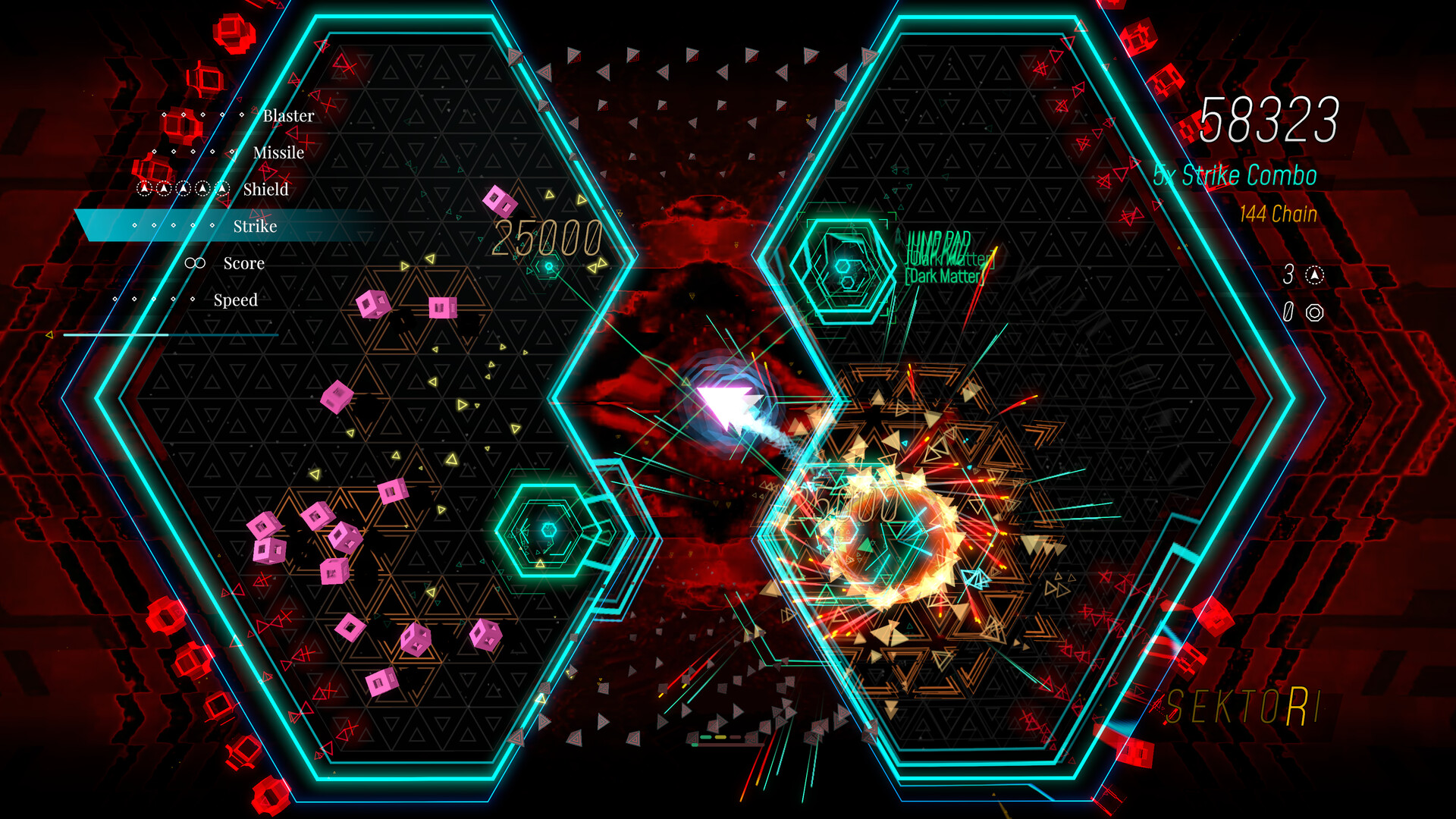
Pick this up on the current 20% discount if you want a pure-skill twin-stick where failure is expected and every run demands total focus; skip it if you want gentle onboarding or any roguelike carry-over between attempts.
Game highlights
Five-world campaign built from randomized layers
The official store page describes a five-world campaign with dynamically changing levels and enemy waves that are hand-crafted, then combined and layered with the upgrade system so each run rearranges the challenge. Multiple reviewers describe this as a refreshing twist on the genre, with one praising how layered waves keep familiar combat feeling novel across attempts. You are never memorizing a sequence so much as reacting to whatever stack the game assembles next.
Configurable ships and upgrade decks for build experimentation
Official features list alternate ships and configurable upgrade decks that let you mold each run, and the developer notes stress meaningful choice in upgrades rather than stat creep. Players responding to long playtimes confirm there is real variety in how runs unfold, and one review notes meaningful choices in upgrade paths and individual upgrades. There is no meta-progression carrying over from run to run, so the variety lives entirely in the moment-to-moment build you assemble.
Three difficulty modes plus a harder Revolution mode
The store listing confirms three difficulty settings aimed at different skill levels, plus a dedicated Revolution campaign mode for players who want maximum challenge. Despite that, several reviewers describe the lowest tiers as still punishing, with one beginner-mode player reporting they could not pass the opening four minutes and considered refunding. Difficulty is something you feel immediately, with no gradual ramp into easier content.
Six alternate game modes and medal-based replay goals
Official features include six alternate modes such as Classic, Gates and Assault, alongside varied challenges and medals to chase for high-score oriented play. Reviewers point to these modes as part of what makes the package feel substantial, with one longtime player using the game as a daily pick-up-and-play companion for months. This is clearly built around replay and personal bests, not a single linear campaign to clear and shelve.
Techno-driven aesthetic and full controller support
The developer describes the visuals and music as fast, saturated and aggressive, and the page warns of flashing lights that may trigger photosensitive issues. Full controller support is listed across categories including DualSense and DualShock, and reviewers confirm it plays cleanly on Steam Deck both handheld and docked. The presentation is intentionally intense, designed to lock you into a flow state rather than offer visual breathing room.
What players are saying
What keeps coming up positively
- The pure gameplay-first design repeatedly draws praise, with players calling it a real video-game-ass video game with no filler meta to grind through.
- Visuals and the techno soundtrack are consistently described as standout, with several reviewers specifically highlighting how readable the chaos feels despite the visual intensity.
- Reviewers consistently praise the variety between runs thanks to layered waves and meaningful upgrade choices, keeping long-term sessions feeling fresh.
- Multiple long-time players treat it as a go-to short-session game, using quick runs as a way to unwind or stay sharp between longer sessions.
Where the friction shows
- Difficulty is repeatedly described as brutal even on lower settings, with several players reporting they cannot clear the opening minutes and consider refunding.
- The lack of any roguelike carry-over between runs frustrates players who want some sense of progression, since every attempt restarts from zero with no unlocks banked.
- Keyboard and mouse players report the game feeling noticeably harder than controller users, with at least one reviewer stuck on early bosses specifically citing their input choice.
- Several reviewers note the title has been overlooked or buried on Steam, which makes finding populated leaderboards or community discussion harder than expected.
Is it worth buying?
At $11.99 on a 20% discount against a $14.99 regular price, the cost is reasonable for the amount of content on offer, but it is not the deepest discount the game has seen. If you already know you love demanding arcade shooters, this is a fair price to pay now; if you are only casually curious, waiting for a steeper sale lets you risk less on a game several players bounced off of within the first few minutes.
Price checked 2026-08-16:$11.99,down from $14.99(20% off)。Player-fit tags
Good fit
- Players who enjoy short, intense arcade runs they can pick up for fifteen minutes at a time
- Twin-stick fans who want pure skill-based challenge with no progression grind between attempts
- Controller users looking for a clean Steam Deck experience with full gamepad support
- High-score chasers who want medal challenges and alternate modes to master
- Players who enjoy techno-driven aesthetics and intentionally chaotic, sensory-heavy presentation
Probably not for you
- Anyone looking for gentle onboarding or a gradual difficulty curve, since multiple reviewers bounced off the opening minutes
- Players who want roguelike meta-progression, since runs do not carry unlocks forward
- Casual twin-stick fans expecting Geometry Wars-level accessibility on lower difficulties
- Keyboard and mouse players who do not want to adapt to a game widely reported as harder without a controller
10Bootstrap Island: a punishing VR roguelike survival adventure for players who embrace failure-driven mastery on a brutal tropical island

STEAM DEAL · 30% OFF
Bootstrap Island
Bootstrap Island is a beautifully atmospheric VR survival roguelike that delivers satisfying physical interactions, but the aggressive roguelike gating, short day cycles, and slow unlocks will frustrate anyone expecting a sandbox like Green Hell. Worth considering only if you specifically enjoy the failure-and-retry loop in VR and can tolerate early-access roughness.
Game highlights
VR-Native Survival Interactions
Every system in Bootstrap Island is built for head-mounted play: tracked controllers handle chopping, lighting fires, and manipulating objects, and the Steam category list confirms VR-only support with tracked controllers and stereo audio. Reviewers consistently describe the moment-to-moment actions as one of the most satisfying physical simulations available in VR survival. This is the core reason to pick the game up at all, because nearly every praise review hinges on how good the hands-on crafting and item use feels.
Roguelike Run Structure With Meta Unlocks
According to the store description, you play Daniel, shipwrecked in the 17th century, and each death feeds back into unlocking better starting gear for future attempts. Resources, weather, and enemy placement shift between runs, so no two attempts feel identical on paper. The official pitch frames failure as the primary teacher, with players encouraged to learn, adapt, and return wiser each time they respawn on the beach.
Configurable Difficulty And Day Length
The developer page lists adjustable day length, world intensity, and survival systems so players can tune the experience from a brutal challenge to a calmer exploration and base-building mode. That flexibility is what lets the same purchase serve both hardcore roguelike fans and players who want a more relaxed sandbox pace. A sandbox mode is also mentioned by reviewers as an alternative path for those who dislike the permadeath gating of the default rules.
Atmosphere, Biomes, And Reactive World
The official description highlights a systems-driven island with day and night cycles, weather, fire, and liquids interacting, plus distinct biomes including beaches, riverlands, and jungle. Multiple reviewers single out the visuals as a standout, with one describing the environment as beautiful enough to briefly make you forget what reality is. The trade-off, as several players point out, is performance, since frame rates can dip even on lower settings.
Tribe Encounters And Story Layer
Beyond the survival basics, you explore signs of a stranded survivor and encounter a local tribe whose reaction depends on your choices, per the store text. The narrative framing around Daniel's past and the meaning of his shipwreck gives each run a thread to pull on, rather than pure mechanical survival. Players who want lore beats alongside their resource management will find this layer adds weight to repeated attempts.
What players are saying
What keeps coming up positively
- Hands-on VR interactions for crafting, fire, and tool use are widely described as some of the most satisfying in any VR survival game.
- Visual atmosphere and island biomes earn strong marks, with several reviewers calling the world beautiful and immersive during exploration.
- Adjustable day length and difficulty let players shift the experience between a relaxed sandbox and a punishing roguelike challenge.
- The core survival loop of breaking coconuts and managing fire around night is described as accessible for anyone familiar with survival games like Green Hell or Don't Starve.
Where the friction shows
- Short day cycles combined with slow movement prevent meaningful exploration and force players into a rushed, repetitive loop before nightfall.
- Core tools such as the knife and the satchel for carrying items are locked behind surviving multiple days, so early runs feel artificially restricted rather than challenging.
- Night enemy swarms scale aggressively, with reviewers reporting overwhelming group encounters that reduce combat to numbers rather than skill, and enemies that seem to track the player unnaturally.
- Performance drops and frame rate dips occur even on lower settings, breaking immersion during otherwise atmospheric moments, and bugs are noted as expected but present during early access.
Is it worth buying?
At $17.49 USD, a 30 percent discount off the $24.99 regular price, this sits in a reasonable range for a VR-only early-access roguelike, but it is not a deep discount and there is no all-time-low claim being made here. The price feels fair if the roguelike meta loop and VR-native interactions sound like exactly what you want, yet the repeated complaints about short days and gated unlocks mean waiting for further patches or a larger sale is also defensible.
Price checked 2026-08-16:$17.49,down from $24.99(30% off)。Player-fit tags
Good fit
- Players who specifically enjoy roguelike survival where death unlocks permanent progression rather than persistent sandbox saves
- VR owners with tracked controllers who want tactile, hands-on crafting and fire-building over menu-driven survival
- Survival fans familiar with Green Hell or Don't Starve who want to translate that knowledge into a short-cycle challenge
- Players who like to tune their experience through adjustable day length and world intensity sliders
- Those who enjoy learning through repeated failure and treating each run as a deliberate experiment
Probably not for you
- Anyone expecting a persistent sandbox survival world in the style of The Forest or Sons of the Forest
- Players who dislike short day cycles, slow traversal, or being rushed back to camp before nightfall
- Those who want meaningful crafting, containers, and tool progression available from the start of a run
- Players sensitive to VR motion sickness, performance hitches, or aggressive night enemy swarms
Share this article