October 14, 1066 CE · United Kingdom · Flour dust rises as a Duke's army assembles on the chalk ridge.
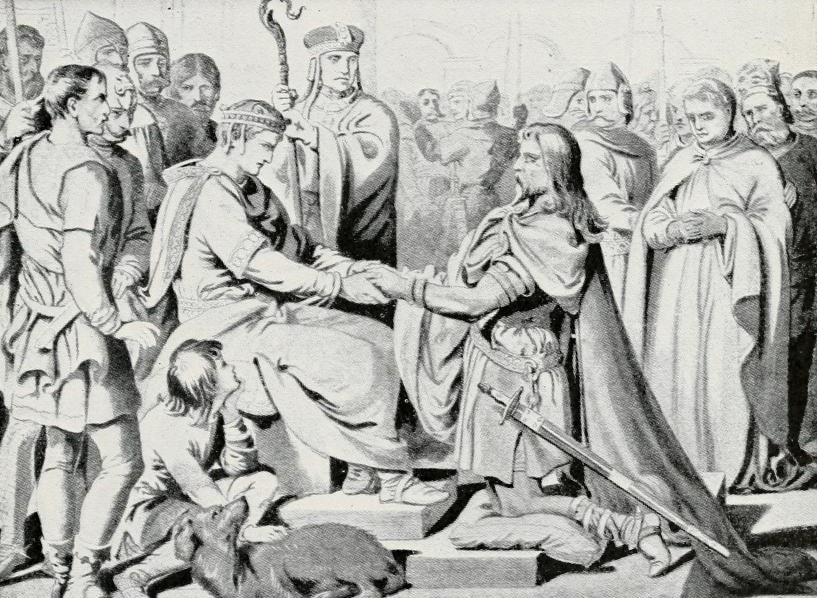
In United Kingdom, Norman Conquest is unfolding. The Norman conquest of England begins with the Battle of Hastings.
My hands push into the cold flour as the morning cooks go silent. The bread troughs sit half-mixed because the camp has stopped breathing. Down the slope, William's host of Norman, French, Flemish and Breton men draws its lines along the ridge above Hastings. The Duke of Normandy sits his destrier where the banner rises. We cross ourselves in our grease-stained tunics and flatten against the ovens. The English have come up by forced march from the north, where their king — the same Harold who struck down Harald Hardrada at Stamford Bridge not twenty days past — now wheels his ranks into a bristling line of ash-wood shields on the higher ground ahead. Trumpets from the Norman line shiver the gulls off the sky. Somewhere a hammer is testing the anvil of a blade. A boy runs past carrying water, his face white as unleavened dough. My fingers still cling to the damp flour as the first shouts crack across the down.
October 14, 1066 CE · France · Bolt nocked, I climb the slope into the bristling ash-wood line.
In France, 威廉一世 (英格蘭) is unfolding. 法國諾曼第公爵威廉一世的部隊在黑斯廷斯戰役中擊敗哈羅德二世的英格蘭軍隊,象徵盎格魯-撒克遜英格蘭時代的結束。
My thumb steadies the crossbow string against the cold oak stock. We Bretons have taken the front rank under the Duke's banner, with the Flemish flanking, Normans in the centre, the French reserve behind. The English ranks ahead stand a forest of ash and lime, bristling with bearded axes. Arrows hiss past my hood. Lord William orders the advance at a walk; the heralds blow long; our boots grind the broken turf. We pour bolts into the gaps; the English hold. Harold himself is somewhere behind that line, the same Godwinson who shattered Hardrada at Stamford Bridge only three weeks gone. The hours slide by like wet rope — feigned retreats, frantic rallies, the cavalry churning back. At last the line buckles, the king falls, and his banner snaps loose above the gorse. The October dusk bleeds down over English chalk, and a new crown is being weighed in our camp. I uncock my bowstring as ravens settle on the ridge.
October 14, 1322 CE · United Kingdom · Hoof-frost feathers my horse as Bruce's riders crest the fell.
In United Kingdom, Robert the Bruce is unfolding. Robert the Bruce of Scotland defeats King Edward II of England at the Battle of Old Byland, forcing Edward to accept Scotland's independence.
The frost feathers my horse's mane as our lances crest the fell. Behind me rides Robert Bruce, King of Scots, and ahead, somewhere down that slope, the English King Edward and his host are caught mid-meal. I drive my spurs in and follow the first riders through the bracken. An English sergeant raises a banner; a bow string snaps; an axe bites into a shield rim. Edward's men scatter for the coast, for boats, for any strand that will carry them off English soil. Whole squires abandon their saddles and plunge into the gill. Our horns wind through the cold air, long and unhurried, while their trumpets shrill in panic. Robert Bruce keeps his visor down, his breath a small plume, and lets the rout run its course. By dusk the field is ours, and Edward's clerks are already drafting acceptance of our crown. My tired bay stamps the rime and I loosen the girth as the last English pikes drop into the bracken.
October 14, 1676 CE · Turkey · Dawn mist smothers the river as foreign horsemen wheel again.
In Turkey, Jan Sobieski is unfolding. After superior Ottoman forces fail to break through Polish defenses under Jan Sobieski in the battle of Żurawno, the Ottoman commander initiates negotiations.
My lance butt sinks into the muddy turf as the Ottoman horsemen wheel in another feint. King Jan Sobieski rides the line behind us, our elected lord of the Polish–Lithuanian Commonwealth, nodding to each colour. The river runs brown beside our earthworks; behind me, Żurawno holds its chapel roof above the smoke. Their cavalry swarms the slope with kettle-drums throbbing, while their disciplined foot test our pallisades through the brambles. We ride them down, walk back, ride them down again. Their great guns huff and roll back in mud. Hour after hour their best divisions crash against Sobieski's entrenchments and recoil. By late afternoon a rider comes out under a green staff, his horse stepping high, a scroll weighted at his belt. Our outriders part to let him pass. The Ottoman commander wishes to talk. Our colonel lowers his sabre and waits in the saddle.
October 14, 1758 CE · Germany · Church bells stop short as white columns close on Hochkirch.
In Germany, Seven Years' War is unfolding. Seven Years' War: Frederick the Great suffers a rare defeat at the Battle of Hochkirch.
Linen shifts to wool as the alarm drum rattles through the dark. I am crouched between tent-ropes, struggling into gaiters, when the church bells toll once and stop, drowned by musket volleys from the churchyard wall. Austrian grenadiers in white coats have already seized the kirchhof; their file leaders call cadence in the freezing mist. Columns of white-uniformed men push through our picket line before the King can dress his battalions. Men stumble past me barefoot, gripping fire-locks with no flints. Our colonel roars to form square; cannon balls plough the cabbages in the parson's garden. Frederick himself comes up at the gallop, his cloak soaked, to steady a line that is already bending. The wood to our left is lost, then the granary, then the high road. By mid-morning the King is retreating across open fields, and the enemy holds the ridge above Hochkirch. I shoulder a wounded comrade and limp for the village stream.
October 14, 1773 CE · Poland · Quills dip as deputies rise for a kingdom's first education ministry.
In Poland, Commission of National Education is unfolding. The first recorded ministry of education, the Commission of National Education, is formed in the Polish–Lithuanian Commonwealth.
My pen hovers, then touches the parchment. The Sejm chamber smells of wet wool and candle-runs; outside, autumn rain taps the Warsaw roofs. The marshal has just announced the new Komisja Edukacji Narodowej, raised by the Sejm and King Stanisław II August today, the fourteenth of October in the year seventeen seventy-three. Beside me, colleagues from our little academy uncross their arms, hearing ourselves named as the first such ministry in European history. The chancellor lifts the wax charter; minor nobles lean forward, eager to plant their cousins in new teaching seats. I copy the long preamble in careful Latin, my breath clouding the page. Across the aisle an older schoolmaster grips his inkwell tighter, watching each seal broken open. Deputies vote by rising in waves. As the chamber empties, I dip my quill afresh and begin drafting tomorrow's lesson plan for an institution that did not exist before sunrise. My ink still holds its shine on the empty page.
October 14, 1809 CE · Austria · Candelabras bend low as plenipotentiaries file toward the imperial desk.
In Austria, Treaty of Schönbrunn is unfolding. The Treaty of Schönbrunn is signed, ending the War of the Fifth Coalition, the final successful war in Napoleon Bonaparte's military career.
My taper snuffers trim the candles as the plenipotentiaries file into the long gallery. Outside Schönbrunn, October wind gnaws the lime avenues; inside, our imperial desk has been cleared and every pen-rest aligned. I have laid out the calf-bound folios for the delegates, who rode through the night to reach Vienna. France has dictated terms since their victory at Wagram on the fifth and sixth of July, and Austria sends representatives here today, the fourteenth of October eighteen-oh-nine. The French secretary reads each clause in a flat voice. My colleague opposite mouths the numbers; we count territorial cessions by the rustle of pages. The Imperial chair at the head of the room stands empty; the question of further war hovers over every page. The Austrian delegate lifts his pen, pauses, then signs. The candles gutter as the door shuts on another coalition. I gather the wet folios and walk the parquet, still listening for the next courier's boots.
Share this article