FAA clears Starship Flight 13 for July 16 launch

The Federal Aviation Administration closed its investigation into the Super Heavy booster anomaly from SpaceX's May 22 Starship Flight 12 and accepted the company's corrective actions, clearing the vehicle for a launch window opening at 6:45 p.m. EDT on Thursday, July 16 from Starbase in South Texas. The FAA's final mishap report identified two most probable root causes for the loss of the booster during its return phase: heat effects on propulsion-system components during ascent and erroneous engine-alarm system settings that caused engines to shut down prematurely. Five of the booster's 33 Raptor engines failed to relight, and the Super Heavy plunged into the Gulf of Mexico. SpaceX implemented four corrective actions spanning hardware and software configuration updates, including an adjusted startup sequence for the upper-stage engines to prevent the roughly 90-degree orientation error that occurred during hot staging.
Flight 13 is the second launch of SpaceX's Version 3 Starship configuration and will mark the first time the vehicle carries functional Starlink V3 satellites, with 20 deployed inside the payload bay. Because the mission follows a suborbital trajectory, the deployed satellites are designed to intentionally burn up in Earth's atmosphere about 20 minutes after deployment; six of them carry cameras to scan the spacecraft's heat shield. The upper stage is expected to attempt an in-space Raptor relight and a controlled splashdown in the Indian Ocean. SpaceX said the mission will aim to complete similar objectives to Flight 12, which debuted the V3 vehicles in May.
Falcon 9 reaches 600th reused-booster flight
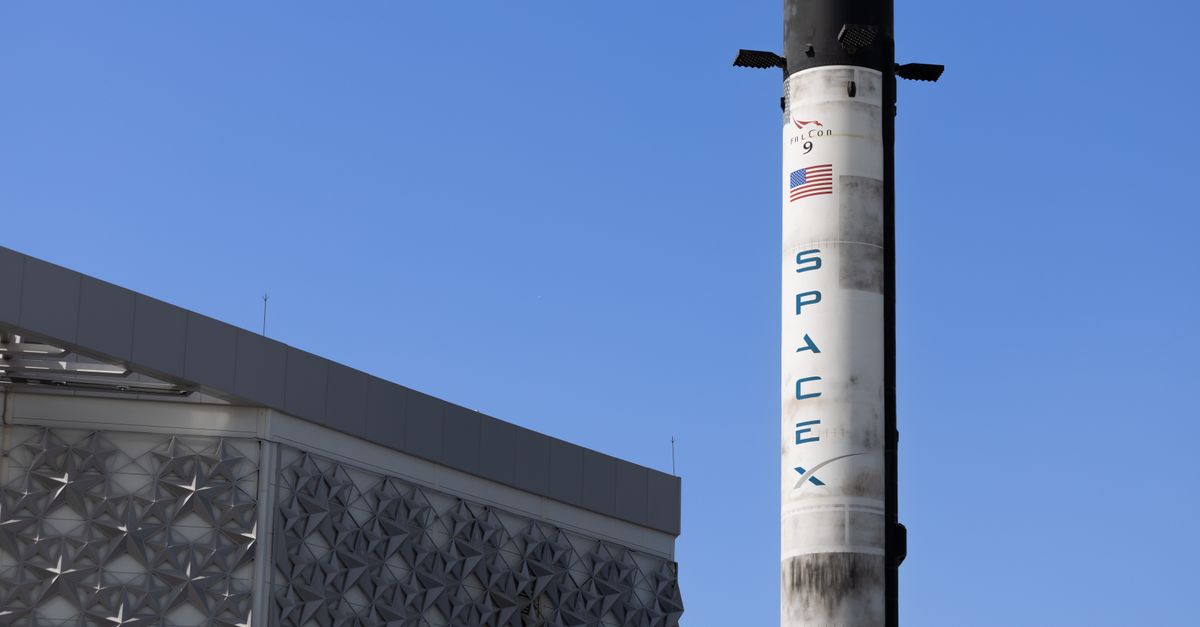
SpaceX reached a milestone in reusable rocketry with its 600th flight of a flight-proven Falcon 9 booster, achieved during a pair of back-to-back Starlink missions less than eight hours apart from opposite U.S. coasts. The first mission, Starlink 15-14, lifted off from Space Launch Complex 4 East at Vandenberg Space Force Base at 9:28 p.m. EDT on July 13 aboard booster B1093, which completed its 15th flight. The second mission, Starlink 10-45, launched from Space Launch Complex 40 at Cape Canaveral Space Force Station at 5:10 a.m. EDT on July 14 aboard booster B1080, which completed its 28th mission. Both flights successfully deployed their Starlink payloads and recovered their first stages on droneships, with the Vandenberg booster landing on Of Course I Still Love You and the Cape booster touching down on A Shortfall of Gravitas. The Florida launch marked SpaceX's 47th liftoff from the Space Coast in 2026, and the company has now logged 83 Falcon 9 missions this year, with the active Starlink constellation growing to more than 10,839 broadband relay units, according to tracker Jonathan McDowell.
Starlink V5 hardware debuts with lower power draw and higher wind tolerance
SpaceX quietly launched the Starlink V5 Standard Kit through its consumer website and mobile app, marking the most significant efficiency overhaul to its residential hardware since the 2023 removal of motorized dish orienting. The new terminal draws an average of 35 to 50 watts during operation, compared with the outgoing V4's 75 to 100 watts, while dish weight drops from 6.5 pounds to 2.4 pounds. Wind tolerance climbs sharply to 265 kph (165 mph), a 175% increase over the V4's 96 kph (60 mph) rating, putting the consumer kit in the same category as SpaceX's maritime Performance hardware. Max throughput is slightly lower than the V4, at 375+ Mbps versus 400+ Mbps. SpaceX has not announced a trade-in program for existing V4 customers. The release aligns with the imminent deployment of next-generation Starlink V3 satellites aboard Starship, which the company says are designed to deliver terabit-class throughput.
SpaceX shares slide toward IPO price amid mixed analyst calls
Shares of SpaceX (NASDAQ: SPCX) continued to retreat, closing near $139.14 on Monday, July 13, and trading around $142.50 in pre-market activity on July 14, leaving the stock within roughly 3% of the $135 IPO price set on June 12. The shares have shed approximately 38% from their intraday post-debut high of $225.64, trimming market capitalization from a peak near $2.9 trillion to roughly $1.83 trillion. Wall Street responses remained divided: Evercore ISI initiated coverage on July 14 with an Outperform rating and a $230 price target, projecting revenue and EBITDA compounding at 106% and 157% through 2028, while Raymond James analyst Brian Gesuale reiterated a Buy with an $800 street-high target. Critics including short seller Jim Chanos and Morgan Creek Capital founder Mark Yusko questioned the valuation, with Yusko comparing the concentrated ownership structure to meme-coins and warning that further multiple expansion from the current $2 trillion range is implausible. Additional headwinds cited by analysts include an August lockup expiration affecting around 20% of insider-held shares, the company's first corporate bond issuance, and competitive pressure after China successfully recovered a Long March booster on July 10.
Share this article