
REFERENCE

Tarot Card Combination Explorer

Select two different cards and compare their pace, scale, themes, tension, and reflection questions without relying on a fixed prediction table.

Free to useEnglish explanationMethod disclosed
Updated

COMBINATION READER

Read two cards as one conversation

Select two cards to compare pace, scale, themes, and reflection questions without pretending that one fixed combination meaning fits every spread.

TWO-CARD METHOD

Select two cards

The output compares themes and scale. The question and spread positions still determine how the pair should be read.

First card
The Fool from the public-domain 1909 Rider–Waite–Smith tarot deck
Upright · Major Arcana

The Fool

A beginning, experiment, or step into unfamiliar territory.

What could you test on a small scale before making a larger commitment?
Second card
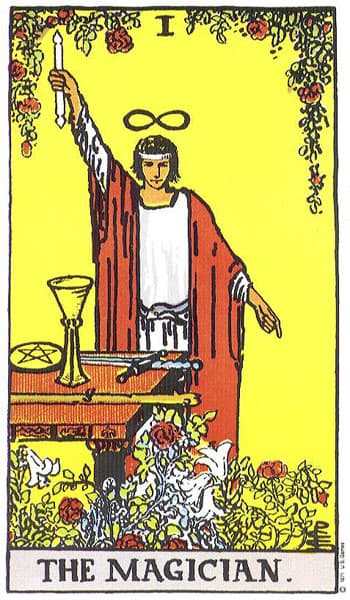
The Magician from the public-domain 1909 Rider–Waite–Smith tarot deck
Upright · Major Arcana

The Magician

Focused agency: bringing available skills, tools, and attention into one deliberate act.

Which resource is already within reach, and what specific action could use it?

The Fool + The Magician

The Fool brings beginning and curiosity; The Magician brings agency and focus. Read the pair as a conversation rather than a fixed prediction.

The two cards reinforce a similar pace. Both cards describe broad patterns, so the reading benefits from a concrete question and real-world evidence.

Questions for this pair
  • What could you test on a small scale before making a larger commitment?
  • Which resource is already within reach, and what specific action could use it?
  • What changes when both questions must be answered together?

RESULT CONTEXT

Help me interpret

Connect the symbols in your Card Combination Explorer result and turn them into one grounded reflection. The interpretation explains the displayed pattern; it does not predict an outcome. You can try 5 interpretations a day as a guest, then sign in for 8 more.

Your choice is explicit. Nothing is sent while you use the calculator. If you click the button, only the result text already visible on this page is sent to NexaCurrent AI. It is not saved as a chat.

Complete the tool first to enable interpretation.

METHOD & CONTEXT

Why combinations cannot be a fixed lookup table

Two cards can interact differently as past and present, obstacle and advice, two people, two options, or adjacent events. Direction, order, orientation, deck artwork, question, and reader method can all change the emphasis. The explorer therefore does not claim that one paragraph is the permanent meaning of a pair. It compares each card’s themes, whether their pace reinforces or conflicts, and whether the pair operates at a broad Major Arcana scale or a practical Minor Arcana scale. This provides a method for reading rather than thousands of near-duplicate verdicts. Selecting the same card twice is blocked because comparison requires two distinct records.

Turn two cards into one ordinary sentence

Begin with a neutral verb between the cards: supports, interrupts, clarifies, delays, redirects, or tests. If both cards lean toward movement, ask what keeps momentum responsible. If one opens and one pauses, describe the condition that must be satisfied before action. A Major and Minor pair often works as principle plus daily expression; two Major cards may need the question narrowed; two Minor cards invite close comparison of suit and rank. The generated summary and three questions are starting points. Rewrite them in language specific to the real situation, then check whether the sentence still makes sense without mentioning tarot. If not, it may be too vague to help.

A scalable tool without 3,003 thin pages

Seventy-eight cards create 3,003 unordered two-card pairs. Publishing an indexable page for every pair before each has independent editorial value would create a large template set with little reason for search engines or readers to keep it. NexaCurrent initially places every combination inside one canonical interactive tool. Separate evergreen articles will be published only for pairs that support original visual analysis, contextual examples, reversal differences, and a substantial reading method. The selector does not add query parameters to the canonical URL. Private choices remain in the browser, and the output is a reflection aid rather than a relationship, health, employment, legal, or financial prediction.

KEEP EXPLORING

M3-REVIEWED EDITORIAL

Browse all guides