What a Career Project Tarot Spread Asks of You
A career project tarot spread is a reflective layout built for one job in mind: turning a vague sense of how a work project is going into something you can act on within a workday. Unlike a daily draw or a general reading, this layout is a structured review. It asks the same four questions that any thoughtful employee, freelance collaborator, or project lead would ask at the midpoint of a task: where is this heading, what is slowing it down, what is already in place to help, and what is the single next step that can be done and verified.
The spread is not designed to predict whether a project will succeed, fail, get funded, or be cancelled. Those outcomes depend on the actual conditions of your work: budgets, deadlines, stakeholder feedback, market shifts, and your own energy over weeks. Tarot, used responsibly here, functions as a structured prompt for attention. You bring the facts, and the cards help you notice which fact you have been avoiding.
Two cards can carry this layout when you let each one speak to a different position. You are not looking for hidden meanings; you are looking for a shape that you can test against the evidence in your inbox, your calendar, and your last one-on-one.
The Four Positions: Direction, Friction, Resources, Next Step
Before laying the cards, write down the project in one sentence. Then label four positions on the table or screen:
**Direction.** Where the project is actually pointing right now, separate from where you wish it were pointing. The card here is descriptive, not aspirational.
**Friction.** The pattern that is resisting progress. This can be external, such as a stakeholder, a missing tool, or a funding gap, or internal, such as perfectionism, scope creep, or fatigue. The card here names the texture of the obstacle rather than blaming a person.
**Resources.** What is genuinely available to you, including people, skills, time, money, equipment, attention, and existing reputation. The card here helps you see abundance or scarcity in a calmer light.
**Next Step.** The single action that can be completed within a verifiable timeframe, ideally this week, that would move the project forward in an observable way.
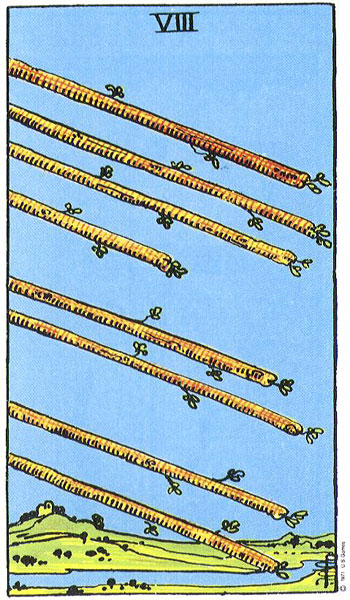
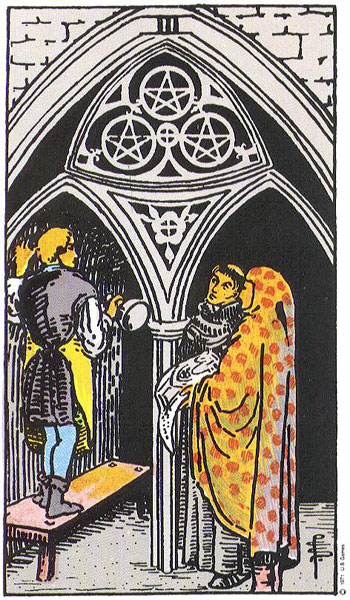
When you only have two cards to dedicate to four positions, you assign each card to one position and let the second card fill the gap by showing what the first card leaves out. For instance, in this layout we are reading the Three of Pentacles and the Eight of Wands. The first naturally sits in Resources because its keywords include resources, practice, and material conditions. The second sits in Direction because its keywords include initiative, creative energy, and purposeful action. Friction and Next Step are then read in the space between them.
That is a deliberate interpretation choice, and you could choose differently if your context demands it. A reading is only useful when the choices are visible to the reader.
Card One: Three of Pentacles and the Resource Layer
When the Three of Pentacles lands in the Resources position of a career project tarot spread, the upright meaning calls forward growth through participation, feedback, or expansion expressed through work, resources, the body, routine, and material conditions. In practical terms for a project review, this is a reminder that what keeps a project alive is rarely a single heroic insight. It is the steady, observable practice of people showing up: someone reviewing drafts, someone reordering the backlog, someone checking the prototype with a user, someone keeping the documentation current.
The constructive direction here is building something useful through steady, observable practice. Notice the word observable. A card reading is most useful when it points to evidence you can point at. If your project has weekly demos, a shared channel where questions get answered within a day, or a manager who has blocked out Friday afternoons for focused review, those are observable practices and they count.
The reflection prompt for this card is: Who or what could help this move beyond its first form? That question is not asking for an abstract mentor figure. It is asking for a name and a role. A specific colleague. A specific document. A specific hour of the week.
Now for the disconfirming evidence. Three of Pentacles reversed can also describe a pattern showing its shadow through scarcity fixation, stagnation, or treating measurable value as the only value. If your honest answer to the reflection prompt is "no one and nothing," the card is still valid; you have just been shown the gap. The reading does not pretend that help exists when it does not. Disconfirming evidence matters as much as an apparent match: write down who has not been available, which routine is missing, and which material condition is short.
Card Two: Eight of Wands and the Direction Layer
The Eight of Wands in the Direction position asks where the energy of the project is actually moving. Its upright meaning describes repetition, movement, skill, or a pattern becoming harder to ignore, expressed through initiative, creative energy, and purposeful action. The constructive direction is directing energy toward work that matters.
For a mid-project review, this card invites you to look at what has been happening repeatedly. Not the one-off bright moment, but the small repeated act: the daily standup you keep postponing, the bug report you keep triaging, the prototype iteration you keep promising yourself. If the same action has shaped the last two weeks, it will shape the next two.
The reflection prompt is: What repeated action is shaping the result? A useful answer names an action, a frequency, and an effect. For instance, posting a written update every Tuesday, which has caused stakeholders to stop emailing for status.
Reversed, the Eight of Wands describes burnout, impatience, or effort without a stable direction. Read carefully here. A reversed card does not mean the project is doomed. It means the pattern has tipped. If you have been sending a flurry of half-finished drafts with no stable review slot, that is effort without a stable direction, and it is verifiable in your sent folder. Disconfirming evidence might be: the project is actually calm, communication is sparse, and the reverse is closer to inertia than burnout. Record that honestly. A reading that ignores the inbox is a reading that has lost its grounding.
Reading Friction as the Gap Between the Two Cards
With the Three of Pentacles in Resources and the Eight of Wands in Direction, Friction is read in the gap. What does the resource layer say you have? What does the direction layer say you are doing with it? Where the two diverge is where the friction lives.
If Resources shows steady participation and a working feedback loop, but Direction shows a flurry of half-finished drafts, the friction is throughput: too many starts, not enough finishes. If Resources shows you are operating solo with no second pair of eyes, but Direction shows you are pushing frequent releases, the friction is review capacity.
When the gap is unclear, hold both descriptions in mind and ask a third question: Where has the project stalled or hurt in the last two weeks? That is your Friction answer, and it should be testable against meetings, tickets, or conversations you can recall.
Record ambiguity honestly. If the gap could be read as either throughput or review capacity, write that down. You are not committing to a single interpretation before the evidence lands. The reading is a hypothesis, not a verdict.
A Low-Stakes Example: Reviewing a Side Project
Consider a freelance designer auditing a two-week redesign sprint for a small business client. The cards drawn are the Three of Pentacles and the Eight of Wands.
Resources, Three of Pentacles upright. The designer has a stable part-time assistant, an active feedback thread with one developer, and a working file structure. The reflection prompt, "Who or what could help this move beyond its first form?", has a clear answer: the developer has not yet seen the final component library, and the assistant has bandwidth to format the handover document.
Direction, Eight of Wands upright. The designer has been sending daily sketches and short updates. The pattern becoming harder to ignore is that the client keeps replying "let's see more." The repeated action shaping the result is sending small variations, one after another, without consolidating.
Friction, read in the gap: resources are solid, but the direction is producing quantity without convergence. The friction is convergence. The project is moving fast in many directions and not arriving.
Next Step, derived from both cards: pause the daily sketch stream for three days. Instead, send the developer the component library on day one, the assistant the draft handover on day two, and the client one consolidated option on day three. That single change is verifiable in the sent folder and the reply thread by the end of the week.
Reversed notes, recorded honestly: if the developer is on holiday and the assistant is unavailable, the Resources card is shadowed by scarcity fixation rather than abundance. If the client has explicitly asked for variety, the Direction card is shadowed by impatience rather than purposeful action. Both possibilities should be recorded alongside the chosen reading.
Verification, Ambiguity, and Where Tarot Stops
Tarot is not a prediction. It cannot tell you whether the client will sign, the proposal will be funded, or the launch will land. Those questions belong to evidence and to qualified people: your accountant, your lawyer, your manager, your doctor, or a crisis line if needed.
Use the reading as a structured prompt, then test it. Within forty-eight hours of completing the spread, write a short journal entry that answers:
Which interpretation did I choose, and what other interpretation was possible?
What observable evidence in the last week supports the interpretation?
What observable evidence contradicts it, and how seriously should I weigh it?
What single action did I commit to, and how will I know it is done?
If the answers reveal that the chosen interpretation does not match the evidence, treat that as success, not failure. You have just refined your view of the project. The reading was useful precisely because it did not protect a wish.
A career project tarot spread is most valuable when it returns you to the project with a sharper question and a smaller next step than you had when you sat down. That is the entire job of the layout: not to tell you what will happen, but to help you notice what is already true.
Share this article