What the Seven of Pentacles Names: Assessment
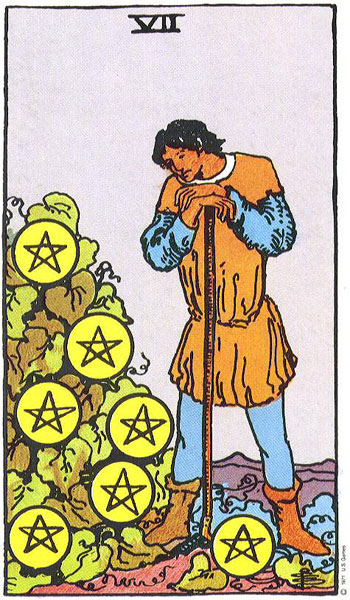
Most readers landing on a search for seven of pentacles tarot card meaning will already suspect the card is about patience or about labor coming to fruit, and those impressions are common shorthand. The grounded reading is narrower and more demanding. The Seven of Pentacles is the card that names **assessment** as the central act. Its upright meaning points to standing back from work, resources, the body, routine, and material conditions long enough to ask whether what you have been doing actually expresses the standard you claim to hold. Its constructive direction is not the harvest itself but the building of something useful through steady, observable practice. In other words, the card describes the moment before commitment becomes clearer, when competing possibilities are still on the table and the next step has to be chosen deliberately rather than by default.
That description is not a forecast of outcome. It is a description of an inner posture. The factual tone of the card is recorded as **mixed**, which matters for an honest seven of pentacles tarot card meaning: the card carries both a constructive opening (steady practice, a usable standard) and a friction (the cost of choosing, the possibility of having wasted effort up to now). A reader who treats it as unalloyed encouragement will miss the friction. A reader who treats it as a warning will miss the opening. Both readings are defensible against limited evidence, and that is part of the tone.
Reading Assessment Against the Wider Pentacles Frame
Pentacles as a suit speak to material conditions, the body, routine, and resources. Within that wider frame, the rank **Seven** has its own job. It is not the suit's card of acquisition, of loss, of generosity, of culmination, or of inheritance. Its specific contribution is the capacity to pause and compare what is in front of you against a chosen standard. That is why the upright meaning is framed as "assessment, competing possibilities, and the need to choose a standard," rather than as a simple statement of gain.
This is a useful distinction when you are reading a spread alongside other Pentacles cards. If the surrounding cards are clearly about resources gained, lost, or shared, the Seven presses you to ask how those changes measure up against what you value. If the surrounding cards are about routine or bodily care, the Seven presses you to ask which routine is still earning its place. If the spread touches work directly, the card is asking you to evaluate the work itself, not just celebrate or mourn its outputs. The seven of pentacles tarot card meaning, properly framed, is the measuring stick inside an otherwise material conversation, not the conversation itself.
One Realistic Low-Stakes Example
Consider a reader who has been keeping a simple weekly budget review for nine months. They started it during a stretch of overspending and the practice has, by their own admission, reduced small unnecessary purchases. They are weighing whether to keep the review in its current form, switch to a different budgeting method, or drop the practice entirely because it feels redundant.
This is the kind of situation the Seven of Pentacles describes well. The practice has produced observable results. Three options sit on the table: refine the weekly review, replace it with a different method, or retire the practice entirely. A standard needs to be chosen. Is the value of the review measured by money saved, by habit strength, by clarity of mind, or by some combination of those. The card's reflection question — which option still makes sense after its cost is included — lands directly on the budget example. Time spent is a real cost. Mental space is a real cost. A reader who only counts the financial savings and ignores the time cost could be moving into the card's shadow territory by narrowing the question to what is easily tallied. A reader who counts time and forgets the original purpose could be heading the same way. The Seven asks the reader to hold both columns at once and choose with eyes open.
The Reversed Reading: When Assessment Stalls
When the same pattern appears **blocked, internalized, or showing its shadow**, the Seven of Pentacles can describe a few recognizable failures of evaluation. The most common is **scarcity fixation**: counting every small unit of cost and gain so closely that the larger question of whether the project itself is worth running goes unasked. Closely related is **stagnation**, where a person keeps doing what they have been doing because stopping would force a decision, and the cost of decision feels higher than the cost of drift. The third is treating **measurable value as the only value**, so anything that cannot be easily tallied (relationships, learning, well-being, future optionality) gets quietly dropped from the ledger.
A reversed reading should not be dramatized into catastrophe. The reversed meaning is structural rather than terminal: the same pattern is still present, but it has stalled. A reader who notices they have been weighing the same trade-off for weeks without moving is in reversed territory even if the underlying practice is sound. A reader who tracks every calorie but cannot say whether their relationship with food has improved is also there. The useful question is the same one the card asks upright, only harder: what is the standard, and is the practice actually measuring against it?
A Plausible Misreading to Watch For
The misreading worth naming is the softening of assessment into reassurance. Many popular accounts describe the Seven of Pentacles almost entirely as "your hard work will pay off; be patient." That reading is not invented from whole cloth, but it does drop the harder content. The reflection prompt on the card — which option still makes sense after its cost is included — only makes sense if an option might *not* survive after its cost is included. A pure patience reading collapses that test.
Another version of the same misreading is the assumption that past effort guarantees present value. Effort is not the same as assessment. A project can be well-maintained and still misaligned with current priorities. A reader using the Seven to congratulate themselves for grinding is using it as a mirror of pride rather than as a measuring instrument. The corrective is to read the card's question literally before deciding how the card speaks to you. If you cannot answer which option still makes sense after its cost is included, you do not yet have the reading — you have a mood.
There is also a quieter misreading in the opposite direction: treating the Seven as a verdict that the past was wasted. The upright meaning does not require that conclusion. It only requires that you decide what counts. Some effort will fail that test. Some will survive. The card asks the reader to sort honestly rather than to declare everything either heroic or futile.
Questions You Can Verify in a Journal
Because the Seven of Pentacles centers on assessment and a chosen standard, the most useful questions to put down on paper are the ones you can answer with evidence you already have, not with intuition. A few pairs, drawn from the card's keywords and reflection prompt, written in a form that can be checked later:
- Which option still makes sense after its cost is included. Answer in one sentence without using the word "should." - What single result have you actually observed from this practice in the last thirty days. Write the observation, not the feeling about it. - If you had to defend this routine to a skeptical friend using only measurable outcomes, what would your evidence look like. Be honest about the gap between the defense and the evidence. - What cost are you currently not counting — time, attention, optionality, relationships. Name it before deciding the practice is worth keeping. - If you stopped this practice tomorrow, what specifically would you lose, and what specifically would you recover. Losses and recoveries both belong in the ledger.
These questions are deliberately written so that the answer can be checked against reality in the days that follow. If your answer to "what have you observed" cannot be matched to a record, a bank statement, a calendar entry, or a body measurement, that is information about the practice, not about the journal.
What Tarot Cannot Tell You About This Card
A few limits are worth recording alongside any seven of pentacles tarot card meaning you adopt, because most misunderstandings of Tarot begin where those limits are skipped over. **Tarot is not a prediction.** The Seven of Pentacles describes a posture of assessment; it does not forecast which option will win or what the ledger will show next quarter. The card cannot tell you whether your current project will succeed, only that it is asking to be measured.
Tarot also cannot replace evidence in the material domain this card belongs to. Decisions about money, body, work structure, and routine are well-served by real data: bank statements, medical guidance from qualified professionals, written budgets, calendars, sleep logs, and so on. The card is a question, not an answer set. If a reading produces a concrete action, that action still has to be checked against the actual conditions of your life, including any that the card itself did not name.
Finally, the Seven of Pentacles carries genuine ambiguity, and that ambiguity deserves equal weight to any apparent match. The same seven can describe someone wisely pruning and someone stuck in stagnation; the same reversed position can describe scarcity fixation or simply the natural discomfort of evaluation. A reader who records both possibilities as they sit with the card is doing more honest work than one who locks in the most flattering interpretation. Where evidence supports the constructive reading, note it. Where evidence pulls against it, note that too. The card is a mirror held at an angle, not a verdict.
Share this article