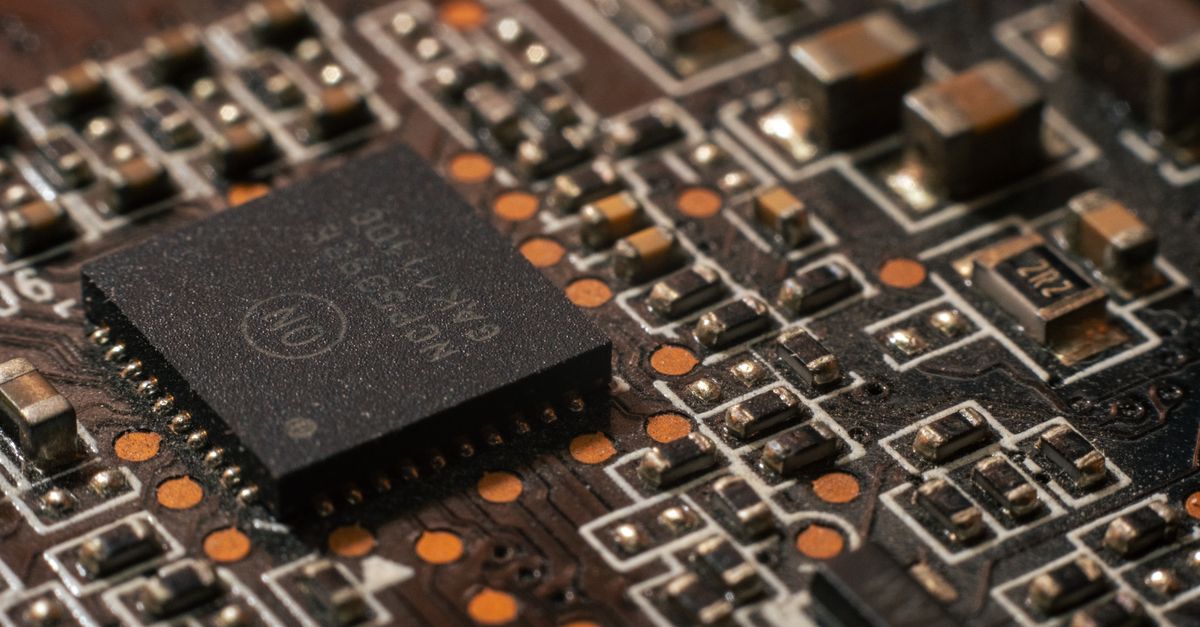
Product lineup unveiled at Advancing AI 2026

At its Advancing AI 2026 event in San Francisco on July 23, AMD announced a new generation of data-centre products that it said outperform rival Nvidia's offerings. The package included the Instinct MI455X AI accelerator, the sixth-generation EPYC "Venice" central processors based on the Zen 6 architecture, and the Helios rack-scale server design. The company described the products as major upgrades to its current line-up and said they compare favourably with competing offerings.
Helios rack architecture and production timeline
AMD said the Helios rack is now in full production, with shipments scheduled to begin at the end of the third quarter and ramp into the fourth quarter. According to AMD's specifications, each Helios rack contains 72 MI455X GPUs paired with 72 Venice CPUs arranged across 18 compute trays, supported by Pensando Vulcano 800-gigabit networking boards and Pensando Salina data processing units. AMD said the configuration delivers more than 18,000 CDNA5 GPU compute units, more than 4,600 Zen 6 CPU cores, and 31 TB of HBM4 memory per rack, with up to 2.4 Tbps of UALink scale-up bandwidth per GPU.
Customer wins and partnerships
AMD used the keynote to highlight deployment commitments. OpenAI's vice president of compute strategy, Sachin Katti, said the ChatGPT creator plans to begin deploying Helios at massive scale toward the end of 2026 and to accelerate adoption throughout 2027, and that OpenAI intends to use AMD's next-generation MI500 chips. AMD also confirmed that Anthropic plans to deploy up to 2 gigawatts of Helios systems, while Microsoft will deploy Helios at scale inside its Azure cloud. Cerebras Systems chief executive Andrew Feldman joined Su on stage to announce a partnership under which AMD and Cerebras will combine their AI servers, beginning in Cerebras data centres.
Market sizing and competitive positioning
AMD chief executive Lisa Su projected that the total computing market will reach US$2 trillion by 2030, with US$1.4 trillion of that in AI accelerators and US$220 billion in CPUs. Su framed the push as an attempt to move beyond being a distant rival to Nvidia, whose technology has dominated AI data-centre buildouts. She said AMD expects to take leadership in scale-up compute, adding that "there's no one company that can solve it all." The company separately introduced the MI430X, a high-performance computing-oriented GPU slated for early 2027, with 288 teraflops of FP64 performance and 432 GB of HBM4, destined for systems including Oak Ridge National Laboratory's Discovery leadership-class supercomputer and France's Alice Recoque machine.
Samsung HBM4 supply deal
Separately, AMD said it is close to signing a formal contract with Samsung Electronics for large-scale supplies of sixth-generation HBM4 memory, building on a memorandum of understanding signed in March. Su told Seoul Economic Daily that the agreement is "almost close" and that Samsung's HBM4 will support AMD's new AI accelerators. Samsung Electronics' foundry head Han Jin-man and DSA chief Cho Sang-yeon attended the keynote and held follow-up talks with AMD's senior executives, including chief technology officer Joseph Macri.
Share this article