September 7, 1191 CE · United Kingdom · Dust thickens on the coastal road as the crusader column pushes south through the midday heat.

In United Kingdom, Battle of Arsuf is unfolding. Third Crusade: Battle of Arsuf: Richard I of England defeats Saladin at Arsuf.
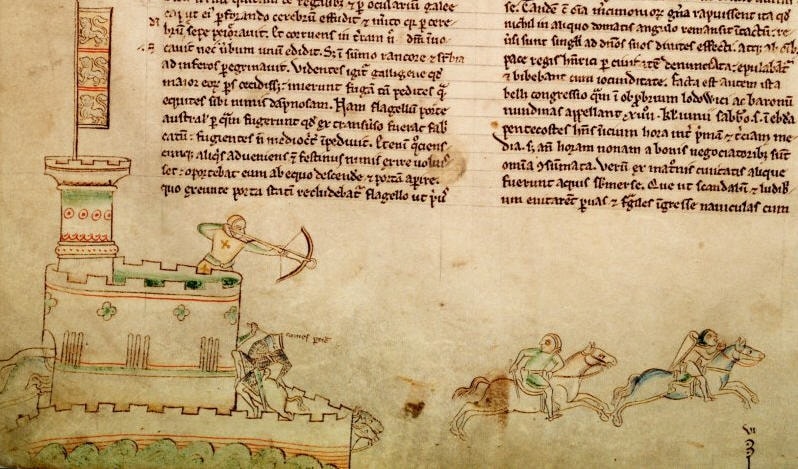
I march within the column of King Richard along the road that hugs the sea. The sun beats on my coif, and the dust kicked up by thousands of hooves and sandals rolls behind us in a yellow cloud. Saracen horsemen ride in long arcs across our flank, loosing arrows that hiss into the shields at the column's edge. The Hospitallers hold the forward rank, their black mantles bright against the pale plain. The Lion Standard of England cracks in the breeze above me, and I keep my grip on my crossbow stock, waiting for the order. The shore glitters to my left, the plain of Arsuf spreads ahead, and the distant thud of kettledrums carries from the ridge ahead.
September 7, 1228 CE · Israel · Sails crowd the harbor of Acre as a small squadron from the Sicilian court drops anchor.
In Israel, Frederick II, Holy Roman Emperor is unfolding. Holy Roman Emperor Frederick II lands in Acre, and starts the Sixth Crusade, which results in a peaceful restoration of the Kingdom of Jerusalem.
I stand on the stones of the Genoese quarter, watching the imperial galleys slide toward the moorings. A Pisan trader like me knows this port: it smells of pitch and salted fish, and the voices on the wharf are a babel of French, Genoese, Arabic and German. I have heard for weeks that Frederick, the new ruler of Sicily and Germany, King of Jerusalem by his marriage, is coming ashore to begin his crusade by treaty rather than sword. No lances are set in the racks on these vessels. Clerks in long robes wait at the rail. I count the seals hanging from the purser's belt, count the coffers being lowered on ropes, count the breaths between one anchor chain and the next. I look south past the breakwater, toward the open sea.
September 7, 1303 CE · France · Horses clatter through the broken gate of Anagni in the small hours before dawn.
In France, Guillaume de Nogaret is unfolding. Guillaume de Nogaret takes Pope Boniface VIII prisoner on behalf of Philip IV of France.
I ride in the column behind the keeper of Philip IV's seal. We have come up from French lands in the dark, and my cloak is soaked with the fine rain that falls on the orchards outside the town. The walls of Anagni loom close, and somewhere ahead a gate hangs open where it should be barred. Guillaume de Nogaret rides with his jaw set, his gauntleted hand on his sword hilt. We are here to seize Pope Boniface on the king's business; that is all I am told. My mare stamps and tosses her head. The street beyond the gate is empty of torches, but voices within the palace carry on the dawn air, and a shutter slams wide against a stone wall.
September 7, 1565 CE · Spain · Trumpets answer across the water as oared galleons round the headland into the roadstead.
In Spain, Philip II of Spain is unfolding. Arrival of the so-called Grande Soccorso ("great relief") by Philip II of Spain to the Great Siege of Malta.
I haul on the halyard with the others as the banner of Philip II climbs the mainmast. We have come south from a Spanish port, and our hulls creak with the weight of provisions, powder and shot meant for the besieged garrison on Malta. The besiegers' fires are visible on the long ridge above the harbors, and our lookouts count the beards and pikes of men stirring in the enemy lines as we draw in. Knights of the Order wait on the quays below the forts, and the first boats are already being lowered over the side. I taste salt on my lips. The sea heaves beneath our keel. Somewhere on the bluffs a cannon answers our arrival with a plume of white smoke.
September 7, 1620 CE · Finland · Axes ring in the pinewoods above the Gulf of Bothnia as the king's survey crew sets new boundary markers.
In Finland, Kokkola is unfolding. The town of Kokkola () is founded by King Gustavus Adolphus of Sweden.
I stand on a granite outcrop near the bay, where the smoke of my neighbor's cabin still hangs in the still air. Word has come that King Gustavus Adolphus has ordered a new town laid out on this stretch of coast, and the men with the chains and the copper stakes are walking the lines already. The surveyor marks a square of cleared ground, the chaplain marks a corner for a church, the soldiers stack their muskets against a boulder while they dig the first postholes. I have fished these waters since I was small. The first stakes of a new trading hall are being driven into the sandy soil. For now the axes ring in the pines above the bay, and the sound carries far across the Gulf of Bothnia.
September 7, 1652 CE · China · Rice fields steam in the heavy sun as word of the rising spreads from village to village.
In China, Han Chinese is unfolding. Around 15,000 Han farmers and militia rebel against Dutch rule on Taiwan.
I lean on my hoe at the edge of the paddies and watch the road fill with neighbors I have not seen for years. They come on foot, with rakes and staves and old matchlocks, gathering in their thousands on the dikes between the flooded fields. The Dutch overseers along the coast have pressed us with taxes and labor until the patience of every hamlet is broken. I count the knots of men clustering under the banyan trees, count the women bringing baskets of rice cakes to feed them, count the hours since the first farmstead was set alight on the plain. The air smells of cut grass and woodsmoke. I shoulder my hoe and step onto the dike to join them. Smoke from a dozen farmsteads climbs above the coastal plain.
September 7, 1689 CE · China · Banners of the Great Qing and the Tsar's envoys hang limp above the wooden palisade at Nerchinsk.
In China, 清朝 is unfolding. 清朝代表索額圖與俄羅斯代表費岳多在尼布楚簽訂界定兩國邊界的《尼布楚條約》。
I kneel behind the desk set up under the canvas awning, grinding ink for the clerks who will copy the agreed boundary between our Great Qing and the Russian realm. The river runs brown past our palisade, and the willows along the bank bend in a wind that has not yet risen. The Russian interpreters huddle over a Latin text drawn up between the camps. A banner stirs in a sudden gust, then hangs limp again. Qing officials lower their seals onto the warm wax. The sun climbs. My brush hovers over the first character of the preamble. A horse whinnies along the ridge and is answered. I wait for the master of ceremonies to give the word that I may begin.
September 7, 1695 CE · India · A Mughal merchantman looms above our rail as we close in under a low moon.
In India, Henry Every is unfolding. Henry Every perpetrates one of the most profitable pirate raids in history with the capture of the Grand Mughal ship Ganj-i-Sawai. In response, Emperor Aurangzeb threatens to end all English trading in India.
I crouch at the gunwale with the others as the Ganj-i-Sawai rolls broadside to us, her gilded stern lifting against the stars. Our captain, Henry Every, paces the quarterdeck with his long gun loose in his hands. The Mughal's decks are high, her gun ports shut, and we are bearded sloops bristling with pistols and cutlasses. The lookouts on her poop exchange words I cannot make out. A flash of her lantern sweeps our hull. Our bosun calls for grapplers and powder. My ears strain for the first crash of iron on her timbers. The sea between us narrows. The moon slips behind a cloud, and I hold my breath.
PLACES IN THIS STORY
Explore the destinations behind this report
Finland
Kokkola
Browse travel guides, places to stay, attractions and local food in Kokkola.
Explore Kokkola →Kokkola travel guide: coastal calm on Finland's western edgeIsrael
Jerusalem
Browse travel guides, places to stay, attractions and local food in Jerusalem.
Explore Jerusalem →A Thoughtful Jerusalem Travel Guide for Slow, Curious VisitorsShare this article