I am halfway down a stony slope when the light begins to thin.

August 17, 804 BCE · Northern Eurasia · The Sun is being eaten
A partial solar eclipse is crossing the far north today. The Sun is darkening over the northern lake country, and no one on the shore has an explanation for the sudden loss of light.
My small flock has been nosing through the grass beside the northern lake. Now the animals press shoulder to shoulder. The warmth drains from the air, though the day is nowhere near finished. Above us, a black curve is cutting into the Sun.
No cloud moves across it. No rain follows. The bright disc simply shrinks, bite after bite, until most of its width is gone. The lake loses its glitter. Stones that were pale a moment ago turn the colour of ash. I keep one hand around my staff and the other over my eyes, looking only in brief, painful glances.
Someone farther along the shore begins beating wood against wood. Another voice answers from beyond the trees. Nobody knows what has climbed into the sky or what it wants from us.
I count my animals again. The Sun is still there, a wounded rim of fire, but daylight feels borrowed now. All I can do is wait beneath it and wonder whether the missing light is coming back.
Far to the southeast, another kind of darkness settles inside a royal court.
August 17, 333 CE · China · A new name enters the register
Inside the Later Zhao court, Emperor Shi Le has died and his son, Shi Hong, is taking the throne. The succession is moving from sealed rooms to public documents while officials wait to learn whether the wider realm will accept the new name.
It is August 17 in the year 333 CE. I am a junior copyist outside the Later Zhao audience hall, holding fresh paper against a wooden board. The corridor smells of lamp oil and damp timber. Men who normally announce every arrival are speaking close to one another, barely above a breath.
Then the message reaches our table. Emperor Shi Le is dead. His son, Shi Hong, now takes the throne.
The brush pauses between my fingers. Two names must change places before the ink on the notice dries. Sand scatters across the wet characters while sealed documents begin moving from hand to hand.
No one tells us what is happening behind the closed doors. No official explains whether every commander will accept the succession. Faces remain still, but sleeves keep brushing past at unusual speed.
The date at the top of my copy reads the eighth year of Xianhe, seventh month, wuchen day. I write it carefully. A court can replace an emperor in a sentence. I do not know whether the realm beyond this corridor will change as quietly.
Beyond China, boots and pack animals are crowding into a narrow Bulgarian pass.
August 17, 986 CE · Bulgaria · Stones are falling into the retreat
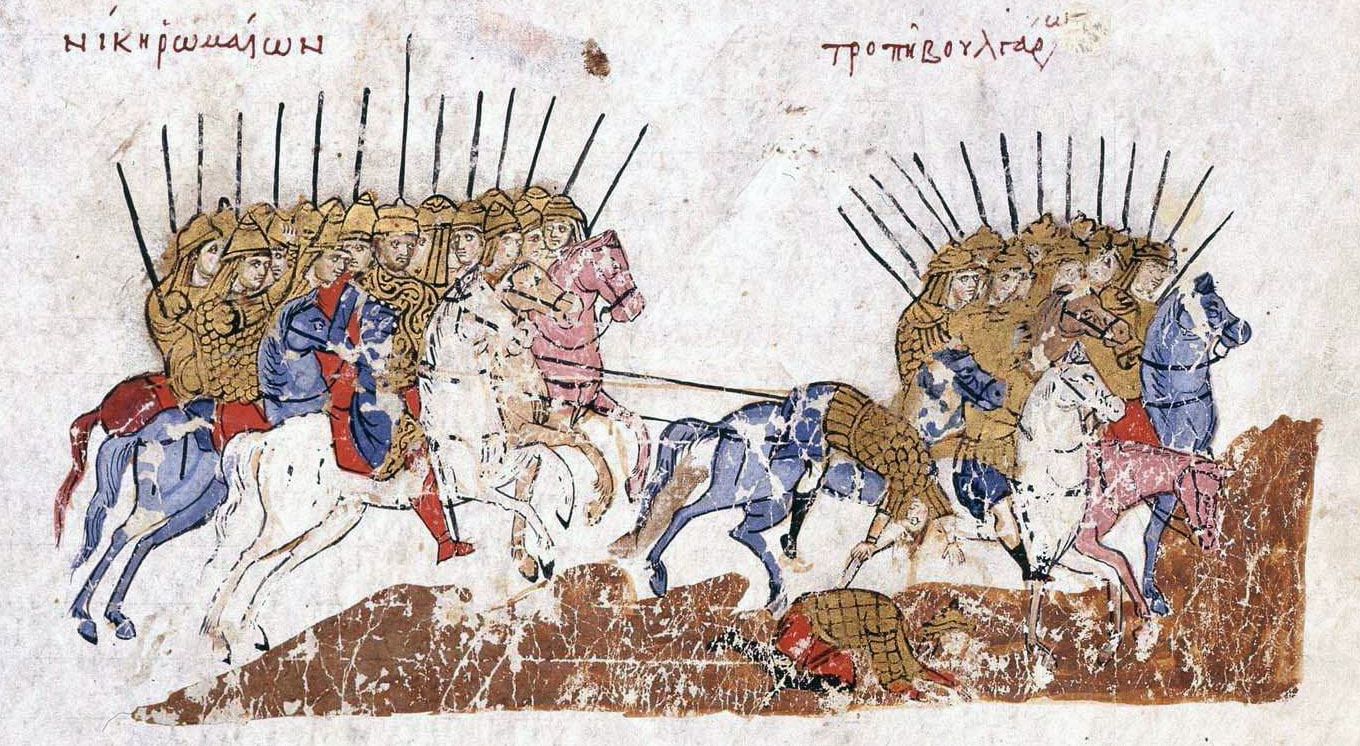
At the Gates of Trajan, Bulgarian forces are closing on Basil II’s retreating Byzantine army after the failed siege of Serdica. The narrow pass is turning the withdrawal into an ambush, leaving the column with little room to form a line.
I walk beside the Byzantine baggage train, one hand on the rope of a stumbling mule. We have left Serdica without taking the city. Food is short. Men have abandoned pieces of siege equipment along the road because the animals can no longer drag them.
The pass tightens ahead. Rock rises on both sides, close enough to throw the marching column into shadow. Then stones come down.
The first crash knocks a soldier from his feet. Arrows follow from above. Shields slam together, mules wrench free and the road folds into itself as men at the front try to turn while those behind continue pushing forward. Bulgarian fighters are striking the column from the heights. There is nowhere to form a clean line.
Dust fills my mouth. A broken cart blocks half the track. I cut the mule loose and flatten myself behind a wheel while boots hammer past in both directions.
Somewhere ahead rides Emperor Basil II. Nobody near me knows whether his guard has found a way through. The shouting is moving closer, and the only road home has become a trap.
Much farther east, the road itself begins to move.
August 17, 1668 · Northern Anatolia · The walls bend like cloth
A vast earthquake tears across northern Anatolia. Houses, roads and settlements are being struck along a fault zone no single messenger can yet describe.
I keep a roadside inn near Bolu. The morning bowls are still on the table when they begin to chatter against one another. A low roar rises under the floor, too deep to be thunder.
Then the room jumps.
The ceiling beam twists. Clay cups burst on the ground. One wall bows outward as if it has turned to cloth, and the doorway fills with pale dust. I reach the courtyard on my hands because standing is impossible. Roof tiles strike the stones around me. Horses pull against their tethers until the leather cuts into their necks.
Across the road, a house settles into itself with a sound like trees splitting in winter. People call names into the dust. No answer comes from some of the doorways.
The shaking weakens, but the earth does not feel still. Small jolts keep passing beneath my knees. Travellers arriving from the east speak of damage stretching from settlement to settlement, far beyond anything one messenger can measure.
I want to go back inside for water. The cracked beam above the door is still shedding splinters. Another rumble gathers somewhere below us, and everyone in the courtyard steps away from the walls.
Across the continent, smoke is beginning to cover the ridges above a Portuguese village.
August 17, 1808 · Portugal · Red lines climb toward the guns
At Roliça, British troops under Wellesley climb toward French positions. The Peninsular War battle is unfolding over exposed ridges.
I tend vines below the heights at Roliça. This morning the slopes belong to cicadas and workers. Now cannon fire rolls between them, and powder smoke drifts over the rows in bitter grey sheets.
British infantry in red coats is climbing toward the French positions. The ridges force the soldiers into narrow approaches where every rock and fold of ground matters. A volley cracks from above. The front ranks disappear behind smoke, then figures emerge again, bent low, still moving uphill.
I crouch behind the stone wall that marks the edge of my field. Musket balls clip leaves from the vines. Men come down from the slope carrying others between them. An officer waves the next line forward before the wounded have cleared the path.
The French troops are giving ground now, pulling away from one height and forming again farther back. British soldiers reach the crest, but nobody around me acts as if the danger is over. Roughly fourteen thousand men have come under Arthur Wellesley, and the French force ahead is withdrawing without dissolving.
Smoke hangs where the sky should be. Lisbon lies beyond these hills. I cannot tell how many more ridges will have to burn before anyone reaches it.
At the same hour in Finland, gun smoke is threading through a stand of pines.
August 17, 1808 · Finland · The road out of Alavus fills with retreating men
Outside Alavus, Swedish-Finnish troops under Adlercreutz are pressing Russian forces back. Fighting moves through the pines as the Russian line gives ground.
I drive a supply cart outside Alavus, close enough to the field that every heavy shot trembles through the wooden wheels. The horses keep throwing their heads. Powder smoke catches between the pines and turns the far edge of the road into a moving grey wall.
Swedish-Finnish troops under Carl Johan Adlercreutz are pressing forward. Commands break apart in the gunfire. Men vanish into the smoke, reappear beside a fence and push on again. The Russian line holds, bends, then begins to pull away.
Soon the road ahead fills with retreating soldiers and riderless horses. I drag my cart into the ditch to keep it from being overturned. A torn pack lies open in the dirt, bread scattered beside cartridges. Nobody stops to gather either.
The firing thins. It does not vanish. Adlercreutz’s men hold the ground around Alavus, but faces remain turned toward the trees where the Russian force has withdrawn. No one beside this cart knows whether it is leaving the field or preparing to strike again.
The horses finally lower their heads. I keep the reins wrapped around my wrist and listen. Somewhere beyond the pines, one more shot breaks the quiet. I stay where I am. Tomorrow has not declared itself yet.
Share this article