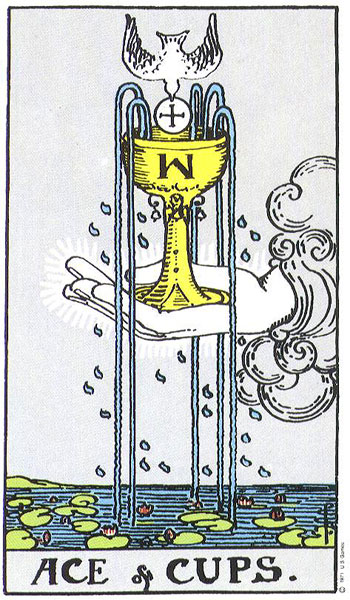
Why "Beginnings" Sits at the Center of the Ace of Cups
When you first encounter the ace of cups tarot card meaning, the word that does the heaviest lifting is "beginning." The card's rank is Ace, which sits at position one within its suit. Its suit is Cups, a grouping in the Minor Arcana associated with feeling, relationship, imagination, and emotional response. The combination is unusually narrow on purpose. Where other Minor Arcana cards describe processes that are already in motion or patterns that have ripened, an Ace names the very first pulse of a pattern before it has gathered weight.
Because the card is concentrated rather than expansive, the question it asks is rarely "what will happen?" It is closer to "what is just starting, and do I recognize it?" A beginning can be small and still be a beginning. It can be a thought, a sensation, a willingness, a single honest sentence. The card's constructive direction, recognizing and communicating the emotional reality of a situation, points to the kind of opening that is named and shared rather than left to simmer unnoticed.
The tone field is described as open, which matters. An open tone in this context means the pattern has not yet hardened into a demand or a verdict. There is room to learn from what is arriving. That room is part of why the card is often read as gentle even when the underlying feeling is intense.
Reading the Card in Its Upright Form
Upright, the card points to a concentrated opening expressed through feeling, relationship, imagination, and emotional response. Four channels are named together, which is worth pausing on. A reader who treats the Ace as only about romance will under-read it. A reader who treats it as only about self-care will also under-read it. The card suggests a starting point where inner experience and the willingness to connect with another person line up at the same moment.
The constructive direction is to recognize and communicate the emotional reality of a situation. Recognition comes first. You name what is actually happening inside you, not the polished version of it. Communication comes next. You let at least one other person hear the real description. Without communication, the opening stays private and tends to drift into either overthinking or avoidance.
Imagination is one of the four named channels, and it is the easiest to misread. Imagination here is the ability to picture a future shape for the feeling, not a prediction that the imagined shape will arrive. Treating it as foresight inflates the card beyond its data.
A useful interpretive choice is to ask: what would a small, named, shared beginning look like in this situation? If you can answer that in a single sentence, the upright reading is doing its work.
When the Pattern Tilts: The Reversed Reading
The reversed position does not flip the card into a different topic. It keeps the same concentrated beginning through feeling, relationship, and imagination, and reports friction in how that beginning is being handled. The pattern may be blocked, internalized, or showing its shadow through projection, avoidance, or becoming overwhelmed by an untested feeling.
Three interpretive paths sit inside that single sentence, and the reader has to choose which one fits the question.
First, blocked. The opening is present but something is preventing it from moving. The block can be external (a conversation you have not scheduled, a message you have not sent) or internal (a story you keep telling yourself about why now is not the right time).
Second, internalized. The beginning has been received but kept entirely private. Internalization can look like maturity on the surface, because nothing dramatic is happening. Underneath, though, the feeling is growing without any outside check, which is how small openings become confusing ones.
Third, shadow forms. Projection is treating someone else as the source of a feeling that is actually yours. Avoidance is sidestepping the feeling by staying busy. Becoming overwhelmed is the failure mode where an untested feeling expands faster than your ability to hold it.
The reversed card asks the same question as the upright, but with the modifier "and what is getting in the way?" A reader who only catalogues bad outcomes will miss that the underlying pattern is still the same opening.
Beginnings vs. the Broader Emotional Landscape
A common misstep is to read the Ace as a verdict on an entire emotional life. The card is narrow. A first step is not a relationship. A flicker of feeling is not a long bond. A creative impulse is not a finished work. The Minor Arcana as a whole describes everyday patterns rather than the larger life themes handled by the Major Arcana, and an Ace inside that system describes the start of a particular pattern, not the whole field it sits inside.
Keeping that distinction matters for honest reading. If the question is "how is my emotional life going?" and the answer is the Ace of Cups, the card is naming a starting point within that life. It is not summarizing the life. The reader has to add context from surrounding cards, the question asked, and the reader's own knowledge of their circumstances. Treating the card as a summary tends to produce either excessive optimism or excessive anxiety, both of which are out of proportion to what a single Ace can claim.
It also helps to keep Cups as a suit and the Ace as a rank distinct in your mind. The Cups suit broadly concerns feeling, relationship, imagination, and emotional response. The Ace adds the idea that this is the first concentrated instance within that broader territory. When the two are merged, beginners often attribute whole-life meaning to what is really a specific starting pulse.
A Realistic Low-Stakes Example
Consider a person who has recently moved to a new city and has spent three months keeping a packed schedule to avoid thinking about how quiet the apartment feels. A friend in the old city mentions, almost as an aside, that she would like to visit for a weekend. The Ace of Cups upright, in this context, would point to the small beginning sitting inside that suggestion. The opening is real. There is feeling in it (relief at being thought of), there is relationship in it (the existing friendship), there is imagination in it (picturing the visit), and the constructive direction is to recognize and communicate the emotional reality: "I would like that, and I have been more isolated than I have admitted."
If the same card appeared reversed, the interpretive choice would lean toward internalization or avoidance. The person might feel the relief and then immediately fill the calendar with new tasks. The opening is blocked by the same busyness that created the quiet in the first place. The reversal does not mean the friendship is doomed. It means the beginning is being held at a distance.
The example is deliberately low stakes. No life-altering decision is being made. The reading still has something to say, because the card is concentrated on beginnings, and a small beginning is still the topic.
Where a Reading Can Slip Into Misreading
A plausible misreading, even with careful attention to the supplied facts, goes like this. The reader notices the word "beginning" and the word "relationship" and concludes that the card is forecasting a destined romantic partner. The supplied data does not support that conclusion. The card describes a concentrated beginning expressed through feeling and relationship, and relationship in this context is a category that includes friendships, family ties, working partnerships, and the relationship a person has with their own inner life. Reading "relationship" as a synonym for "romantic destiny" is an inflation that the card cannot defend.
A second misreading is treating imagination as evidence of foresight. The upright description names imagination as one of the four channels of the opening, but imagination in this card is the capacity to form an internal image, not a guarantee about the future. Tarot is not a prediction. Any reading that claims to see a specific outcome goes beyond what the card's data can support.
A third misreading is treating the open tone as a promise that nothing difficult will happen. Open is not the same as safe. A beginning can be open and still be uncomfortable. The open tone describes the space available to learn from what is arriving, not a guarantee about what is arriving.
A fourth is reading the reversed purely as bad news. The reversed pattern is the same opening, with friction in how it is being handled. A reversed Ace is not a closed door. It is a door with something leaning against it.
Ambiguity is part of honest reading. When the upright meaning and the situation both fit, the reading is clear. When the situation is too vague to name a specific beginning, the reader should record the ambiguity rather than force a fit. Disconfirming evidence matters as much as a match. If the reader cannot point to a single concrete beginning that the card could be naming, that absence is data, and it deserves to be logged.
Journal Questions to Verify the Fit
The card's own reflection question is a useful starting place: what small beginning would let you learn quickly? That question is specific on purpose. Small is part of the prompt. Learning is part of the prompt. Quick is part of the prompt.
A few journal questions help test whether the card actually fits the moment:
- Can you name, in one sentence, the specific beginning that the card could be pointing to? If not, the reading is too abstract to verify. - Does the beginning involve feeling, relationship, or imagination, or does the reading require stretching one of those words to fit? Stretching is a warning sign. - Is the constructive direction visible? Can you see what recognizing and communicating the emotional reality would actually look like in this case? - If the card is reversed, can you identify which of the three friction modes (blocked, internalized, shadow forms such as projection, avoidance, or being overwhelmed) is closest to the situation? - What evidence would change your mind about the reading? If nothing could, the reading has moved from reflection into belief, and that is a sign to step back.
Tarot, used well, is a way to slow down and look at a pattern with more care than habit allows. It is not a forecast and it does not replace evidence from the rest of your life. Medical, legal, financial, safety, and crisis decisions belong with qualified professionals, not with a single card. The Ace of Cups, in particular, is a card about the size of a beginning, and a small honest opening, named and shared, is often the most useful answer it has to offer.
Share this article