The question this card places in front of you
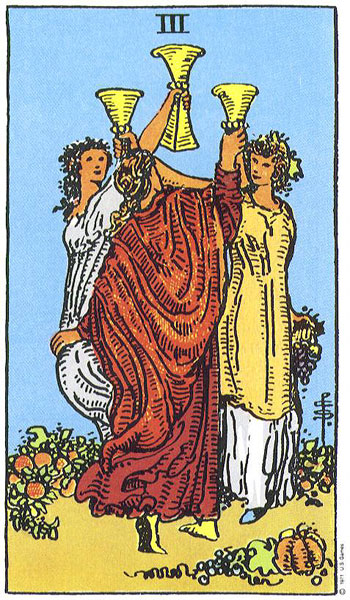
The Three of Cups tarot card meaning centers on a specific kind of movement inside your emotional life: growth itself. The suit of Cups, taken as a whole, describes the territory of feeling, relationship, imagination, and the way inner states get expressed outward. Within that larger territory, the number three marks a phase where something has moved past its first form and is asking to be tended. The constructive direction named for the upright position is the act of recognizing and communicating the emotional reality of a situation rather than leaving it unspoken or mistaking it for something else.
So when this card appears in a spread you are working with, the question is not simply "how do I feel?" It is the narrower, more practical one of what helps a feeling develop past its earliest stage. A feeling that has only just surfaced may still be small, fragile, or unnamed. The open tone of the card points toward the conditions that allow it to expand: participation, feedback from other people, and the imagination that lets a person picture a situation from more than one angle. The card's reflective prompt makes that explicit: who or what could help this move beyond its first form?
That framing matters because emotional life is broader than growth. A reading can correctly describe a feeling as present, vivid, or even overwhelming without describing anything that is actually growing. Growth implies direction, response, and a change in scale or clarity over time. If you are tracking whether the card fits what is happening, the test is not whether emotion is in the room but whether the emotion is moving and being met.
Upright: growth through participation, feeling, and imagination
Upright, the Three describes growth through participation, feedback, or expansion expressed through feeling, relationship, imagination, and emotional response. Each of those words does some work. Participation points to the role of other people or shared activity in moving a feeling along. Feedback points to the role of response — someone hearing you, mirroring you, or gently correcting you. Expansion points to the feeling itself becoming wider, more textured, or more articulate than it was a moment ago.
In practical terms, the upright card often matches situations where someone has begun to articulate an internal state and finds it is received rather than dismissed. A friend who lets you finish a thought before responding. A meeting in which you say the honest thing and discover that others had been carrying a similar question. A creative project in which an early sketch turns into a draft because someone else contributed the missing piece. None of these need to be dramatic to count as growth. The card's signal is the small, verifiable movement from an unformed state to a more articulated one, with another person or context playing a part.
A useful test for an upright match: can you name the feeling, the person or context that helped it move, and the change that has already taken place? If all three are describable, the card is likely tracking something real. If only the feeling is describable and the rest is speculative, the upright meaning is suggestive rather than confirmed.
Reversed: when the pattern stalls, inverts, or overwhelms
Reversed, the same pattern may be blocked, internalized, or showing its shadow through projection, avoidance, or becoming overwhelmed by an untested feeling. The three moves named in the supplied description — blocked, internalized, and showing its shadow — describe different ways growth can fail to happen even when the underlying feeling is present.
A blocked pattern looks like inaction that has a clear cause. You may know what would help you develop past the current stage and be unable, for practical or interpersonal reasons, to do it. An internalized pattern is subtler. The feeling is present but is being held entirely inside, so it neither advances nor dissipates. A pattern showing its shadow includes projection, where you attribute your own feeling to someone else; avoidance, where the structure of your days is organized around not meeting the feeling; or overwhelm, where an untested feeling has grown large precisely because it has not been spoken, named, or shared with anyone who could respond.
The reversed position does not mean the opposite of feeling. It means the feeling is no longer moving in the way the upright card describes. That distinction is worth holding. Reversed Cups cards can still describe strong emotion; what changes is whether the emotion is being recognized, communicated, and met in a way that lets it develop.
A low-stakes example: noticing growth in a small group conversation
Consider a low-stakes situation. You have been part of a small reading group or project team for several months. Recently, you have started to feel that the early excitement has worn off and that the work is becoming routine. You mention this to a colleague at a coffee break, expecting polite disagreement. Instead, the colleague nods and says they have been feeling something similar, and offers one concrete observation about a part of the work you have been avoiding. Over the next week, you notice yourself returning to the avoided section and finding it less dull than it had seemed.
The Three of Cups, read upright, fits this sequence. The feeling (loss of early momentum) was named. It was received (the colleague did not dismiss it). It was met with a small piece of feedback (a specific observation). A change in scale and clarity followed (the avoided section now feels approachable). Nothing supernatural is required to describe this. It is a recognizable pattern of growth through participation.
If the same conversation had gone differently, the card might not fit as well. If the colleague had listened but offered nothing specific, the feeling might remain blocked. If you had carried the feeling alone for another month, it might have become internalized. If you had told yourself that the colleague was the one losing interest, the pattern would be showing its shadow through projection. The example is intentionally modest because the card's signal is usually modest too. Growth in emotional life tends to be small, verifiable, and dependent on the actual people in the room.
A plausible misreading: confusing celebration with growth
A common misreading of the Three of Cups tarot card meaning is to assume the card is only about parties, friendships, or celebrations. That assumption collapses growth into a single emotional color and reads the card as confirmation of good feeling rather than evidence of development. The misreading is plausible because the card belongs to a tradition in which festive interpretations have become familiar, but the supplied data points elsewhere. The upright description specifies growth through participation, feedback, or expansion, and the reflective prompt asks who or what could help something move beyond its first form. Neither phrase is the language of party-going.
The misreading matters because it can lead to two specific errors. The first is reading the card as a generic positive signal in social contexts, when the more accurate question is whether a real emotional shift has been shared and built on. The second is reading the card's reversed position as relational conflict or social withdrawal, when the more accurate question is whether growth itself is being blocked, internalized, or projected. If you are tracking what the card actually points to, the test is development in feeling, not the presence of other people.
This is also where the limits of one card become visible. A celebration, a friendship, a party, a wedding, or a reunion can all be present without any growth in feeling having occurred. The card does not, on the supplied facts, confirm or deny those events. It points specifically to whether something is moving past its earliest form with the help of participation, response, or imagination. Holding that distinction is the difference between using the card and being used by an interpretation you have carried in from elsewhere.
Journal prompts for verifying your own reading
The card's own reflective question is a useful starting point: who or what could help this move beyond its first form? From there, a short journal practice can help you decide whether the card is actually tracking something in your situation or whether you are projecting onto it.
Try writing answers to the following in plain language, without trying to sound certain. First, name the feeling in one sentence — not the situation, not the other person's behavior, but the feeling itself, using words a friend would recognize. Second, describe the person, conversation, or context that has helped the feeling move in the last week or two. If nothing comes to mind, write "none yet" rather than reaching for an answer. Third, describe the change you can already verify, even a small one. A topic you raised that you would not have raised a month ago counts. Fourth, write the one thing that is currently blocking, internalizing, or distorting the feeling, if anything is. Fifth, write what you would need to test, in real life, to know whether the card's growth reading is accurate for you.
These prompts are not a way to make the card true. They are a way to record what is true, and to notice the difference. The more honestly you write, the more useful the page becomes when you look back at it later. If a journal entry from two weeks ago now reads differently from what you wrote today, that gap is information, not failure.
The limits of one card: ambiguity, disconfirming evidence, and using real help
Tarot is not a prediction. The Three of Cups is a Minor Arcana card that describes a pattern in feeling, relationship, and imagination. When it appears in a spread, it offers a structured question, not a forecast. Real events will sometimes match its description and sometimes will not. Recording apparent matches and disconfirming evidence with equal care is part of using the cards honestly. If a journal page shows three weeks of entries in which the named feeling has not moved, or in which the people described have consistently been absent, that is information the card is telling you to weigh, not to argue with.
Ambiguity is part of the practice. A single card cannot tell you whether growth is happening in a relationship, a creative project, or a phase of personal life, because the same pattern can show up in any of them. The interpretation choices you make about which area of life to apply the card to are yours, and they deserve to be checked against evidence you can describe to another person. If your reading produces a course of action that affects your health, finances, legal situation, or safety, the card is the wrong tool for the decision. Qualified help from a doctor, lawyer, financial advisor, or crisis line is the right tool.
Used within those limits, the Three of Cups is a precise and gentle instrument. It asks whether something in your emotional life is being met in a way that lets it develop, and it names the conditions — participation, response, imagination — under which development is most likely. Whether those conditions are actually present in your situation is something only you, with the help of the people around you, can verify.
Share this article