The Logic Behind Three Positions
A situation obstacle resource tarot spread uses three defined roles to keep a reading focused on review rather than prediction. Each position asks one specific question, and the cards speak to those questions with their own language. The discipline of assigning roles prevents the kind of storytelling that turns a layout into entertainment.
The first position surveys what is already in motion. The second names what is creating friction. The third invites attention to what can be drawn upon. None of these roles promises an outcome, and a careful reader treats them as prompts for reflection rather than clues about what will happen next.
Tarot cards do not predict events. They are images paired with writing prompts that surface what you may already know but have not yet articulated. When a card matches a moment in your life, that match reflects the quality of your attention, not a supernatural signal. When a card fails to match, that mismatch is just as informative. Recording the gap is part of how the practice matures.
Holding One Coherent Question
A coherent question is what keeps the three positions from collapsing into ambiguity. Without it, each card floats free, and the reader is left stitching meaning after the fact. With it, the layout becomes a structured way of looking at one thing from three angles.
A useful question is short, specific, and answerable through reflection rather than lookup. Questions framed as "what is happening with X" usually work better than "will X happen." The first kind invites examination; the second demands certainty that no card can offer.
Try phrasing the inquiry in present tense. "What is happening with my creative project this week" beats "will my creative project succeed." If the question branches into several concerns, narrow it before laying out the cards. Three positions cannot do the work of ten.
A quick check before drawing: can you describe the situation behind the question in two sentences? If not, the framing is still too foggy, and any card drawn will land on fog. The discipline of writing the situation down first is what turns a coherent question into a workable one.
The Situation Position: Three of Wands
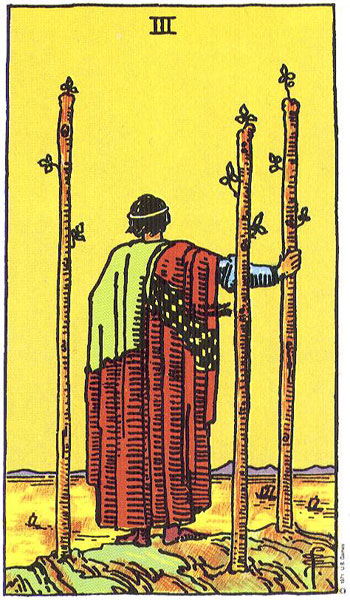
The first card answers "what is actually here?" In this layout, that role is held by the Three of Wands, upright. The card describes growth through participation, feedback, or expansion, expressed through initiative, creative energy, and purposeful action. Its constructive direction is directing energy toward work that matters.
This is not a card about waiting. It describes a situation in which something has been started and is now reaching outward. Feedback has come in, or is being invited. The first form has already taken shape, and the question is what comes next.
When this card sits in the situation position, the reading starts by acknowledging momentum. The reader is asked to recognize what is already moving before looking at obstacles or resources. Skipping that step leads to spreads that fixate on difficulty and miss what is working.
If the Three of Wands feels foreign to the situation the reader named, that is worth recording. Sometimes the question is about a plan still at the proposal stage, and the card's language of feedback and expansion does not fit. The mismatch is data; it suggests the situation is earlier than the question assumed, or framed differently than reality. Disconfirming evidence deserves the same care as a clean match.
The Obstacle Position: Five of Swords
The second card answers "what is creating friction?" In this layout, that role is held by the Five of Swords. The card describes friction that exposes a weak assumption or an unmet need, expressed through thought, language, decisions, and conflict. Its constructive direction is using clear distinctions and honest communication. Reversed, the same pattern can appear as overthinking, rigid conclusions, or words used as weapons.
The tone of this position is pause. Obstacles in this spread are not enemies to defeat. They are signals pointing to where a plan has not been fully thought through, or where a need has gone unnamed.
When the obstacle card lands in this position, the reading invites the reader to ask: what is the disagreement, loss, or pressure revealing? That reflection prompt is suggested by the card itself. The friction is information, not a verdict.
A common mistake is to read an obstacle card as a prediction of failure. The Five of Swords specifically warns against that reading. The card names friction as a clarifying force; the reader is meant to use it, not be stopped by it.
It is also worth noticing when this card's description does not match the reader's experience. Sometimes the obstacle is not friction but fatigue, or a logistical gap. Noticing that gap protects the spread from being forced into a particular shape, and it sharpens the next step.
The Resource Position: Six of Pentacles
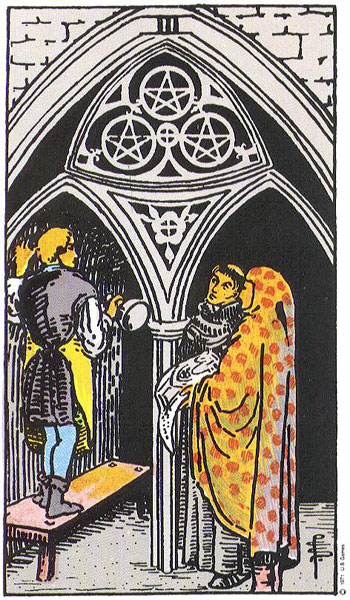
The third card answers "what can be drawn upon?" In this layout, that role is held by the Six of Pentacles. The card describes exchange, recovery, recognition, or movement after difficulty, expressed through work, resources, the body, routine, and material conditions. Its constructive direction is building something useful through steady, observable practice. Reversed, the same pattern can show as scarcity fixation, stagnation, or treating measurable value as the only value.
This position is the one that often changes a reading most. Without a resource slot, obstacle cards tend to dominate, leaving the reader stuck in friction. The third position pulls attention toward what is available: time, skills, support, recovery, or routine.
The Six of Pentacles is a particularly grounded resource card because its language stays close to material conditions. It does not promise luck or transformation. It asks the reader to look at exchanges they are already part of, recognition they have received, or the basic practices that hold a project together.
A common error is to read this card as a promise that help is coming. The card describes exchange and steady building, not rescue. When the reader treats it as reassurance, the spread drifts toward fortune-telling. When the reader uses it to ask what fair progress would look like for everyone involved, the card becomes a working tool.
If the language of exchange and recovery does not fit, that mismatch also deserves a note. Sometimes the available resource is encouragement rather than material; sometimes it is a constraint that protects the reader from overextension. The card is a prompt, not a verdict, even in the resource slot.
Reading Without Promising an Outcome
The three positions together offer a structure, but the structure does not generate predictions. Each card is a prompt; what the reader brings to those prompts determines what comes out. Responsible readers keep that distinction visible in their notes.
One way to hold this discipline is to write a one-line summary after the reading that names only what is observable. "I have momentum in my project; I am in a conflict that needs clearer language; I have steady routines I can lean on." That kind of note describes the present rather than forecasting the future.
Another check is to ask where the reading could be wrong. If the obstacle card names friction but the situation card names expansion, is the obstacle blocking the expansion, or is the friction actually part of the expansion? Holding both possibilities, rather than locking in one, keeps the spread honest.
Tarot cannot substitute for qualified advice in medical, legal, financial, or safety decisions. If a reading surfaces something urgent, the appropriate next step is to bring it to a professional who can work with real evidence. The spread is a thinking aid, not a decision-maker.
A Low-Stakes Example and Journal Prompts
Consider a reader named Ava, who is two weeks into planning a community workshop. She writes one coherent question before laying cards: "What is happening with my workshop, and what do I need to look at?"
In the situation position, she lays the Three of Wands. She recognizes that she has reached out to two partner organizations and received a reply from one. Outreach is in motion, and feedback has begun. That matches the card's language of feedback and expansion. If it had not matched, she would have written down the gap and adjusted her read.
In the obstacle position, she lays the Five of Swords. She has been arguing with one of her partners about the workshop's topic, and the disagreement has stalled a joint decision. The card's reflection prompt fits: what is the disagreement revealing? She writes that the topic debate is actually a values question that neither of them has stated out loud. The friction has a clear source.
In the resource position, she lays the Six of Pentacles. She remembers that she has a colleague who has run similar workshops, and who offered to share templates. Exchange, recognition, and steady practice all map onto the card's language. The resource here is not exotic; it is a concrete offer she had been overlooking. Reversed concerns, like scarcity fixation, do not show up in her notes.
Ava does not conclude that the workshop will succeed. She concludes that momentum exists, that a friction needs honest language, and that a useful offer is available. Those are all things she can verify on her own before taking action. Each conclusion maps to one of the three positions; nothing is added that the spread did not invite.
Journal prompts to use with this layout:
- Describe in two sentences what is currently in motion in the situation you named. - What does the friction card reveal that you had not stated plainly? - What resources, exchanges, or routines are already available that you have not been drawing on? - Where could this reading be wrong, or where is the gap between card and life? - What is one observable next step that does not depend on prediction?
When the spread is read with attention to gaps and verifiable details, it becomes a tool for review rather than a substitute for evidence. The cards are prompts; the reader does the thinking.
Tarot is a reflection practice, not a prediction. This guide cannot determine future events or replace direct evidence and qualified help for medical, legal, financial, safety, or crisis decisions.
Share this article