Imagery and What It Offers to Notice
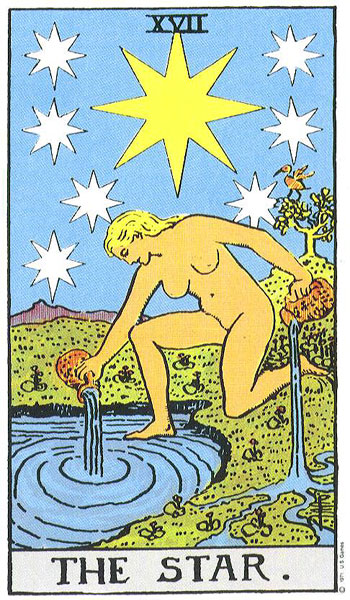
Most readers who look up the star tarot card meaning arrive curious about a single, well-known picture. The Major Arcana card numbered 17 typically shows a kneeling figure pouring water onto land and into a stream, beneath a large eight-pointed star and a circle of smaller stars. The sky is open, and the posture is unhunched. Whatever your tradition, the image rewards close attention because the card has always been read as much from visual cues as from keywords.
Notice what is visible rather than what you are told to see:
- **Openness of posture.** The figure is not armored, crowned, or clutching. Hands are occupied with pouring, not with grasping. This is consistent with the card's traditional association with openness rather than achievement. - **Two directions of flow.** Water returns to the source as well as flowing forward. This visual detail is often read as renewal that is bidirectional: looking back to learn, and looking forward to orient. - **A clear sky.** The night sky is calm, not stormy. Many depictions place the largest star directly above the figure. This is one of several features that gives the card its reputation for signaling a quiet rather than dramatic phase. - **A neutral landscape.** Ground and stream are not decorated with trophies or ruins. The figure kneels on bare earth. This visual plainness invites the reader to project less and observe more.
What the imagery does not show is also worth recording. There are no onlookers, no audience, no completed project, and no visible reward. If a reading leaves you feeling the card promises instant relief, the picture itself argues against that interpretation. Use the image to slow down. The picture is a still point, not a peak.
Upright Meaning: A Quiet Return of Confidence
When the star tarot card meaning is discussed in its upright position, the language tends to be steady rather than triumphant. The supplied upright description is: renewed orientation, openness, and the gradual return of confidence after difficulty. Three words deserve separate attention.
**Renewed orientation** suggests that a sense of direction is being re-established, not invented from scratch. If you have just come through a period of confusion, this is the card most often associated with the moment you notice you can pick a direction again. The keywords used in many reference decks are renewal, orientation, and hope.
**Openness** points to a posture more than an outcome. You may be more willing than you were a week ago to listen, to revise, to be seen. This is observable: do you find yourself asking questions you would have shut down earlier?
**Gradual** is the most important qualifier. Confidence that returns gradually is, by definition, not instant. If you are looking for evidence, look for small signs rather than large ones. Did you return a phone call? Did you open a draft? Did you sleep one hour longer without spiraling? These are the kinds of events that fit the upright meaning in a testable way.
A useful upright prompt is: what small sign would count as genuine renewal rather than instant resolution? Write the answer in a sentence, not a paragraph. If the only sign you will accept is a complete reversal, the card's traditional message does not apply, and that mismatch is information.
Reversed Meaning: When Hope Feels Remote
The reversed meaning of the star tarot card meaning is often summarized as hope that feels remote, or comparison that obscures quiet evidence of recovery. Reversals in most decks are not opposite meanings but a softening or distortion of the upright theme.
Two patterns appear often in real readings:
- **Remote hope.** You may know, intellectually, that things are better than they were. The evidence is there on paper. Yet the felt sense of hope is missing, and small setbacks loom large. The card, reversed, asks you to notice whether the absence of feeling has been mistaken for the absence of fact. - **Comparison.** Recovery is quiet, and someone else's loud recovery makes yours look like nothing. The reversed star is a frequent flag for the moment a reader compares their own week two to someone else's week twelve.
The reversed card is not a verdict. It is a nudge to write down what you would accept as evidence if you were a fair external observer, and then to check your own notes against that standard. If your evidence list is empty, the card may be pointing to a real issue worth professional attention. If your evidence list is full but your mood disagrees, the card may be pointing to the gap between evidence and feeling, which is itself useful information.
A Practical Reflection Method
A reading is a reflection exercise, not a forecast. Tarot is not a prediction, and treating it as one tends to make readings either overconfident or frightening, neither of which is useful. The card supplies a frame; you supply the specifics.
A simple method, suitable for a journal entry of ten to fifteen minutes:
1. **Name the situation in one sentence.** Avoid stories; a single clause is enough. 2. **Pull the card or read about it.** Record the upright and reversed meanings in your own words. 3. **Write the small-signs list.** Three to five concrete events from the past week that fit the upright meaning. 4. **Write the counter-list.** One or two observations that cut against the reading. 5. **Choose the prompt that fits.** If the upright fits, use the renewal prompt. If not, use the reversed prompt. 6. **Set a date to re-check.** A week is often enough.
The point is not to be right. The point is to be testable. If your reading cannot be checked against reality, it cannot be improved. A reading that you cannot argue with is a reading you cannot learn from.
A Grounded Example: Returning to a Creative Routine
Consider Maya, who used to write for thirty minutes each morning before a difficult period at work. She stopped writing for two months. The Star came up when she asked a general question about her creative life.
Using the upright meaning, her small-signs list looked like this. She opened her draft folder three times in the past week without being asked. She sent a short note to a writer she admires. She bought a new notebook but had not yet started it.
Using the reversed meaning, her counter-list looked like this. She had not yet written a single sentence. She compared her slow return to a friend who had just finished a novel. The thought of writing still tightened her chest.
The verification questions she wrote for her journal were: what single sentence would count as a real start, and whose timeline am I measuring myself against? She scheduled a re-check in one week.
A week later, her evidence list had one entry: she wrote a paragraph she did not delete. Her counter-list had shrunk. The reading had not predicted this paragraph. It had simply given her a way to notice it without inflating it. This is what the star tarot card meaning tradition is best at. It does not announce outcomes, it sharpens attention.
Verification Questions for Your Journal
The most useful journal questions are those that produce yes-or-no answers rather than essays. Here are some that fit the card's traditional themes.
- What is one event from this week that I would describe as a small sign of renewal, in language a stranger would accept? - What is one event from this week that cuts against that reading? - If a friend described my week, would they call it hopeful, neutral, or stuck, and does my own account match? - Am I measuring my progress against a reasonable starting point or against someone else's finished project? - What would count as genuine progress one week from now, written specifically enough that I can recognize it?
Write the answers the same day, with dates. Re-read a month later. Patterns become visible only across time, and a dated record is the simplest tool for catching the difference between an apparent match and a real one. If your journal only ever contains confirmations, the method has drifted, and the drift is the lesson.
Limits of Interpretation
A short note on what a reading cannot do. Tarot is not a prediction. It does not know the future, the thoughts of another person, the outcome of a medical question, or the right answer to a legal or financial decision. For any of those, use real evidence and qualified help. A reading is most useful when it is treated as a structured prompt for self-reflection, not as a source of facts.
Two cautions deserve emphasis. First, record ambiguity and disconfirming evidence as carefully as you record an apparent match. A journal entry that notes only the moments that fit the card will quietly teach you that the card is always right, which is a sure sign the method has drifted. Second, do not use a reading to avoid a decision. If you find yourself waiting for the card to tell you whether to apply for the job, call the doctor, or send the message, the card is doing the wrong job. Put it down and return to the evidence.
The Star, like every card in the Major Arcana, is a frame, not a fact. Its value depends on what you bring to it: dated notes, honest counter-examples, and the willingness to be wrong. Treat it as a quiet tool for orientation, and it will do quiet work. Treat it as a voice that knows your future, and it will only reflect back the assumptions you carried into the reading.
Share this article