What the Four Aces Share
The four Aces share an identical core description in the supplied card data: each one is "a concentrated beginning or opening." That phrasing is repeated, almost word for word, across all four Minor Arcana cards. Before suit enters the picture, the rank itself points to the same structural moment: a starting point where energy, attention, or possibility has gathered in a single place and is ready to move.
Because the rank is held constant, comparing the aces in tarot across suits lets a reader isolate the variable of suit. You are not learning four unrelated cards. You are learning how one position, the Ace or 1, is inflected differently by Wands, Cups, Swords, and Pentacles. The shared scaffolding makes the differences easier to see, because every difference you notice is doing real work.
A reader should resist two opposite mistakes. The first is treating the Aces as if they were interchangeable, since the descriptions sound so similar. The second is treating them as if they had nothing in common because the suit language differs. The honest middle position is to hold both: same shape, different material. The reflection question printed on each card is also identical, which is worth noting because it signals that the editor of these descriptions wants the reader to approach each Ace with the same open, low-stakes curiosity regardless of suit.
Where the Suits Diverge
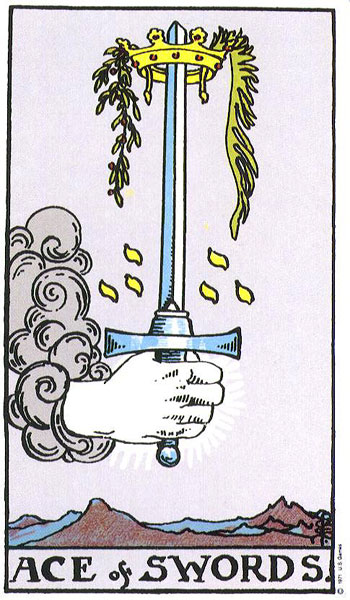
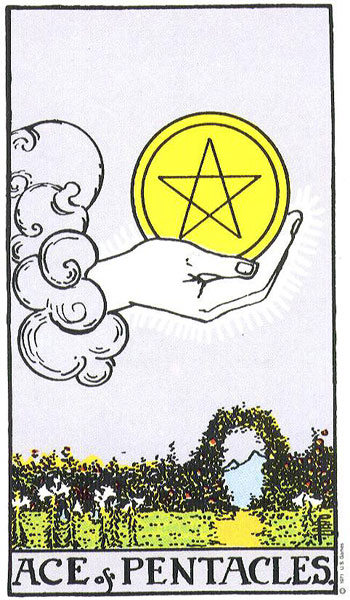
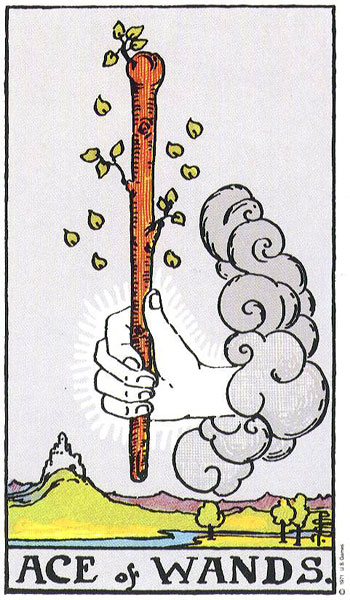
Each Ace takes the concentrated beginning and routes it through a different domain. The Ace of Wands expresses that opening through "initiative, creative energy, and purposeful action." The Ace of Cups runs it through "feeling, relationship, imagination, and emotional response." The Ace of Swords sends it through "thought, language, decisions, and conflict." The Ace of Pentacles grounds it in "work, resources, the body, routine, and material conditions."
These four lists do not overlap much. That is the point. If you drew the Ace of Wands and read it as a financial opening, you would be borrowing vocabulary that belongs to Pentacles. If you drew the Ace of Swords and read it as a romantic opening, you would be borrowing vocabulary that belongs to Cups. The suit is a constraint, and constraints help.
A useful exercise is to take any real-life beginning and ask which suit list it best fits. A new exercise routine fits Pentacles because of the body, routine, and material conditions. A new conversation that needs to happen fits Swords because of thought, language, and decisions. A new creative project fits Wands because of initiative, creative energy, and purposeful action. A new friendship or reconciliation fits Cups because of feeling, relationship, and imagination. Some beginnings will fit more than one suit, and that ambiguity is information rather than failure.
The Constructive Direction in Each Suit
Beyond the keyword lists, each Ace has a constructive direction, which the card data describes as the way the energy moves when it is being used well. These directions are not the same.
The Ace of Wands says the constructive direction is "directing energy toward work that matters." That is a call to apply initiative somewhere specific, not to start many things at once. The Ace of Cups says the constructive direction is "recognizing and communicating the emotional reality of a situation." That is a call to name what is actually being felt, and to share that naming. The Ace of Swords says the constructive direction is "using clear distinctions and honest communication." That is a call to draw lines carefully and speak without pretending distinctions are blurrier than they are. The Ace of Pentacles says the constructive direction is "building something useful through steady, observable practice." That is a call to do small, repeated, measurable work over time.
When the four directions are placed side by side, they describe four different labor models. Wands asks for focused effort. Cups asks for accurate feeling and honest speech about it. Swords asks for sharp thinking and clean wording. Pentacles asks for sustained routine. A reader can use this to ask which labor model is missing in a situation, rather than which card is "right."
Where the Reading Can Slip: Reversed Shadows
The card data treats reversal as the same underlying pattern with a problem attached. Each reversed Ace "may be blocked, internalized, or showing its shadow." The shadow content differs by suit, and these differences are where readers often overreach.
Reversed, the Ace of Wands risks "burnout, impatience, or effort without a stable direction." Reversed, the Ace of Cups risks "projection, avoidance, or becoming overwhelmed by an untested feeling." Reversed, the Ace of Swords risks "overthinking, rigid conclusions, or words used as weapons." Reversed, the Ace of Pentacles risks "scarcity fixation, stagnation, or treating measurable value as the only value."
These lists describe failure modes that genuinely differ. Burnout is not the same as stagnation. Projection is not the same as rigid conclusions. A reader who treats all reversed Aces as "things are stuck" has lost information that the card data was careful to preserve. A reader who treats all reversed Aces as "shadow work needed" has imported vocabulary that the supplied facts do not contain.
It is also worth recording what the data does not say. It does not say reversals are more likely under stress, or that certain readers interpret them differently, or that any suit is harder than another to read upright. A careful comparison leaves those gaps visible.
A Low-Stakes Example: Choosing Among the Aces
Imagine a reader has been offered a chance to join a small weekly writing group. Several Aces could describe this moment, and the suit you assign to it changes what advice you would give yourself.
If the situation reads as the Ace of Wands, the focus is initiative and creative energy. The constructive direction is to direct that energy toward work that matters, so the practical question is whether the writing group serves a project you actually care about. If the situation reads as the Ace of Cups, the focus is feeling, relationship, and imagination. The constructive direction is to recognize and communicate the emotional reality, so the practical question is what you are actually hoping to feel in the group, and whether you have said so out loud to anyone.
If the situation reads as the Ace of Swords, the focus is thought, language, and decisions. The constructive direction is to use clear distinctions and honest communication, so the practical question is whether your reasons for joining can survive being stated plainly. If the situation reads as the Ace of Pentacles, the focus is routine, time, and material conditions. The constructive direction is steady, observable practice, so the practical question is whether you can protect a weekly hour in a real calendar.
The same event produces four different reflective questions. None is more correct than the others in advance. The point of comparing the four aces across suits is to make those differences visible so you can pick the question that matches the part of the situation that is actually in motion.
Testing Competing Interpretations in Your Journal
When two suits both seem to fit a beginning, the supplied card data does not tell you which is "true." That is appropriate, because Tarot is not a prediction and the card descriptions do not claim to predict outcomes. What the data does offer is a way to test competing readings against evidence.
A simple journal method: pick a real beginning from the past week. Write which Ace fits it, and which Ace is the strongest alternative. Then list one observable fact that would support the first reading and one observable fact that would support the second. If the supporting facts are equally thin, that is itself a finding: the reading is underdetermined, and you should not act on it as if it were settled.
It helps to write down disconfirming evidence with the same care as confirming evidence. If you read a new exercise routine as the Ace of Pentacles, the disconfirming note might be that you have started three routines this year and not finished one. If you read a new conversation as the Ace of Swords, the disconfirming note might be that you are still avoiding the topic you said you would raise. A match that cannot survive one disconfirming observation was never a strong match.
Three questions that work across all four suits, drawn directly from the constructive directions in the card data:
1. What is the smallest step that would let you learn quickly whether this opening is real, rather than only imagined? 2. Which failure mode from the reversed descriptions feels closest to your actual risk, and what would you do to keep that mode from becoming the story? 3. Two weeks from now, what single observation would tell you whether the constructive direction is being honored or quietly abandoned?
These questions are deliberately small. The card data consistently uses language like "small beginning," "steady, observable practice," and "learn quickly," which signals that the Aces do not call for dramatic action. They call for careful, testable first steps.
Limits and What Tarot Cannot Tell You
Studying the four aces in tarot across suits is an exercise in how a single rank behaves under different conditions, and it produces a more honest reader, not a more certain one. Several limits are worth stating plainly.
The card data does not include timing, probability, or other people's intentions. It does not tell you whether a beginning will succeed, only what shape the beginning takes and what constructive direction is associated with that shape. For medical, legal, financial, safety, or crisis decisions, the right sources are qualified professionals and direct evidence, not a card reading.
The descriptions also do not justify using Aces for fortune-telling or for claims about another person's hidden motives. The reflective question on each card is addressed to the reader about the reader's own beginning. Staying inside that frame is what keeps the practice useful rather than speculative.
Finally, the four Aces share a tone described as "open." That word does a lot of work. It signals that the editor of these descriptions does not want the Aces read as fixed promises or fixed warnings. They are openings, and openings remain open until action and evidence close them one way or another. Holding that openness is the hardest part, and it is the part the card data keeps returning to.
Share this article