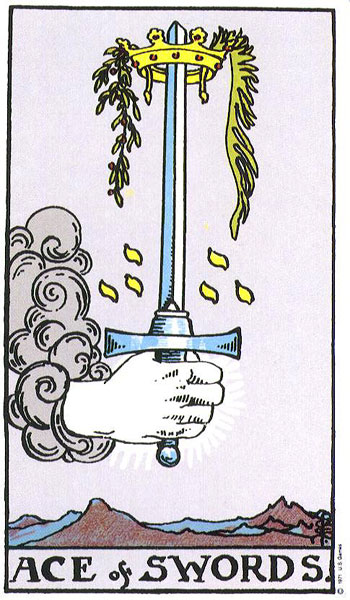
What This Card Marks
The Ace of Swords belongs to the Minor Arcana, and within that group it marks a concentrated beginning or opening, one that takes shape through thought, language, decisions, and the friction that often surrounds them. When you sit with this card for an ace of swords tarot card meaning, it is worth noticing that an Ace marks a starting point, not a finished insight. The card is a doorway, not the room. The room is the rest of the suit; the doorway is the moment one decides to step through.
A useful image here is the first sentence of a difficult email. Before that sentence, nothing has been asked or proposed. After it, even if the response is slow, the conversation has begun. The Ace of Swords tends to land on moments like that: a phone call you decide to make, a definition you write down, a boundary you name out loud, a question you stop avoiding. None of these are large in scale, but they all share the same shape. They convert an unformed possibility into something that can be addressed, argued about, refined, or sent.
This is also why the tone of the card is open rather than resolved. A beginning does not yet know what it will become. That openness is part of its meaning, and it is one of the things readers most often overlook when they want a quick answer.
Thought, Language, Decisions, and Conflict: The Wider Context
The suit of Swords concerns thought, language, decisions, and conflict across all its ranks. The Ace is the seed of that theme, not the full pattern. Keeping this distinction matters because an Ace is narrow and concentrated while the rest of the suit is broad and ongoing. A reading that treats the Ace of Swords as if it described someone's whole inner life is likely to overreach.
The wider context of thought and communication includes several layered activities. It includes noticing that two ideas are not the same. It includes choosing a word over a softer one because the softer one is misleading. It includes naming the real disagreement in a meeting rather than the polite disagreement. It also includes the friction that follows honest speech: the awkward silence after a truth, the small resistance from someone who preferred the confusion, the moment you wonder if clarity was worth the cost.
Because the suit is broad, an Ace can be a useful diagnostic. When you are unsure which thread to pull, the card often points to the earliest one. If you can locate the first sentence, the first decision, the first naming of the issue, you have usually found where the Ace is operating. The other elements of the situation will still be there, but they will be downstream of that one starting move.
To stay grounded, ask which of these activities is actually beginning in your situation. If nothing has begun, the card may be pointing toward what could begin if you let it. If several things have already begun, the Ace may be confirming the earliest, simplest one and asking you not to confuse it with the rest.
Reading It Upright
In its upright orientation, the Ace of Swords indicates a beginning expressed through clear distinctions and honest communication. Constructive use of the card looks like careful thinking, precise wording, and a willingness to make a decision and accept its consequences. It is less about being right and more about being clear.
A constructive upright reading often shows up as:
- A small decision that has been postponed and is now ready to be made. - A sentence or paragraph that names the actual issue for the first time. - A piece of writing that organizes scattered notes into a usable structure. - A conversation in which you say what you meant, without padding it.
The upright card does not promise that the beginning will be painless. Beginnings rarely are. It does suggest that the energy of the moment is on your side if you are willing to be precise. Honesty here is not cruelty. It is the difference between communicating and performing communication. When the reading fits, you can usually feel the difference: a sense that something has finally been said in a way that can be worked with.
Reading It Reversed
In its reversed orientation, the same pattern may be blocked, internalized, or showing its shadow. The themes of thought, decision, and communication are still active, but their direction has bent. A reversed Ace of Swords can mean the beginning is being delayed, the words are stuck in your throat, the thinking has gone circular, or the words are being used as weapons instead of tools.
Three shadow patterns are worth watching for:
- Overthinking. The beginning stays hypothetical because you keep refining it past the point of usefulness. - Rigid conclusions. A quick judgment hardens into certainty, and the openness of an Ace is lost. - Words as weapons. A clear sentence is written, but its purpose is to wound rather than to clarify.
A reversed reading is not a verdict. It is a prompt to notice which of these patterns fits and to ask what small adjustment would let the same energy move again. Sometimes the answer is to wait. Sometimes the answer is to speak more carefully. Sometimes the answer is to acknowledge that you do not yet have the words and that is acceptable too. The reversed card is also the easiest place to overinterpret, because any time you have struggled to say something, the pattern can seem to fit. Keep an eye out for ordinary hesitation and treat it as ordinary unless the situation clearly involves one of the three shadow forms above.
A Realistic Low-Stakes Example
Consider a familiar situation. You have shared a workspace with two colleagues for several months, and the small frictions have added up. One colleague interrupts you in meetings. The other borrows your equipment without asking. You have not said anything because you are not sure it is worth raising, and you are not sure what you would say.
This is exactly the kind of scene where the Ace of Swords can be useful. The card is not telling you to deliver a speech. It is pointing toward a small beginning that lives in thought and language. A constructive reading might be: write down the single sentence you wish you had said in the last meeting. That is the beginning. If the sentence is, "Please let me finish before you respond," you now have a sentence. If it is, "I would like equipment to be returned the same day," you now have a sentence.
A reversed reading might be that you keep revising the sentence in your head, rewriting it to sound softer, rehearsing it until it no longer sounds like you. Or you send it, but the words are sharp and aimed at the person rather than at the situation. Both are recognizably the same theme with a different bend.
The example is low-stakes because no one's health, safety, or livelihood is at issue. It is also realistic because most of the beginnings the Ace of Swords describes look like this: small, verbal, postponed. The card tends to mark where the work is, not where the drama is.
Where the Reading Can Go Sideways
Two misreadings come up often. The first is treating every Ace as if it were the same. Aces share the shape of a beginning, but each suit begins in a different element. A beginning in thought is not a beginning in feeling, and conflating them can lead you to act in the wrong register. If your situation is primarily emotional, the precise, clarifying tone of the Ace of Swords may feel cold, and another card may be a better fit.
The second misreading is mistaking planning for beginning. Writing a list is not the same as starting. Drafting an outline is not the same as speaking. The card marks the moment a thought crosses into action or expression, and a reading that only describes your internal process has not yet located the beginning. If you cannot point to a sentence sent, a decision made, or a word spoken, you may still be upstream of the card rather than at it.
It is also worth recording that this is not a prediction. Tarot is not a forecast, and no card can tell you what will happen tomorrow. What a card can do is describe a pattern that is already present in how you are thinking and speaking. If the pattern does not fit your day, the honest move is to set the card aside. A reading that insists it must fit despite your lived evidence has stopped being reflective and started being performative. Disconfirming evidence is just as informative as confirmation, and a journal that records both will be more useful over time than one that records only matches.
Journal Questions and Limits of Interpretation
One prompt to work with is the card's own question: What small beginning would let you learn quickly? It is a useful starting prompt because it constrains the answer to something you can act on this week. Large initiatives rarely allow quick learning. Smaller ones usually do.
A few additional questions you can verify in a journal:
- What is the one sentence I have been avoiding writing or saying? - Where did I confuse thinking about a decision with actually making it? - Have I been using clear language, or language that protects me from being clearly understood? - If I name the actual disagreement, what changes? - What would a one-sentence version of my situation sound like? - Where in the past week did I see the pattern fit, and where did it not?
A card meaning is only useful when paired with your own evidence. Record what fits and what does not. An apparent match is interesting; an apparent mismatch is often more informative, because it shows you where the card's pattern does not apply. Interpretation also has real limits. If your situation involves medical decisions, legal questions, financial commitments, safety risks, or emotional crisis, please rely on qualified professionals and direct evidence rather than on any reading. Tarot reflection supports clear thinking. It does not replace it.
Share this article