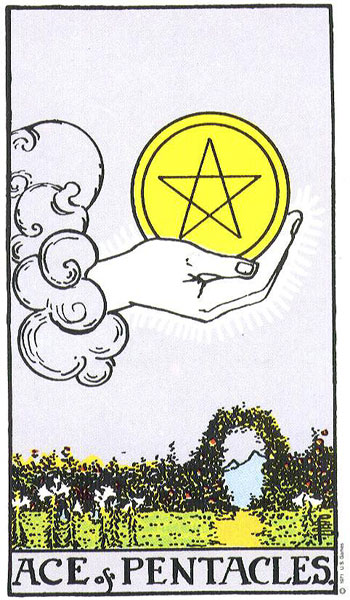
How to Begin Reading the Ace of Pentacles
The Ace of Pentacles is one of seventy-eight cards in a standard deck, and it sits within the Minor Arcana as the opening card of the Pentacles suit. Because it is the first rank in that suit, it carries the energy of a concentrated beginning rather than an established outcome. When readers ask about the ace of pentacles tarot card meaning, they are often really asking two questions at once: what kind of beginning is being marked, and whether it has the resources to grow. Holding these questions apart is the first practical step, because they have different evidence behind them.
A common shortcut is to treat any Ace as automatically lucky. The card data here is more modest. It points to a starting point in work, resources, the body, routine, or material conditions, and to a constructive direction that emphasizes steady, observable practice. Nothing in the supplied facts promises that the beginning will turn into a major result. The opening is the event; the outcome is a separate question for other cards, the wider spread, and the reader's own record of how similar projects have played out in the past.
Think of the card as a marker on a timeline rather than a verdict. It says: something is starting, and that starting has a practical shape. What you do with that shape is where interpretation, journaling, and real-world evidence all come in.
Beginnings Versus the Wider Work and Resources Story
It is easy to slide from the Ace into a generalized conversation about money, employment, or physical health. The Pentacles suit does cover work, resources, the body, and material conditions, but the Ace is the narrowest possible statement inside that suit. It is the seed, not the tree. The numbered cards that follow it describe what happens when that seed is cultivated, tested, or neglected, and the court cards describe the kinds of people who tend to handle material matters in characteristic patterns.
For this reason, an Ace of Pentacles appearance should rarely be read as a final answer about career or finances. It is more useful as a question prompt: where in your life is a small, concrete opening available right now. The constructive direction is to build something useful through steady, observable practice, which suggests that the value of the card is what you do with the next visible step, not how you feel about the reading.
A useful habit is to note, alongside the card, the smallest physical step that could be taken within a week. The card's own reflection prompt asks, "What small beginning would let you learn quickly?" That phrasing is worth taking seriously. A beginning you can learn from quickly is almost always small, concrete, and observable within days rather than months. If you cannot name one, the reading is probably pointing at a beginning that has not yet arrived, and the most honest note is "no current opening in this area." That kind of honest note is far more useful over time than a confident-sounding interpretation built on nothing.
Reading the Upright Meaning with Discipline
The upright description offered for this card is unusually clear about its limits. It is described as a concentrated beginning or opening expressed through work, resources, the body, routine, and material conditions, with a constructive direction that points toward building something useful through steady, observable practice. Each of those five domains is a possible landing place, and the reader's job is to choose the one that fits the question and the surrounding cards.
If the question is about work, the upright reading can point to a new project, role, or method that is genuinely starting rather than being imagined. If the question is about resources, it can point to a small, tangible inflow: a returned deposit, a tool purchased, a budget category opened. If it is about the body, it can point to a new physical routine or a first step toward a recovery plan. If it is about material conditions, it can point to a change in housing, equipment, or daily logistics. Routine is the fifth option and the easiest to miss: an opening can also be a reshaped habit, a cleared schedule block, or a new way of handling an existing task.
Because the constructive direction is steady and observable, the upright reading is best supported by evidence that can be checked. A short list works well: what was started, when, what was spent or committed, and what can be measured within a week. If the situation is too vague to log in that way, the reader should mark the reading as ambiguous rather than as a confident match. Ambiguity is a valid outcome, and recording it honestly makes future readings more accurate.
Reading the Reversed Meaning Without Inflating It
The reversed description is the same pattern as the upright, but turned inward or obstructed. It mentions blocked beginnings, internalization, scarcity fixation, stagnation, and the error of treating measurable value as the only kind of value. Each of those is a real possibility, but none of them should be read as a fixed fate.
A blocked beginning can be as simple as a form that has not been submitted or a conversation that has not been scheduled. An internalized beginning can be a plan the reader has been carrying privately without external support. A scarcity fixation is the mental habit of treating every resource question as an emergency. Stagnation is the absence of the small step that the upright reading would call for. The last option, treating measurable value as the only value, is the most subtle and often the most important: it is the trap of assuming that what can be counted is what counts.
When recording a reversed Ace of Pentacles, it helps to ask which of these five dynamics best fits the situation. Picking one is more useful than a vague sense that "things are off." It is also fair to note disconfirming evidence: moments in the same week when resources did flow, when a step was taken, or when the reader managed to act on something other than a measurable score. A reversal is rarely total, and a journal entry that records the counter-examples is closer to the truth than one that records only the gloom.
A Realistic Low-Stakes Example You Can Use to Test Your Reading
To make this concrete without relying on invented symbols, consider a workplace scenario that fits the supplied facts. Maya, a mid-career professional, draws the Ace of Pentacles while asking about a stalled side project. She has been wanting to learn a new reporting tool that her team will adopt next quarter. Her first reading is that the card marks a beginning in work, with a constructive direction of steady, observable practice.
She chooses the smallest visible step she can take in one week: thirty minutes a day for five days, blocked in her calendar, using the tool's free tutorial on real data from her current job. She logs the start date, the time spent, and one concrete output per day, even if it is rough. By the end of the week she has a working draft of a report and a clearer sense of where the tool fits.
The point is not that the card guaranteed success. The point is that the reading translated into a concrete beginning, and the beginning produced observable evidence in the form of logged minutes and a saved file. A week later, when she rereads her notes, she can see whether the opening was real and whether her practice matched the constructive direction the card suggested. If the project had not started, the entry would read differently, and that honest reading is just as valuable as a positive one.
Common Misreadings and a Journaling Method to Verify Them
Three misreadings come up often enough to be worth naming. The first is treating the Ace as a promise of wealth. The supplied facts describe a beginning in resources and material conditions, not a guaranteed outcome. The second is confusing the Ace with the Ten, which sits at the other end of the suit and would describe an established state of material security rather than an opening. The third is using the card to avoid a decision by waiting for more clarity, on the assumption that the Ace will resolve the question on its own. The data frames the constructive direction as practice, not as passive waiting.
A simple journaling method keeps the interpretation honest. After each reading, write three short entries. First, the smallest concrete beginning that fits the card, with a date. Second, the single piece of evidence that would confirm the reading within seven days. Third, the single piece of evidence that would disconfirm it. Reading the journal a month later usually shows which interpretations were anchored in the situation and which were projections from a hopeful mood.
The broader discipline is the same one the card itself describes. Tarot is a reflective tool, not a prediction, and it works best when it points the reader toward verifiable practice. Decisions about medical care, legal questions, finances, safety, and crisis situations belong to qualified professionals and to direct evidence, not to a card drawn in calm reflection. Used that way, the Ace of Pentacles can be a steady prompt to begin something small, observe what happens, and learn quickly from the result.
Share this article