What This Card Is Asking You to Look At
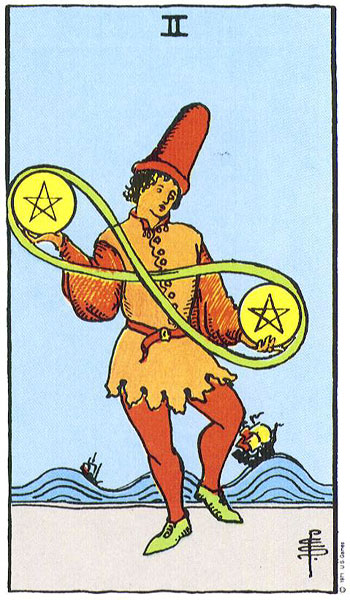
The Two of Pentacles tarot card meaning centers on a specific kind of moment: when you are trying to keep two practical options in view at the same time and feel the strain of deciding between them. The card belongs to the Minor Arcana, sits at the rank of Two, and falls within the Pentacles suit, which deals with work, resources, the body, routine, and material conditions. The number Two signals pairing or a balancing act, and the suit narrows that signal to the observable, day-to-day side of life rather than to feelings, beliefs, or long-range identity.
It is worth saying at the top: Tarot is not a prediction. No card can tell you which option you should pick, what another person is thinking, or what the market will do next month. A card like this one is best read as a structured prompt for reflection. It points to a pattern - holding two things at once - and asks whether that pattern is serving you or stalling you. Treat the reading as one input among several, and weigh it against real evidence: your calendar, your bank statement, your sleep, and the advice of people qualified to help in the domain you are weighing.
The card's tone is described as mixed, which is useful to notice early. A mixed tone means the situation is not a clean win or a clean loss. Something is being built, and something is being strained. Holding both observations at once is part of what the card is asking you to do, rather than a sign that the reading has failed to give you a clear answer.
The Shape of the Choice: Pairing, Not Multitasking
A common misreading is to treat this card as a signal for general busy-ness or for juggling many small tasks. The supplied material narrows it further. The card is not about doing many things at once. It is about a choice, a pairing, or an effort to keep two specific realities in view, expressed through work, resources, the body, routine, and material conditions. The plural is exactly two, not ten.
That distinction matters because a busy period and a genuine choice have very different remedies. A busy period usually wants better scheduling, delegation, or a quieter week. A genuine choice wants comparison, weighing, and often the courage to keep the two options distinct for a little longer rather than collapsing them into one prematurely. The card's own reflection question captures this: "What needs to be compared instead of prematurely combined?"
When the card shows up upright, its constructive direction is building something useful through steady, observable practice. Practice is the operative word. Whatever you choose, the card is gently suggesting that the value will come from what you do repeatedly and measurably, not from a single inspired decision. The choice itself matters, but the small actions that follow it matter more. A useful test: if you cannot describe the practice that would follow the choice, the card is asking you to slow down before you commit.
Work, Resources, and the Body in Practice
Because the suit is Pentacles, the choice lands in a material register. We are not being asked to weigh abstract values, relationship dynamics, or long-term spiritual directions. We are being asked to weigh things that show up in our time, energy, money, and physical capacity. That grounding is helpful. It means you can check the reading against fairly concrete evidence: how many hours you actually have, what the budget looks like, whether your sleep has changed, whether the routine you are considering is realistic on a Tuesday in November, not just on a hopeful Sunday morning.
The keywords attached to the card - a choice, resources, practice, material conditions - reinforce this. Notice that the keyword is not "balance." Balance is one way the choice can go, but the card itself is more neutral than that. It simply marks the moment of holding two practical realities and asks you to look at how you are doing it.
A practical implication: if the card appears when you are facing a decision, the most useful follow-up questions are practical ones. Which option uses your resources more sustainably? Which one leaves room for the body to recover? Which one has a feedback loop - a way for you to learn whether it is working within a few weeks? A choice that can be observed and adjusted is a better fit for this card's constructive direction than a choice that demands a leap of faith with no review window.
A Low-Stakes Example: The Two Calendar Problem
Imagine someone who has been offered a part-time evening course that would build a useful skill, and who is also considering taking on a small freelance project that would bring in some extra money over the next two months. Both options are reasonable. Both use Tuesday and Thursday evenings. Neither is a crisis. This is the kind of small, two-realities moment the Two of Pentacles is built to point at.
Using the card here does not mean flipping a coin. It means slowing down and asking: what needs to be compared, not combined? The course and the freelance project are not the same thing. They are not interchangeable units of "Tuesday evening." The course has a curriculum, a cohort, a fixed end date. The freelance project has a deliverable, a payment, an open timeline. Combining them mentally as "two things I want to do" can hide the fact that they ask for different resources, and that the body cannot sustain both on the same evening in the same week.
A useful second pass is to ask which option has the stronger feedback loop. With the course, the feedback is built in: assignments, peers, a clear end point. With the freelance project, the feedback is mostly financial and arrives at the end. If practice and observable learning matter right now, the card's constructive direction points toward the option that gives more frequent, smaller signals about whether it is working. That is the kind of grounded comparison the card is asking for, not a mystical preference for one path over another.
Reversed: When the Pattern Stalls
The reversed Two of Pentacles is not automatically a warning. The supplied material says the same pattern may be blocked, internalized, or showing its shadow. The word "may" is doing real work here. Reversal can mean many things, and the reader is responsible for checking which one fits.
Three shadow expressions are named in the card data. The first is scarcity fixation: the feeling that there is never enough, no matter what is chosen, so the choice feels paralysing rather than freeing. The second is stagnation: a sense that the two options have stopped being a real choice and have settled into a loop, where the weighing has become the activity rather than the choosing. The third is treating measurable value as the only value: collapsing the comparison to money or hours alone, and ignoring quieter signals like energy, learning, body, and meaning.
If the card lands reversed in a reading, the work is to look at which of these three, or what combination, is present, and to look for the disconfirming evidence. Disconfirming evidence matters as much as confirming evidence. If you suspect scarcity fixation, the question is whether there is actual scarcity in your resources right now, or whether the feeling of scarcity is preceding the facts. If you suspect stagnation, the question is whether the two options are still genuinely different, or whether you have already chosen in your head and the loop is a delay tactic. If you suspect that measurable value has crowded out other kinds of value, the question is which non-measurable factor you have been discounting, and what it would take to put it back in the weighing.
Recording where the shadow pattern does not fit is part of an honest reading. A reversed card that prompts a careful inventory of your week, and that turns out to point at one specific bottleneck rather than a global sense of stuckness, is still doing useful work.
A Plausible Misreading to Watch For
A plausible misreading worth naming directly: assuming the card tells you which option to pick. The card does not do that, and the supplied material does not support that reading. The Two of Pentacles points at a pattern of holding two realities, asks what needs to be compared, and notes that the constructive direction involves steady practice. None of that is a directive. It is a frame, and a frame is most useful when you keep filling it with your own evidence.
A second misreading is treating the reversed meaning as a verdict on the reader's character. "You are scarcity-fixated" is not a fair paraphrase of the card. The card names a possible shadow pattern; the reader's job is to check whether it applies, and to record where it does not. Treating any card as a label on a person is a habit worth avoiding in any reading, and this card is no exception. Shadow patterns are observations about a moment, not personality diagnoses.
A third misreading is overgeneralising from the suit. Pentacles is associated with work, resources, the body, routine, and material conditions, but the association is not a wall. A reading about a relationship decision can still be touched by Pentacles if the relationship question is entangled with time, money, shared space, or living conditions. The suit narrows the lens; it does not fence off the topic. Over-applying the suit boundary can make a reading feel stricter than the card actually is.
Journal Prompts to Verify in Your Own Notes
These prompts are designed to be answered in writing, slowly, with evidence beside them. The goal is to use the card as a structured prompt, not as an oracle.
1. Where in my current week am I genuinely keeping two practical options in view, and where am I conflating many small things into a single vague sense of being busy? 2. For each of the two realities, what is the smallest observable signal that would tell me, within two weeks, whether the choice is working? 3. What would I be comparing if I kept these two options separate for one more week, instead of trying to combine them into a single plan? 4. If I suspect a shadow pattern (scarcity fixation, stagnation, or measurable-value-only), where is the disconfirming evidence in my notes? What would that evidence look like if I went looking for it on purpose? 5. What would the constructive direction actually look like in my week, written as specific time blocks rather than as a feeling?
For any decision that involves medical, legal, financial, safety, or crisis-level stakes, the card is not the right tool. Use qualified professionals, official sources, and direct conversation with the people involved. The Two of Pentacles is a prompt for reflection on practical, day-to-day choices, and it works best when the reader keeps the rest of their evidence on the table.
Share this article