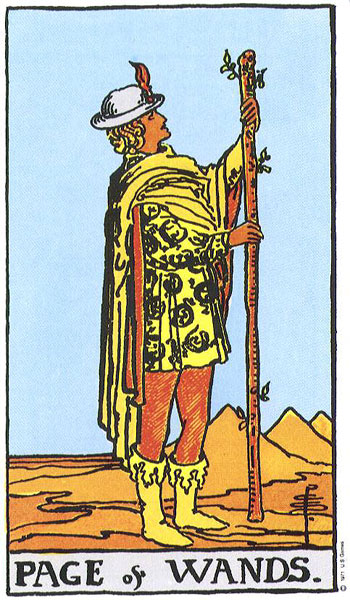
Two Adjacent Ranks, Two Different Tasks
When people compare tarot pages vs knights, they often look for a simple contrast: a beginner and a doer, a learner and a runner. The supplied card data offers something more precise. Pages carry an upright meaning centered on curiosity, a message, and learning through direct contact, while Knights carry active pursuit and the strengths and costs of momentum. These are not stages in a sequence; they are different orientations toward the same suit's themes. A Page is the part of you that wants to know what something feels like in the hand. A Knight is the part of you that has already decided to ride.
That difference matters because the same keywords appear in both ranks. Initiative, creativity, and action are listed on the Page of Wands and the Knight of Wands. Feeling, relationship, and imagination appear on the Page of Cups and the Knight of Cups. Thought, decision, and communication appear on the Page of Swords and the Knight of Swords. Resources, practice, and material conditions appear on the Page of Pentacles and the Knight of Pentacles. What shifts between Page and Knight is not the topic but the relationship to it. The Page makes contact; the Knight commits to motion.
A note on framing: this comparison is interpretive. The meanings that follow are one reading among several. Tarot is not a prediction, and a court card in a spread is not a forecast about a real person. The goal here is to offer a useful way to look at the eight cards in this set, and to record where that lens holds and where it slips.
Why Suit Context Reframes the Court Cards
Reducing any Page or Knight to a young person or an active person strips the card of its suit context. A Page of Wands and a Page of Swords are both curious learners, but they are curious about different things. According to the supplied upright meanings, Wands expressions run through initiative, creative energy, and purposeful action, while Swords expressions run through thought, language, decisions, and conflict. Curiosity in Wands wants to make something. Curiosity in Swords wants to understand and articulate.
The same applies to Knights. The Knight of Wands is described as moving with initiative and creative energy, with a constructive direction of directing energy toward work that matters. The Knight of Pentacles, by contrast, expresses the same pursuit through work, resources, the body, routine, and material conditions, with a constructive direction of building something useful through steady, observable practice. Both move; one moves toward the spark, the other moves toward the harvest.
This suit dependency also changes what a reversal means. The data describes reversed Pages and Knights as the upright pattern blocked, internalized, or showing its shadow, but the shadow itself is suit-specific. A reversed Page of Wands may show as burnout or impatience; a reversed Page of Cups may show as projection or avoidance; a reversed Page of Swords may show as overthinking or rigid conclusions; a reversed Page of Pentacles may show as scarcity fixation or stagnation. A reversal is not a generic warning. It is the suit's own quality turned back on itself, and the court rank determines whether that turn shows up as hesitation or as momentum that has lost its center.
Two interpretations worth holding at once: court rank can describe a temporary role the reader is playing, and it can describe a quality the reader is trying to grow. Neither reading is privileged in the card facts. Readers who treat court cards as roles will weight situation and context; readers who treat them as qualities will weight practice and growth. Both are workable.
Pages in Practice: Curiosity That Touches the Material
The upright Page in this dataset is paired with the same reflection prompt across suits: what could you approach as a student rather than an expert. That repetition is a clue. Pages are not asking whether the reader is qualified. They are asking whether the reader is willing to be a beginner in a specific domain.
Consider how this plays out suit by suit. The Page of Wands approaches creative work with curiosity and initiative, learning through direct contact with the material. Its constructive direction is to direct energy toward work that matters. The Page of Cups approaches feeling and relationship with curiosity, learning through emotional response and imagination. Its constructive direction is to recognize and communicate the emotional reality of a situation. The Page of Swords approaches thought and communication with curiosity, learning through language and decisions. Its constructive direction is to use clear distinctions and honest communication. The Page of Pentacles approaches resources and routine with curiosity, learning through steady, observable practice. Its constructive direction is to build something useful.
What ties them together is contact. A Page who only reads about Wands has not met the Page of Wands. A Page who only theorizes about Cups has not met the Page of Cups. The cards describe learning as something that happens in the hand, on the page, in conversation, on the floor of a workshop. That is why direct contact appears in the upright definition and why a reversed Page is described as having that contact blocked or internalized.
One useful interpretation choice: a Page in a spread can point to a message more than a person. The keywords list a message as a central feature of Pages. That is worth taking seriously. Sometimes the card is asking the reader to notice a small piece of information that has just arrived, not to recruit a new identity.
Knights in Practice: Momentum and Its Costs
The Knight upright meaning in this set is described as active pursuit and the strengths and costs of momentum. The reflection prompt paired with Knights is where is movement useful, and where is it outrunning judgment. Knights are not told to stop. They are asked to notice which of their motions are useful and which are ahead of their own thinking.
Suit context reshapes the question. The Knight of Wands is asked whether creative initiative is moving toward work that matters or simply toward the next thing. The Knight of Cups is asked whether emotional pursuit is keeping pace with what is actually felt, or whether feelings are being chased faster than they can be named. The Knight of Swords is asked whether decision-making and argument are moving with clear distinctions or outrunning them. The Knight of Pentacles is asked whether routine and resource use are building something observable or just keeping busy.
The cost of momentum is in the card data. Reversed Knights share the suit's shadow language. A reversed Knight of Wands can show as burnout, impatience, or effort without a stable direction. A reversed Knight of Cups can show as projection or avoidance. A reversed Knight of Swords can show as words used as weapons. A reversed Knight of Pentacles can show as stagnation. Notice that the last one is interesting: in Pentacles, lost momentum does not speed up, it stalls. The shadow follows the suit.
Another interpretation choice worth holding: a Knight is not automatically a recommendation to act. The upright meaning describes a quality, not a prescription. There are moments when the most honest Knight reading is that the reader already has enough momentum and the question is whether to slow down. The reflection prompt supports that reading. It does not assume motion is the answer.
A Low-Stakes Example: Choosing a Skill to Learn
A useful way to test these cards without turning them into prediction is to pick a low-stakes situation and see what each rank would ask. Suppose the reader is considering learning to bake bread on weekends. A Page reading and a Knight reading will point to different things.
Under a Page lens, the question is how to approach as a student. The Page of Wands would invite curiosity about creative expression: trying a new shaping technique, a different flour, an unusual hydration. The Page of Cups would invite attention to feeling: noticing what the process does to mood on a Saturday morning. The Page of Swords would invite clarity of language: reading recipes carefully, distinguishing between terms like shaggy and smooth, and asking what each step actually changes. The Page of Pentacles would invite contact with the material: weighing flour by feel, learning what dough sounds like when it is ready, building a routine that the kitchen can hold.
Under a Knight lens, the question is about momentum. The Knight of Wands would ask whether the reader is treating baking as a creative outlet or as a way to chase the next loaf trend. The Knight of Cups would ask whether the emotional payoff of a good crumb is driving choices that the appetite cannot actually sustain. The Knight of Swords would ask whether the reader is making decisive choices about recipes or arguing with themselves about which book to trust. The Knight of Pentacles would ask whether practice is producing something steady and edible, or whether the routine is becoming a different kind of work.
Both lenses are valid. They can also contradict each other. The Page of Wands encourages trying many things; the Knight of Pentacles encourages doing one thing enough times to learn it. That tension is not a flaw in the cards. It is the point. Tarot is not a prediction, and a court card reading is not a single instruction. It is one quality among several the reader can choose to develop.
There is also disconfirming evidence to record. Not every reader will find a clear Page or Knight quality in their week. Pulling the Page of Swords when the reader is not studying language or making decisions can feel like a mismatch. That mismatch is part of the reading. The card may be pointing to a small message, to a quality the reader has not noticed yet, or it may simply not fit the moment. Honesty about the fit is part of how the cards stay useful.
Journal Questions and the Limits of Any Card Meaning
The reflection prompts in the card data are starting points, not conclusions. They are designed for journal use because journal use keeps the reader in charge of the interpretation. A few questions that can be verified against a week of notes:
- What did you approach as a student this week, and what did you already consider yourself expert in? Where did the expert posture cost you? - Where did you notice a small message or piece of information that you almost dismissed? - Where did momentum help you, and where did it outrun your judgment? - What did you build through steady, observable practice, and what did you start without finishing? - Which suit shows up most often in your reflections, and what does that suit's shadow look like when it is blocked?
These questions can be answered with evidence: notes, receipts, calendar entries, and conversations. Tarot is not a prediction, so the value of the cards is not in telling the reader what will happen. The value is in offering a vocabulary for noticing what is already happening, and a structured way to reflect on it.
There are limits. Court cards are sometimes read as describing people, but the supplied data does not support mapping a Page to a child or a Knight to a young man, nor any other identity claim. The cards describe qualities and constructive directions; they do not describe ages, genders, or fixed roles. There are also moments when the same card will not fit. That is also a limit, and worth recording. A reflection prompt is offered by the card, not enforced by it. The reader's notes on where a card did not fit are as part of the reading as where it did.
For medical, legal, financial, safety, or crisis decisions, real evidence and qualified professionals remain the standard. Tarot can offer a reflective frame; it cannot offer diagnosis, counsel, or warning. Keeping that boundary clear is part of what keeps the practice honest.
Share this article