The Stable Spine of the Five
When you read the **fives in tarot across suits**, the first thing to notice is how much the four cards share. Each Five is described as friction that exposes a weak assumption or unmet need. Each carries the same tone marker: a pause. Each closes with the same reflection question: "What is the disagreement, loss, or pressure revealing?" That shared architecture matters, because it lets a reader see the differences between suits as variations on a single underlying process rather than as four unrelated cards that happen to share a numeral.
In other words, the number Five is not a topic. It is a structural cue. It tells the reader to slow down, to register that pressure is present, and to ask what assumption is being tested. The suit then tells the reader where that pressure lives and what kind of corrective movement is constructive. Reading the Fives as a set is one of the cleanest ways to see number and suit working together rather than competing.
This is also why two readers can look at the same Five and walk away with very different stories. The shared pattern is the same. The reader's task is to figure out which domain the friction is actually showing up in, and that depends on context, not on inherited tradition. The shared language is a tool for that work, not a substitute for it.
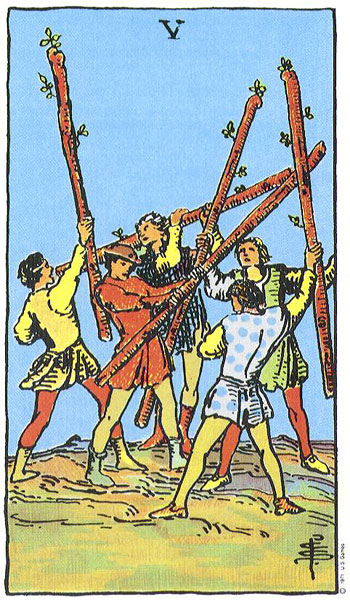
Five of Wands: Friction in the Action Domain
The Wands Five places friction inside initiative, creativity, and purposeful action. The constructive direction offered by the card is directing energy toward work that matters. Read together, this suggests that when the friction appears here, the weak assumption tends to live in what someone is doing or trying to start. The unmet need is for effort to land somewhere real rather than scatter in many directions at once.
Reversed, the same pattern may be blocked, internalized, or showing its shadow through burnout, impatience, or effort without a stable direction. Notice that reversed does not simply turn the card into a "good" meaning. It points to the same friction, only expressed through depletion or restlessness instead of visible disagreement. A reader who treats reversed as automatically opposite will lose information, because the corrective direction in Wands still applies: effort needs somewhere to land.
A useful question in Wands is whether the action itself is the problem or whether the absence of direction is. Two situations can look identical from the outside and still call for very different responses, and only context can distinguish them.
Five of Cups: Friction in the Feeling Domain
The Cups Five places friction inside feeling, relationship, imagination, and emotional response. Its constructive direction is recognizing and communicating the emotional reality of a situation. Here, the weak assumption is more likely about what someone has been telling themselves they feel, or what they have been avoiding feeling. The unmet need is for the inner picture to be acknowledged honestly rather than smoothed over.
Reversed, the card can show projection, avoidance, or becoming overwhelmed by an untested feeling. An untested feeling is one that has not yet been checked against what is actually happening. Two readers can land on very different interpretations here depending on whether they treat the reversed state as suppressed feeling or as flood. Both readings stay inside the same architecture. They differ on which corrective move is being asked for: careful expression, or careful pausing.
A useful question in Cups is whether the emotion is the friction or the report of the friction. Someone reporting sadness is not necessarily sad; someone reporting calm is not necessarily untroubled. The card invites the reader to test the report rather than to repeat it.
Five of Swords: Friction in the Thinking Domain
The Swords Five places friction inside thought, language, decisions, and conflict. Its constructive direction is using clear distinctions and honest communication. The weak assumption in this suit is usually a category error, a word being used to mean two things at once, or a conclusion that has hardened before the evidence was checked.
Reversed, the same friction can surface as overthinking, rigid conclusions, or words used as weapons. The reversal is not "less conflict." It is conflict turned inward, where thinking and speaking become the site of pressure instead of the visible disagreement itself. A reader who records this distinction can compare it to actual events later rather than assume the reversal softened the outcome.
A useful question in Swords is what word is being asked to do too much work. If a single term is being asked to cover several different situations, the friction often lives in that conflation, and the corrective move is to separate the meanings before deciding.
Five of Pentacles: Friction in the Material Domain
The Pentacles Five places friction inside work, resources, the body, routine, and material conditions. Its constructive direction is building something useful through steady, observable practice. The weak assumption here is often that a resource is missing when, on inspection, the gap is in how resources are organized or in what is being measured as valuable.
Reversed, the pattern can show scarcity fixation, stagnation, or treating measurable value as the only value. This is a useful warning: a reversal in Pentacles is not a guarantee of material improvement. It can mean the person has begun to overvalue what can be counted and discount what cannot.
A useful question in Pentacles is what the friction looks like when measured over a week rather than a day. Many material frictions shrink or grow depending on the time window chosen, and the card's constructive direction of steady, observable practice is a method for choosing that window honestly rather than reactively.
Testing Competing Readings in Real Context
Because the four Fives share so much language, competing readings usually differ on which suit's lens fits best, not on whether friction is present. A practical way to test is to write the friction in plain language first, without naming the suit, and then ask which domain the friction is showing up in: action, feeling, thought, or material conditions. If two suits both seem to fit, the reader should note which lens is producing a more useful next step, not which one is "true," because the cards do not provide a truth claim here. They offer a structure for naming pressure.
A short low-stakes example: imagine a small volunteer group keeps missing meetings. A reading that lands on the Swords Five would emphasize unclear language about who owns which task and would suggest the corrective move is making distinctions explicit. A reading that lands on the Pentacles Five would emphasize that the scheduling pattern does not match members' actual availability and would suggest adjusting the structure. A reading on the Wands Five would focus on whether the group has lost a sense of shared purpose and would suggest re-aligning effort. A reading on the Cups Five would focus on unspoken disappointment that no one has named.
None of these is automatic. The reader's job is to record what evidence supports each lens and what evidence cuts against it, and to revisit the record after a week. A second reader might disagree with the first reader's suit choice. That disagreement is useful, not a failure. It is a chance to ask which domain the friction was actually showing up in once the week has passed, and the disagreement becomes data rather than a verdict.
The honest way to handle ambiguity is to write it down, not to resolve it. A reading where every suit seemed plausible is itself information. It often means the friction is general rather than domain-specific, and the corrective move is to pick one domain and watch what happens.
What Journaling Can and Cannot Show
Journaling after a reading is the simplest way to record both apparent matches and disconfirming evidence. Useful prompts for any of the Fives include:
- What was the friction described in plain language before the suit was named? - Which suit's domain did the friction actually appear in over the next week? - What evidence would have falsified the reading, and did that evidence appear? - What did the reversed state actually look like, if it appeared: blocked, internalized, or showing its shadow? - Was the constructive direction offered by the card (work that matters, emotional honesty, clear distinctions, steady practice) the move that helped, or was a different move what helped?
Tarot is not a prediction. The cards do not state what will happen. They offer a structure for noticing what kind of pressure is present and what assumption may be untested. For anything involving medical decisions, legal questions, financial risk, personal safety, or crisis situations, the right source of guidance is qualified professional help, not a card layout.
The discipline of recording ambiguity alongside apparent matches is what turns a reading into something the reader can learn from rather than something the reader is asked to trust on faith. Without that discipline, the same Four Fives can be made to mean whatever the reader wants them to mean. With it, even a reading that looks like it did not land becomes a record of what was tried, what was noticed, and where the next read can begin more honestly.
Share this article