What Stays the Same Across the Four Tens
When you encounter the tens in tarot across suits, the same backbone runs through all four cards: completion, accumulated consequences, and a transition into a new cycle. Each card also ends with the same reflective question, "What has reached capacity, and what should happen after closure?" This shared scaffold is the part of the reading you can lean on even when the suits differ sharply in mood and direction.
The "pause" tone is also shared across the set. None of the four Tens describe a card that pushes you forward recklessly or pulls you backward anxiously. Each asks you to register what has finished and to consider what comes next with intention. A reader can use this stable layer as a baseline for any comparison, since it tells you what the number alone contributes before the suit begins to color it.
What Changes by Suit
The differences live in the suit's domain. Wands shape the shared pattern through initiative, creative energy, and purposeful action. Cups shape it through feeling, relationship, imagination, and emotional response. Swords shape it through thought, language, decisions, and conflict. Pentacles shape it through work, resources, the body, routine, and material conditions. The number stays the same; the medium changes, and with it the texture of what "completion" actually means.
This is the comparison that matters in practice. A reader who notices only the Ten pattern will say, "Something is finishing." A reader who notices the suit will say, "Something is finishing, and the question is what kind of something." The added precision is what makes the comparison useful rather than repetitive, and it is also what allows two readers to disagree productively about the same spread.
Suit by Suit: Where Each Ten Lands
The four suit-specific readings below follow the same template: constructive form, then shadow form, then a comparison with the other suits. Reading them in order is one way to build a stable mental map of how the Ten pattern changes its texture. The aim is not to memorize four separate interpretations but to see how each suit adds a different layer to the shared scaffold.
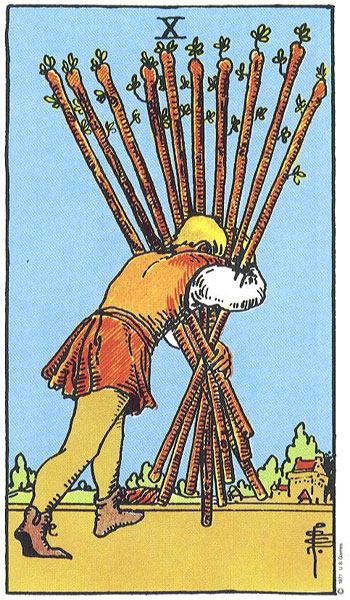
The Ten of Wands and Initiative
In its constructive form, the Ten of Wands points toward directing energy toward work that matters. Completion here means an initiative has run its course, and accumulated consequences sit with the effort you chose to take on. The next cycle, when it comes, will be shaped by what you do with that energy now, and the reflective question lands squarely on initiative: what do you want to start, and what have you outgrown?
In its reversed or shadow form, the same pattern may show as burnout, impatience, or effort without a stable direction. Here the comparison with the other Tens becomes instructive. Wands reversed is specifically about action that has lost its anchor, while Swords reversed is about thinking that has lost its anchor, and Cups reversed is about feeling that has lost its anchor. The shared "blockage" sounds alike until the suit gives it texture and tells you which faculty has been overtaxed.
The Ten of Cups and Emotional Reality
For Cups, the constructive direction is recognizing and communicating the emotional reality of a situation. The Ten's completion pattern expresses itself through feeling and relationship, so what has "reached capacity" is usually a chapter of emotional life rather than a project or a plan. The transition into a new cycle asks what shape your inner world will take next and who will be part of it.
The shadow form may appear as projection, avoidance, or becoming overwhelmed by an untested feeling. Compared with the Ten of Wands shadow, the strain is internal rather than driven by external load. The reader can use this contrast to notice whether pressure is coming from demands on time and effort, as with Wands, or from demands on the heart and the imagination, as with Cups. Both feel heavy, but the comparison points toward different remedies.
The Ten of Swords and Clear Thought
Swords express the Ten pattern through thought, language, decisions, and conflict. Its constructive form is using clear distinctions and honest communication, which is a quieter kind of completion than Wands or Cups might suggest. Here closure arrives through naming what is actually true, including truths that may be uncomfortable to articulate.
The reversed form may surface as overthinking, rigid conclusions, or words used as weapons. Reading Swords next to Cups is especially clarifying. Swords reversed is about conclusions that have calcified, while Cups reversed is about feelings that have not been tested. Both can look like stubbornness from outside, but the comparison distinguishes them and tells the reader whether to loosen a thought or to test a feeling.
The Ten of Pentacles and Steady Practice
Pentacles frame the same pattern through work, resources, the body, routine, and material conditions. The constructive direction is building something useful through steady, observable practice. Completion here tends to mean a material chapter has ended: a job, a budget cycle, a household arrangement, a physical routine, a savings goal, or some other concrete structure.
The shadow form can include scarcity fixation, stagnation, or treating measurable value as the only value. Against the Ten of Wands, Pentacles reversed points less to overwork and more to the trap of measuring worth by outputs alone. The difference is often the part that helps a reader reframe their next step, since Wands asks about initiative while Pentacles asks about what the initiative is producing and at what cost to the rest of life.
Read together, the four suit descriptions build a single picture: every Ten involves closure, and every Ten asks the reader to redirect rather than simply stop.
A Worked Example With Competing Interpretations
Suppose someone draws the Ten of Cups upright and the Ten of Pentacles reversed in a spread about a household decision. Both cards carry the shared completion pattern and the same reflective question. The first impulse might be, "Two endings, two fresh starts." That reading is not wrong, but it is thin, and a second reader could just as easily emphasize the contrast between Cups and Pentacles and arrive at a different emphasis.
A more careful reading notices that Cups points toward relationship and feeling, while Pentacles reversed points toward material conditions in shadow. The Ten-level completion in Cups suggests an emotional chapter has reached capacity; the Ten-level completion in Pentacles suggests a material chapter has too, but with a scarcity or stagnation flavor. Reading them side by side, the comparison points toward a transition that involves both inner and outer reorganization, with a risk of measuring the relationship by what it produces rather than what it means.
A second reader might emphasize Cups and downplay Pentacles reversed, or do the reverse, and a third reader might focus only on the shared pause tone. The comparison holds multiple readings open, which is healthier for a reflective practice than picking one too quickly. Tarot is not a prediction, so none of these interpretations should be treated as a forecast. All of them should be tested against the reader's own evidence over the following days.
Keeping a Verification Journal
One way to test competing readings is to write the alternative interpretations down before you know which fits. Note the suit, the shared Ten pattern, and at least two suit-specific readings, even ones you doubt. Then, over the following days, observe what actually happens. Record observations that match, observations that match only with effort, and observations that disconfirm. Disconfirming evidence is at least as valuable as confirming evidence, because it tells you where the comparison broke down and where your initial assumptions were too narrow.
Questions worth keeping in the journal include the following. Which suit domain did the day mostly live in: action, feeling, thought, or material conditions? Did the "pause" tone fit, or did the day press forward without a clear closure? Did the suit-specific shadow apply, or did a different suit's shadow appear instead, suggesting that your reading misidentified the dominant strain? Did the reflective question lead to a useful next step, or did it feel abstract and hard to apply?
Recording both apparent matches and apparent misses trains you to read the four Tens as a comparison set rather than as four separate cards that happen to share a number. Over time, the shared pattern becomes a stable reference, while the suit-specific texture becomes more legible, and your confidence in either layer can be calibrated against what you actually observe.
Limits of Any Single Reading
Any comparison of the Tens will leave ambiguity. The four cards share so much language that a reader can easily collapse them into one card, losing the suit-specific texture that makes the comparison useful. They also differ enough that two readers can produce opposite interpretations from the same spread, as the worked example shows, and a single reader can do the same on different days.
Treat the comparison as a way to ask better questions, not as a way to arrive at one correct answer, and treat the cards as prompts for reflection rather than as sources of prediction. For decisions about health, safety, money, legal matters, or crisis situations, rely on qualified professionals and direct evidence rather than on a Tarot reading. The Tens are best used as prompts for reflection, grounded in the reader's own life and verifiable in a journal. Tarot is not a prediction, and no comparison of cards replaces careful thinking about real conditions.
Share this article