What This Card Traditionally Shows
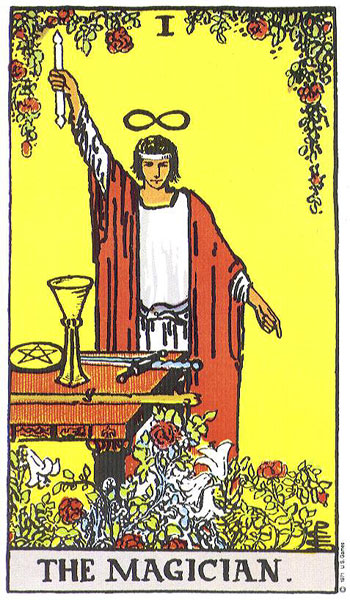
When people discuss the magician tarot card meaning in classical decks such as the Rider–Waite–Smith tradition, the imagery is usually consistent even though painters differ. A single figure stands at a table holding a wand or rod raised toward the sky, with one hand pointed down to the earth. On the table lie the four suit emblems: a cup, a pentacle, a sword, and a wand. Above the figure hovers an infinity sign or lemniscate, and around the shoulders a cloak of red and white or another contrasting pair. The ground is sometimes a garden, sometimes bare.
These symbols are not secret codes. They are prompts. The upright posture and the hand-to-hand gesture suggest a link between what is above (a goal, an idea, an available resource) and what is below (the actual material situation you are in). The four suits on the table signal that the ordinary resources of daily life — feelings, practical matter, intellect, and creative drive — are present. The infinity suggests something ongoing rather than a single trick.
For reflection purposes, treat the picture as a checklist. It asks: what tools are already on your table, and where is your attention going right now?
Upright Meaning for Reflection
Upright, The Magician reads as focused agency. The card does not promise magic in the literal sense. It points to the moment when you bring skills, tools, and attention together into one deliberate act, rather than letting them drift in different directions.
The brief supplied for this guide frames it that way: bringing available skills, tools, and attention into one deliberate act. The keyword list names agency, focus, and resources. So a useful starting question is: which resource is already within reach, and what specific action could use it?
That phrasing matters. It is concrete. It asks you to identify one resource and one action. Vague resolutions like "I should be more focused" do not survive contact with the day. A specific resolution — "I will use my afternoon quiet hour to outline the proposal using the notes I already have" — does.
A second prompt worth carrying: what is in the way of alignment? The figure is standing upright, with both arms extended. If your attention is on a goal but your actual workday is filled with unrelated tasks, the gap is the message, not the goal. The card, used reflectively, draws your eye to that gap rather than to a forecast.
Reversed Meaning for Reflection
Reversed, The Magician does not flip into "bad". It asks the same question from a different angle. Effort may be scattered, performative, or disconnected from the resources actually available.
Scattered means attention is fragmented: many small starts, none carried through. Performative means the visible action is shaped for an audience rather than for the work itself — long planning sessions that produce no draft, careful social media posts about a project that has not begun. Disconnected from resources means using tools or narratives that do not match what you actually have access to.
A reflective prompt for the reversed card: which of these three patterns am I doing this week? Then write down a recent instance of each. For example: I started four small tasks and finished none — that is scattering. I spent time describing a plan publicly without taking the smallest private step — that is performance. I described myself as a person with connections I do not actually have — that is disconnected from real resources.
The reversed card does not need to be dramatic. In most weeks it shows up as a small mismatch between gesture and ground, and that is plenty to work with.
A Grounded, Low-Stakes Example
Consider Maya, who pulled The Magician upright while thinking about a move from her current job to freelance work. The upright position suggested focused agency. The card did not promise the move would go well. It prompted her to look at what was already on her table.
Maya listed, in a notebook, what she actually had: two steady clients from her current contract, a list of past colleagues who had referred work to her, six months of savings set aside, and one specific skill she was regularly complimented on. The card's question — which resource is already within reach, and what specific action could use it — translated, in her case, into a single action: send three short emails this week to the colleagues listed, asking if they knew anyone who needed her specific skill.
That action was small, specific, and used an actual resource. It did not depend on a sudden break. After two weeks, one of those emails led to a conversation that became a paid project. The card, if you are keeping score as a reflective tool rather than a prediction, would call that a match: a focused agency moment that produced a traceable result.
Now consider the disconfirming case. Suppose Maya had done the same reflection, written out the same list, but had chosen a different action — redesigning her website for two months. The card would still read as upright. The interpretation would still be coherent. But the outcome would not appear, because the action did not match the resource the card pointed to. In a journal, both outcomes deserve to be recorded. The mismatch between action and outcome, not the card image, is the lesson.
This is what is meant by treating ambiguity and disconfirming evidence as carefully as an apparent match. Confirmation bias pulls us toward remembering the wins and forgetting the misses. A reflective practice keeps both, and is the more useful for it.
How to Test Your Interpretation in a Journal
A useful journal entry after pulling The Magician has four parts. It takes about fifteen minutes and survives honest rereading a month later.
1. The draw and the question. Write the card, its orientation, and the question you held. "Magician, upright. Question: how do I use my next week well?" 2. What I see in the image. Two or three sentences only. Mention posture, hands, and what is on the table. This grounds your reading in the image rather than in mood. 3. My first interpretation, before I clean it up. Write it raw. "I think this means everything is going to work out." Good. Now rewrite it as a concrete prompt. "I am taking this to mean: pick one project, list the tools I already have for it, and choose one action." 4. What evidence would change my mind. Name one observation that would count as a miss. For instance, if three weeks pass and no action was taken because the reflection felt complete, the interpretation has not been tested. If an action was taken and nothing useful followed, that is still data, not a failure of the card.
A month later, return to the entry. Did the concretized prompt help? Did a related action actually use a resource you had previously overlooked? Did nothing happen, and is the reason that the prompt was too vague to act on? All three answers are valuable. The purpose is not to prove Tarot right. The purpose is to make your own attention more honest.
Where Reflection Ends and Prediction Does Not Begin
Tarot is not a prediction. This needs to be said clearly, because the cultural pull of the form is toward certainty, and a calm reflection practice depends on resisting that pull.
A reflection uses a card to organize attention. A prediction claims the card shows a future event. The first is a tool for thinking; the second is a claim about reality that no card can back up. If you are facing a medical, legal, financial, safety, or crisis decision, do not use any card. Use qualified professionals and the evidence available to you: medical records, legal counsel, licensed financial advice, crisis hotlines, and the people in your life who know the situation.
Even on smaller decisions, predict nothing. Treat every card as a prompt with limits. The Magician upright does not mean your project will succeed. It means that focused agency is worth trying, on a specific action, with resources you can actually name. The Magician reversed does not mean failure. It means that scattered, performative, or mismatched effort deserves a closer look, in a specific instance, this week.
When the card seems to land on something real, record it. When it does not, record that too. Over months, a careful journal will show you which prompts from The Magician — and from other cards — actually shaped your decisions, and which ones were background noise. That is the durable value: not a forecast, but a sharper sense of your own attention.
Common Questions to Carry Forward
A short list of open questions can keep a reflective practice honest. Carry them forward from one reading of The Magician to the next. They work for any card, but they fit The Magician especially well because its theme is focus.
- Which resource is already within reach, and what is one specific action that could use it this week? - Is my effort scattered, performative, or disconnected from the resources I actually have? - What evidence would change my mind about the interpretation I just wrote down? - What is the smallest concrete step that uses one named resource, and when will I take it? - If I read this card again in three months, what would I want the answer to have been?
Treat the answers as data about your attention, not as verdicts about your life. The cards are prompts. The work is yours.
Share this article