What the Card Shows
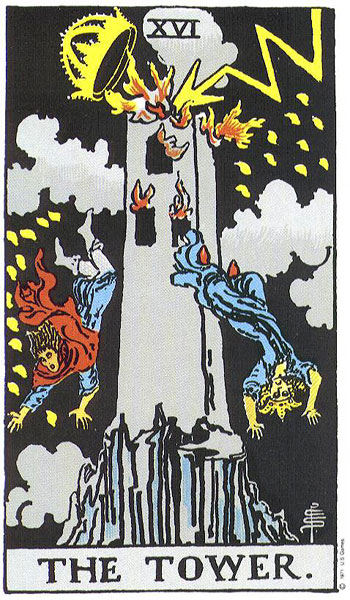
The Tower is the sixteenth card of the Major Arcana. The image most readers encounter shows a tall structure struck by something falling from above, with figures in freefall and flames visible along the upper portion. Lightning, a crown being displaced, and debris are common elements across traditional and modern decks. The sky is often dark or stormy, while the ground below remains intact.
This matters for interpretation because every choice you make in reading is grounded in what is visible on the card. Before assigning meaning, pause and describe the picture. What is at the top? What is at the bottom? What looks stable, and what looks unstable?
Observational practice:
- The tallest part of the structure is the part that fails first - The figures are leaving the tower, not running toward it - The ground is unaffected; only what was built is being affected - The crown is being removed, suggesting a change in authority or perception
Notice that nothing in the image suggests a person caused the event deliberately. The disruption appears external to the structure itself. That detail often shapes how upright and reversed interpretations are written.
Upright Meaning: A Disrupted Assumption
Upright, The Tower points to a disrupted assumption, an unstable structure, or a revelation that makes the former arrangement impossible to maintain. The card reflects a moment where what you believed or relied on no longer holds together.
This is not a forecast. It is a description of a pattern that often shows up when a belief, plan, or relationship has already begun to crack. The "lightning" in the image is often, in real life, information that arrived, a conversation that surfaced, or a change in circumstances that exposed something you had not yet looked at directly.
Reflection prompts for the upright position:
- What did I believe recently that I no longer believe, or no longer fully believe? - Which plan, agreement, or identity is being tested by reality rather than by my effort? - What is being revealed that I had been avoiding? - If the old structure cannot be saved, what was useful about it that I can carry forward?
The Tower upright is rarely about a person who is doing something terrible to you. It is usually about a structure you built or inherited that has now shown its limits. Reading it as "something bad will happen" is the most common error. Reading it as "something I was relying on is showing its age" is closer to the card's actual shape.
Reversed Meaning: Delayed or Internalized Change
Reversed, the card shifts from sudden collapse to managed or delayed disruption. The same forces are present, but they are working below the surface, slowed down, or being absorbed rather than expressed. Change may be delayed, internalized, or managed before a larger collapse occurs.
Think of this as a quieter version of the same theme. You may already know something is unstable, and the question becomes whether you are allowing it to unfold or trying to hold it in place. Reversed Tower does not mean "safe." It often means "the disruption is happening inside the system rather than visibly outside it."
Reflection prompts for the reversed position:
- Where am I aware of a problem but postponing action? - Is the change already underway, only more slowly than I want? - Have I been internalizing a realization I have not yet spoken aloud? - What would it look like to manage this on my terms rather than wait for it to manage me?
Reversed readings are where fortune-telling instincts grow strongest, because the language of "delayed" easily slides into prediction. Stay with observation: what is the actual evidence that change is slow rather than dramatic? What is the actual evidence that you have already begun to act, even quietly?
A Grounded Example
Imagine you have been in a job for several years. Recently, a colleague left, a project was restructured, and your role has been asked to change in ways that do not match the original agreement. You pull The Tower for a weekly reflection.
A reading that drifts toward prediction might say: "You will be fired soon, or the company will fail." That is the kind of statement no card can support. A reading that stays grounded looks like:
- The structure (your role as it was) is no longer what it was - The revelation (the restructure, the colleague's exit) is already in evidence - The instability is real, not imagined - The question is what you can build next, using what you have learned in the old role
In this example, the card matches what is already observable. It does not add new information. It frames what is happening so that you can decide, with clearer eyes, what to do next. The decisions still belong to you. They are informed by your real situation, not by the card.
If a friend pulled the same card in the same week and nothing in their work life matched, the card would not have "predicted" the wrong outcome. It would simply not apply to them in that moment. This is the kind of misfit that matters, and it should be recorded rather than explained away.
How to Test Your Interpretation Against Evidence
This is the most important section, because it is where reflection becomes practice. Tarot imagery is suggestive. Real life has specifics. The two should be checked against each other, not layered on top.
A simple method:
1. Before the draw, write down what you expect might come up. Be specific. 2. Pull or consider the card. 3. Write down the interpretation you are considering. 4. Over the next week, collect two kinds of evidence: things that match, and things that do not. 5. At the end of the week, write a short note about whether the interpretation held up, partially held up, or did not apply.
The point is not to grade the card. The point is to keep your reading honest. Cards can sound true because they are vague. Specifics are harder to fake. If your interpretation cannot be matched against specific, dated observations, it is too loose to be useful.
Two cautions:
- Apparent matches often feel stronger than they are. Confirmation bias is the tendency to notice what fits and skip what does not. Record both with the same seriousness. - Disconfirming evidence matters more than confirming evidence. If three details match and one clearly does not, the interpretation is probably partial. Sit with the partial answer rather than forcing a full one.
This approach is consistent with how reflective practice is taught in coaching, therapy, and journaling traditions. The image is a prompt. The evidence is the test.
Limits of This Approach
It is important to be explicit: Tarot is not a prediction. No card can tell you what will happen tomorrow, who is thinking what, or what the outcome of a specific situation will be. Cards are symbols made by people, interpreted by people, and read in moments shaped by mood, context, and recent events.
Several limits are worth naming:
- Imagery is symbolic, not literal. A tower falling is not a forecast of a building collapse. - Interpretation is shaped by the reader. Two readers will see different emphases, and both can be reasonable. - Reversed cards are especially prone to over-reading. The reversal is a convention, not a fixed rule. - Cards cannot diagnose medical, psychological, legal, or financial problems. If a situation involves safety, health, money, law, or crisis, please use qualified professionals and real evidence. A reflection practice is a companion, not a substitute.
This guide offers one possible reading of the tower tarot card meaning among many. It is meant to support thoughtful reflection, not to replace it. If a reading ever pushes you toward a decision you would not otherwise make, that is a signal to slow down and bring in real-world input.
Journal Questions to Try
These questions are designed to be answered in writing, with reference to a specific situation. They work best when you replace "the situation" with a concrete example from your own week.
- What structure, belief, or plan am I currently relying on, and what is the oldest piece of evidence I have that it still works? - What has been revealed in the last month that I have not fully acknowledged? - If this structure failed tomorrow, what would I keep and what would I let go? - Where am I delaying change that I already know is happening? - What would "managed change" look like, if I were choosing the pace? - What is one piece of disconfirming evidence I am tempted to ignore? - What is one thing a qualified friend or professional would say about this situation if I asked?
Write the answers in a dated entry. Re-read them a week later. Notice what shifted and what stayed the same. This is the practice: a calm, evidence-aware look at what is true, with a symbolic image as a starting point rather than a final word.
Share this article