The shape of a one card daily tarot check in
A one card daily tarot check in is a short ritual with a strict order: observe first, interpret second, choose one action, then return in the evening to compare what happened against what you expected. The structure exists because the same card, looked at the same way, can drift toward prediction if there is no second pass. One card is enough. Spreads are tempting, but they invite you to read across cards and skip the pause that makes the rest of the practice work.
The first pass is observation. You look at the card you have drawn and write down what you actually see and what you feel in your body, without assigning meaning. The second pass is interpretation, where you compare your notes against the card's stated meaning and ask whether they fit. The third step is action: one small, concrete thing you will do today that aligns with what you noticed. The fourth is the evening evidence review, where you sit with what actually occurred and mark down what matched and what did not.
This loop is a literacy practice. The goal is to keep observation, interpretation, and outcome in their own lanes so you can see, over weeks, where the card language helps you notice things you would otherwise miss and where it tends to project onto the day. The shape of the practice matters more than any single card, because the cards change and your patterns of reading do not.
The card is a prompt; the journal is the record. If you only collect cards and never reread your notes, you are reading the weather without the map. The record is the part that teaches you how you read.
Holding the card in observation mode
Before you reach for keywords, give the card sixty seconds of looking. Write down three things you notice that are not in any keyword list: a colour impression, a sense of the figure's posture if a figure is shown, an emotion that arrives uninvited. Do not name the meaning yet. Observation mode is not a long phase. It is a short one, deliberately cut off from interpretation, so the next phase has something honest to work with.
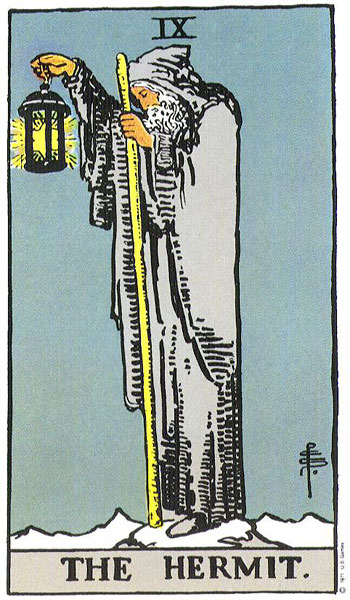
For a Major Arcana card like The Hermit, the upright statement reads as deliberate withdrawal, careful inquiry, and creating enough quiet to identify your own position. The tone listed with the card is pause. None of those words need to appear in your observation notes. The point is to register your own reaction before you borrow the card's vocabulary. If you write "withdrawal" in your observation notes, you have already started interpreting, and you have lost the chance to see what you actually noticed.
A useful prompt is: "If a friend handed me this image and asked me what I noticed, what would I say?" Write that down. It separates first impression from assigned meaning. A second useful prompt is to note what you do not feel. If the card's tone is supposed to be pause and your body is in a hurry, that is a piece of observation worth recording on its own.
Then ask whether the card's own reflection question fits your day. For The Hermit, that question is: what question deserves uninterrupted thought, and when should that thought return to the world? If your day has no room for that question, note that too. A mismatch between the card and your circumstances is information, not a failure of the card and not a failure of you.
A working example with The Hermit, upright
Imagine a freelance illustrator with three small client revisions due by Friday, a cancelled evening plan, and a friend who wants a long answer to an email about a difficult work situation. She draws The Hermit upright in the morning and decides to do the loop properly.
In observation mode, she writes: the card feels quiet, she notices she has been holding her shoulders high since she sat down, and the cancelled evening feels like relief rather than disappointment. She does not write "withdrawal" yet. She also writes that her first reaction to the friend's request was irritation, which surprises her more than the card does.
In interpretation mode, she compares her notes to the upright statement. Deliberate withdrawal fits the relief she registered about the cancelled plan. Careful inquiry fits the friend's email, which she has been postponing. Creating enough quiet to identify your own position fits her body noticing tension before she did. She does not force all three threads to mean the same thing. She picks the one that fits her day best.
Her interpretation choices are honest. She could decide that the card is about the friend's email, about the cancelled plan, or about her shoulders. She picks the friend's email because that is where the inquiry fits best, and she writes that choice down with the reason. If she had picked the cancelled evening, the evening review would test a different hypothesis. The card does not pick for her, and the journal record will show which thread she followed.
When The Hermit appears reversed: noticing the difference
The reversed Hermit reads: solitude may have become isolation, or reflection may be delaying a necessary conversation. The same loop applies, but the observation step needs to be more careful, because reversal prompts often produce immediate dramatic stories. The mind prefers a reversal to be a warning, and warnings feel true even when they are not.
In observation mode, write what you noticed first, then look at the reversed meaning. Does the card seem to be about isolation, about delay, or about neither, and what in your day would let you tell the difference? If you cannot tell, write "ambiguous" and move on. Ambiguity is allowed in the journal. Writing "I cannot tell yet" is itself a useful entry.
In the example above, suppose the illustrator had drawn the card reversed on a day when she had already postponed the friend's email twice that week. The reversed meaning fits clearly. Her interpretation choice is to send a short, honest reply today even though she does not yet have a complete answer, rather than wait until she has thought it through perfectly. That action is small. The reasoned fact is that sending a partial reply is closer to the world and further from delay, and the loop lets her test that.
If she had drawn it reversed on a day when she had no email pending and no one waiting on her, the reversed meaning might not fit. Recording that mismatch is part of the practice, not a refusal of the card. A prompt that does not fit your day is data, not disrespect.
From observation to a single action
The action step is the easiest place to lose the discipline of the practice. Choose one small, specific thing you can verify by tonight. Not a resolution. Not a forecast. One action that the evening review can look at and either confirm or not.
For the illustrator with the upright Hermit, the action is to write the first two sentences of the friend's reply before lunch. She can verify by evening whether she did, and what changed in the email, and in her own sense of the problem, after those sentences went out. The action is verifiable because it has a time bound and a clear outcome. The day either contained it or it did not.
A few boundaries. If the question in front of you is medical, legal, financial, safety, or crisis-related, do not use the card as the basis for the decision. Use a clinician, a lawyer, a qualified financial adviser, an emergency line, or someone trained for the situation. The card can be a place to slow down and notice what you feel, but it is not a substitute for that evidence and for the help you can verify. Real situations deserve real sources of help, and the practice itself asks you to keep that distinction clear.
Keep the action narrow enough that you can tell whether it happened. "I will think about my career" is not verifiable. "I will read one article and write down one sentence about what I noticed" is. If you cannot tell at the end of the day whether you did the thing, the action was probably too vague.
The evening evidence review
In the evening, open the same journal entry. Underneath your morning notes, write three short lines: what matched, what did not, what you noticed that you had not expected to notice at all. The three-line structure is a habit that keeps the review from becoming a vague impression. Each line asks for a different kind of evidence.
For the illustrator, the matching line might be: "Sent the first two sentences, felt lighter, the rest of the day was less pressured." The non-matching line might be: "I expected the email to take an hour and it took ten minutes." The unexpected line might be: "I noticed I had been avoiding the friend's email because I was afraid of giving the wrong advice, not because I did not know what to say." All three lines are evidence. None of them is a verdict.
The evening review is the part of the one card daily tarot check in that turns a feeling into a record. Over weeks, the record is more useful than the cards. The cards are prompts; the record shows you which prompts your mind keeps turning into predictions, and which prompts it treats as invitations to slow down. The pattern that emerges over a month of entries is the part that teaches you something you could not have learned from a single card.
If nothing matched at all, write that. If the card's meaning felt forced from the start, write that too. The card is not a prediction. It is one image, one stated meaning, and your notes about the gap between them. The gap is the most useful part.
Recording what did not match
The hardest part of the practice is recording disconfirming evidence with the same care you give a match. When the day confirmed your interpretation, you will remember to note it. When it did not, you will be tempted to skip the page, or to soften the wording so the day sounds closer to the card than it was.
Write it down anyway. A single Hermit upright drawn on a Tuesday does not mean Tuesday will be quiet. It means the card offered a prompt about withdrawal and inquiry, and Tuesday was what it was. If the day was loud and you sent no quiet message and no email and took no quiet walk, that is not a failure of the card. It is a data point about the gap between the image on the page and the texture of a real day. Data points that contradict your reading are still data points.
Tarot is not a prediction. It is a structured way to slow down, to register a feeling before you explain it, and to compare what you expected to notice with what you did notice. The Hermit's reflection question can guide the same action for any card you draw: what question deserves uninterrupted thought, and when should that thought return to the world? That question is portable. It does not depend on a particular deck, a particular tradition, or a particular year. It depends only on whether you are willing to write down what you actually saw, before you tell yourself what it means.
A practice like this only earns its keep over weeks. One card, one journal page, four passes per page. The patience the practice asks for is the same patience the card asks for. That is the whole point of the loop.
Share this article