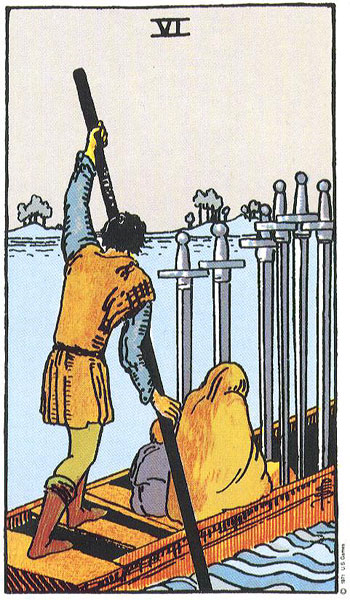
What This Card Addresses in the Swords Suit
The six of swords tarot card meaning centers on a particular kind of progress: the kind that comes after something difficult has been worked through with clear thinking. Within the Swords suit, this card stays focused on thought, language, decisions, and the resolution of conflict. It is not a card about feelings directly, nor about material resources. It belongs to the realm of how a person frames a situation, chooses words, and recognizes when a shift has become possible.
Because the card sits in the Minor Arcana, it speaks to everyday situations rather than to large life themes. As the sixth card in its suit, it represents a midpoint. Earlier Swords have often sharpened distinctions or exposed tension. Here, the question becomes whether the mental energy that has been spent can now move toward something workable. The tone is open, suggesting that a fair outcome is still within reach if the conversation stays honest.
For readers who want a starting definition, this card points to recovery expressed through the way you think, speak, and listen. That recovery is not the same as forgetting what happened. It is the kind of repair that comes when someone returns to clear distinctions and treats the other people in the situation with accurate language.
The Recovery Thread Within the Wider Mental Context
Recovery is one strand within a wider context of thought and communication, and it is worth keeping those two threads separate. The broader Swords territory covers any time someone has to make decisions, draw lines, or navigate conflict. That larger context is alive in every Six of Swords appearance. The recovery strand, though, is narrower. It applies when something has already gone through a hard stage, and the next step is to recover a workable mental posture.
A useful way to read the upright meaning is to ask which of the four upright ideas fits the situation: exchange, recovery, recognition, or movement after difficulty. Sometimes the card points to a fair trade-in of one view for another. Sometimes it points to genuine recovery after a low point. Sometimes the emphasis is on recognizing that progress is already underway. Sometimes it points to the movement itself, where a decision or conversation finally starts to lift the situation.
The constructive direction of this card uses clear distinctions and honest communication. That phrase is worth slowing on. Clear distinctions mean saying what is actually the case, not what is convenient. Honest communication means language that matches the speaker's real position, even when that is uncomfortable. Together, this is what makes recovery possible in a Swords context. Without these conditions, the same pattern that produced the difficulty can simply repeat.
Where Thought and Decisions Carry the Movement
Movement after difficulty is rarely automatic. In a Swords reading, the movement that the Six describes depends on the quality of attention given to the situation. A person has to think carefully, name what has changed, and choose words that respect everyone in the room. That process is what turns the upright meaning from a label into a lived pattern.
Recognition plays a role here. Recognition is the moment when someone sees the situation as it is, rather than as they would prefer it to be. In practical terms, that might be acknowledging that a particular tone was hurtful, or that a decision was made too quickly, or that another person has more at risk in the exchange. Once recognition lands, the same facts can be talked about with cleaner language, and progress becomes a fair project rather than a contest.
The reflection prompt that accompanies this card, "What would fair progress look like for everyone involved?", is a direct test of whether thought and language are doing their job. If a person can answer that prompt without defensiveness, the movement the card describes is already underway. If the answer collapses into a justification of one side, the constructive direction has not yet been reached, and the reading has more work to do.
A Low-Stakes Example You Can Compare to Your Own
Consider a small group that runs a community newsletter. After a few issues, two of the editors realize their feedback to a third editor has been sharper than they intended. The third editor has stopped volunteering for certain tasks, and the group is starting to feel heavier than it should.
A first reaction might be to apologize quickly and move on. That can help, but it can also skip past the part where clear distinctions matter. A second pass, more in line with the Six of Swords, would have each person name specifically what they said that landed badly, name what they actually value about the third editor's work, and then ask the third editor what fair progress would look like. That conversation is the recovery. It uses honest communication because each person gives language to their real position. It uses clear distinctions because the group separates tone from intent, and past comments from present ones. The movement afterward is small and practical: revised feedback habits, a more even distribution of tasks, and a calmer room.
This is a low-stakes example because no one is in crisis and no major decision hangs in the balance. It is the right scale for testing how the card's meaning shows up. If the pattern can be recognized at this scale, it becomes easier to see whether it applies to something larger, and easier to tell when it does not.
The Reversed Reading and a Plausible Misreading
The reversed meaning keeps the same elements but changes their direction. The pattern may be blocked, internalized, or showing its shadow through overthinking, rigid conclusions, or words used as weapons. Blocked means that progress is stalled and the usual flow of exchange has stopped. Internalized means that the conflict has turned inward and is being replayed in the person's own thinking. Overthinking is the most familiar form of this reversal, where distinctions stop being clear and every option looks equally bad. Rigid conclusions are the next step, where a person stops listening and treats their first framing as final. Words used as weapons is the external version, where the same language that could have repaired the situation is now used to harm.
A plausible misreading is to treat the word recovery as if it meant the problem was already resolved. The upright meaning does not say that. It says that recovery is what the situation is moving toward when clear distinctions and honest communication are in use. If those are not yet present, the card is closer to a description of where honest work is needed than a description of where things already stand. A second misreading is to read any six-card appearance as a signal of completion. Number six does carry a sense of shift, but in the Swords suit the shift is conditional. The mental work has to be done.
Recording Ambiguity and Disconfirming Evidence
Tarot is not a prediction. A card describes a pattern that may be active in a situation, not an outcome that is guaranteed. That is worth keeping in view whenever a Swords card surfaces, since Swords themes often tempt readers to treat their reading as a forecast of an argument or a decision. The upright Six describes a pattern that the reader is also participating in, and the reversed Six describes what happens when that participation slips.
Because the meaning is not a prediction, ambiguity and disconfirming evidence should be recorded as carefully as an apparent match. If the card seems to describe a recovery underway and the situation looks stuck, that mismatch is information. If a reversed card seems to point to overthinking and the situation is in fact calm, that is also information. A short note in a journal, written the same day as the reading and revisited a week later, will show whether the pattern held, softened, or never quite applied. That habit does more for learning the card than any single reading can.
For decisions involving health, money, safety, employment, or relationships in crisis, this card is not a substitute for qualified help. Real evidence and the advice of someone trained in the relevant field should carry those conversations. The card is best used to clarify how the reader is approaching the situation in language and thought, which is a smaller and more workable task.
Questions Worth Writing Down
The reflection prompt given for this card is worth using as the first journal question: "What would fair progress look like for everyone involved?" Writing the answer slowly, and then rewriting it after rereading, often reveals where the language has been hiding a preference.
A few additional questions that sit well with the card's meaning:
- Where in the current situation am I using clear distinctions, and where am I letting an old framing do my talking for me? - Have I said plainly what I think, or have I softened the language until the meaning shifted? - If the situation involves another person, what would they write if they were answering the same questions? - What would count as evidence, this week, that the recovery is genuine rather than performed? - If a friend described my situation to me, what would I notice first?
These questions are meant to be checked against real events, not against the card. That is what makes the reading a study in pattern rather than a forecast, and it is where the most honest learning from this card tends to happen.
Share this article