Where this card sits, and what recovery means in its context
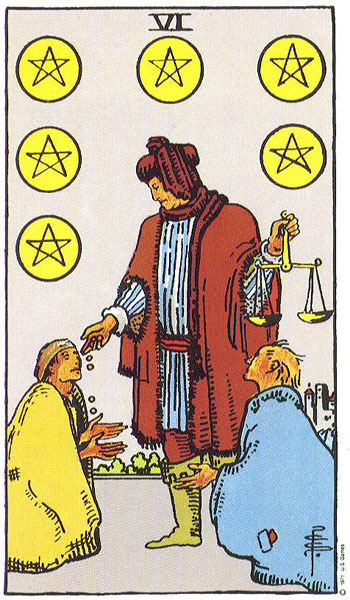
The Six of Pentacles is a minor arcana card in the suit of Pentacles. Pentacles concerns work, money, the body, physical setting, and material conditions. Number six within that suit sits past the first five building blocks and just before the seven, which means it rests in a transitional spot where what has been built can now be distributed, balanced, or recalibrated. The upright reading for this card uses the phrase "exchange, recovery, recognition, or movement after difficulty expressed through work, resources, the body, routine, and material conditions." That sentence is dense, and it is the spine of any honest six of pentacles tarot card meaning worth sitting with.
The word worth isolating is recovery. Recovery in this card is not the same as abundance, and it is not the same as luck. The suit frames recovery as the return of circulation after something slowed down. A paycheck arrives after a lean stretch, a workflow resumes after a disruption, a routine settles back into place after illness. The constructive direction offered is "building something useful through steady, observable practice." The word observable is doing real work here. Recovery in this card is something you can track, not something you have to feel certain about.
Upright reading: fair exchange and the return of throughput
In its upright sense, the Six of Pentacles describes a moment where the inputs you have been putting in start to come back out in usable form. The keywords associated with the card are exchange, resources, practice, and material conditions. Read together, they describe a system: you put work or resources into a situation, the situation moves, and the movement produces something you can put to use. Recognition, when it appears here, is not applause; it is feedback in the form of results that can be counted. Movement after difficulty is recovery in physical terms, such as a body returning to baseline after strain, and in practical terms, such as a budget or a project finding its stride again.
The upright posture carries a moral texture that is easy to miss. Exchange implies that something is being given and something is being received. Fair is not stated directly, but the reflection question that hangs over the card asks, "What would fair progress look like for everyone involved?" Read on its own terms, the card is curious about reciprocity, not one-sided rescue. Recovery that runs through fair exchange is more durable than recovery that runs through a single donor saving a single recipient. If you draw this card and the situation in front of you is one-sided, the gap between the card's frame and your situation is itself a clue worth writing down.
Reversed reading: blocked exchange, fixation on scarcity, and hollow measurement
The reversed reading describes the same pattern as blocked, internalized, or operating in shadow through scarcity fixation, stagnation, or treating measurable value as the only value. Those are three different shadow shapes, not one, and they each want a different response.
A blocked exchange looks like a working setup where effort goes in but no usable output returns. You keep practicing, you keep sending applications, you keep showing up to the role, and nothing in the material conditions changes. A fixation on scarcity looks different. The inputs or outputs are technically there, but attention keeps narrowing onto what is missing, and the narrowing is so tight that planning turns reactive. Treating measurable value as the only value is the subtler shape. You have outputs you can count, and you begin to trust only those counts. Other forms of progress, including rest, relationships, or skill that has not yet paid back, get discounted as unreal.
Stagnation is named separately in the reversed reading, and it is worth keeping apart from blockage. Blockage implies something is obstructing the flow. Stagnation implies the flow has stopped on its own, often because it was never reviewed, revised, or rebalanced. A blocked exchange can sometimes be cleared by removing an obstruction. Stagnation usually requires redesigning the routine itself.
A realistic low-stakes example of recovery in progress
Picture a freelance project that ran past its deadline, slipped by two weeks, and was finally delivered. The invoice goes out. For a week or two, the inbox is quiet. Then a payment arrives for two-thirds of the expected amount, with a note saying the remainder will follow once the client's own funding clears. This is the kind of moment where the upright Six of Pentacles is a reasonable fit. Resources are starting to circulate again after difficulty, and the system is moving. Recovery is incomplete and the schedule for the remaining payment is unclear, but throughput has resumed.
The same situation read through the reversed frame becomes a study in stagnation. The work is done, the invoice is out, and the partial payment sits in the account. The freelancer now has to decide whether to chase the remainder or wait, whether to take on new work with the partial funds already in hand, and how to interpret the gap in their income against their planning. The card's keywords do not say which answer is right. They describe the texture of the moment well enough that a journal entry can be written about it.
If the freelancer keeps checking the bank balance hourly and starts turning down new leads because of the freeze, the reading becomes a scarcity fixation rather than mere blockage. The distinction is useful because the response changes. Blocked exchange argues for more communication or a different channel. Scarcity fixation argues for protecting attention and limiting check-ins so decisions are made from a quieter baseline.
Where the card is most often misread
Two misreadings come up often enough to name by name. The first is treating any suggestion of money in a Tarot reading as a prediction of cash flow. The Six of Pentacles is a minor arcana card about exchange, resources, and material conditions, and it does not forecast the next bank statement. Treating it as a financial forecast flattens a card that is concerned with the quality of an ongoing system into a claim about a future amount.
The second misreading is the conflation of recovery with relief. Relief is the absence of a specific source of difficulty. Recovery is the rebuilding of throughput after difficulty has passed. A reading that lands on this card while the difficulty is still actively pressing is, on the facts at hand, a strained fit. The upright meaning names "movement after difficulty." If no movement has happened yet, the card is doing one of two things: pointing toward movement the reader has not registered, or being misread as a softer, kinder card than it actually is. The disconfirming evidence in that case is the timeline. If the difficulty is still in progress, the card's promise of recovery should be held loosely until at least one observable sign of return has shown up.
A quieter misreading is the assumption that exchange means generosity without self-interest. The reflection question works in both directions. The reader is one of the parties involved. A reading that interprets the card as a call to keep giving without balancing what returns is reading against the grain of what is actually on offer.
Interpretation choices and questions to verify in a journal
Tarot readings work best when the reader makes interpretation choices they can later check. With this card, three choices are worth naming explicitly.
First, decide whether you are reading the situation as upright-leaning or reversed-leaning. Both postures use similar language, so the deciding question is whether exchange is actually moving. If there is movement, even small, the upright frame is closer. If there is no movement, or if attention has narrowed into a scarcity loop, the reversed frame is closer.
Second, name which of the suit's domains is most affected. Pentacles covers work, money, body, routine, and setting. The same recovery signal can show up in any of them. A reader who writes "my work" without naming which domain is at stake will have a hard time later deciding whether the card fit.
Third, separate observable signals from felt signals. Observable signals are things you can write down, such as a date, a number, a name, an action taken. Felt signals are moods, intuitions, and impressions. Both have a place in interpretation, but only the first can be verified later. The card's emphasis on "steady, observable practice" is a cue to give weight to the trackable side.
Four journal questions, each tied to the facts above:
- Where in my work, body, or routine is something actually starting to circulate again? - If I picture the fairer version of progress for everyone in this situation, including me, what does it look like in concrete terms this week? - Is exchange blocked right now, has the flow stopped on its own, or has my attention narrowed onto scarcity? - What would one observable sign of recovery look like, and by when would I expect to see it if this reading holds?
The disconfirming evidence question is just as important as the matching one. If the situation gets worse in the next two weeks in a way that contradicts the reading, write that down too. A reading that only collects confirming evidence is not really testing itself.
Limits of a Tarot reading, and when to turn to other tools
Tarot is not a prediction. It does not forecast income, job offers, medical outcomes, or the decisions of any other person. The card's themes and questions describe a landscape to look at, not events that will happen. A useful reading points at what to ask; it does not stand in for the evidence that answers those questions.
This means the Six of Pentacles is best used alongside real sources of evidence for any decision that touches money, health, work, or safety. A budget drawn from actual statements is more reliable than any card. A medical question belongs with a qualified clinician. A question about someone else's thoughts or intentions belongs with direct conversation or professional advice. All four keywords - exchange, resources, practice, and material conditions - point outward, toward the world, and that is the direction this card invites you to look, at the system around you rather than the next supposed outcome.
If a reading on this card surfaces something urgent, such as a financial crisis, a health concern, or a feeling that you cannot think clearly, treat the reading as a prompt to reach out to a qualified professional rather than as something to act on directly. The card's framing question, with its emphasis on including everyone, is a useful general orientation because it asks the reader to include themselves and others, which is the kind of frame that usually leads toward real help rather than solo attempts at fixing a problem that is beyond one person.
Share this article