What the Rank Difference Actually Names
The phrase "tarot queens vs kings" invites a comparison that the Minor Arcana treats with unusual precision. Within a single suit, the Queen and the King do not describe personalities, genders, or even people. They describe two positions in relation to the same quality. The supplied card data names those positions directly: the Queen is described as "mature inward command and a capacity held with discernment," while the King is described as "mature outward stewardship, standards, and responsibility for effects."
That distinction is the spine of this comparison. Inward command refers to a capacity a person already holds and can apply without needing an audience, a title, or a visible result. Outward stewardship refers to the use of that same capacity when other people, expectations, or downstream consequences are involved. The Queen asks how the quality can be practiced without external proof. The King asks what responsible leadership of the situation would require. Reading the two cards together is therefore less about choosing one and more about asking which relationship to the quality is needed at the moment.
Rejecting fixed personality labels matters here. The Queen of Wands does not belong to a particular temperament, and the King of Cups is not automatically the "emotional grown-up" of any relationship. The cards describe modes of engagement, not identities. A reader who treats either rank as a permanent trait will misread every spread where the same person occupies both positions in different contexts.
How Each Suit Carries the Same Pattern Differently
The comparison only works because each suit applies the Queen and King distinction to a different domain. Looking across the four pairs, the suit governs what is being commanded or stewarded; the rank governs how it is being related to.
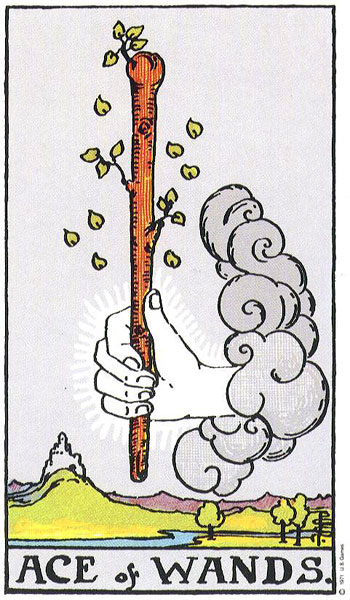
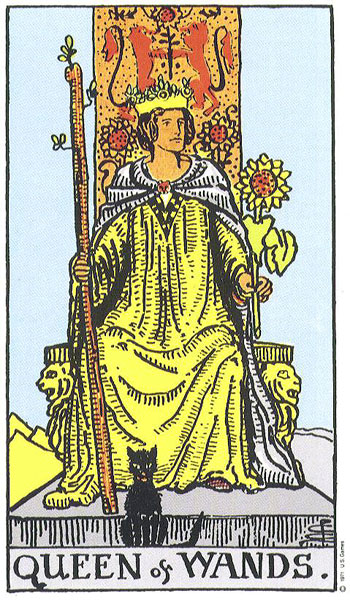
In Wands, the shared material is initiative, creativity, and purposeful action. The Queen of Wands holds this material with discernment, asking how creative energy can be directed toward work that matters in a self-sustaining way. The King of Wands takes the same material and asks what responsible direction of effort looks like when others are affected. Both cards warn in their reversed form about burnout, impatience, and effort without a stable direction; the warning applies regardless of rank, because the underlying capacity is identical.
In Cups, the domain is feeling, relationship, imagination, and emotional response. The Queen of Cups practices recognizing and communicating the emotional reality of a situation from a grounded inner place. The King of Cups takes on the responsibility of doing that communication well, holding standards so the emotional truth does not become an excuse for either avoidance or manipulation. Their shared shadow, when reversed, is projection, avoidance, or being overwhelmed by an untested feeling.
In Swords, the domain is thought, language, decisions, and conflict. The Queen of Swords uses clear distinctions and honest communication as an inner discipline; the King of Swords applies the same clarity as stewardship, which means accepting that words have effects on the people who receive them. Their reversed warnings overlap: overthinking, rigid conclusions, and language used as a weapon.
In Pentacles, the domain is work, resources, the body, routine, and material conditions. The Queen of Pentacles builds something useful through steady, observable practice, sustained without needing applause. The King of Pentacles does the same work with the additional layer of standards and accountability for outcomes. Their shared shadow, when reversed, includes scarcity fixation, stagnation, and treating measurable value as the only value.
The throughline is consistent enough to be useful: each Queen is the private practice of the suit's quality, and each King is the public accountability for it.
Reading Queens and Kings in Context: Question First, Card Second
A common misreading is to assign Queens to "inner life" questions and Kings to "outer life" questions as if that were a rule. The reflections attached to the cards complicate that. The Queen cards all ask how the quality can be practiced without needing external proof, which is a useful question in any spread where the reader is tempted to wait for validation. The King cards all ask what responsible leadership of the situation would require, which is a useful question in any spread where other people, stakes, or consequences are visible.
Context determines which is more useful, not the topic of the question. A career question can be answered by either rank depending on whether the reader needs to cultivate a skill (Queen) or to act on behalf of others (King). A relationship question can ask either how to hold the quality privately (Queen) or how to take responsibility for the effects of that quality on a partner, family, or team (King). The same person can draw both cards in the same reading and be pointed toward two distinct tasks at once.
This is also where ambiguity should be recorded honestly. When a reading surfaces both a Queen and a King of the same suit, the cards do not always tell the reader which task comes first. The data supplies two distinct questions and lets the reader decide which is more urgent. A page that claims a clean answer here is overreaching, and a journal entry that pretends the ambiguity did not exist is incomplete.
When the Shadow Side Appears on Either Side of the Table
The reversed meanings are nearly identical within each suit. That is not a redundancy in the data; it is a quiet instruction. The shadow of Wands (burnout, impatience, effort without direction) can fall on a private practitioner as easily as on a public steward. The shadow of Cups (projection, avoidance, untested feeling) belongs to whomever has stopped checking the feeling against reality, regardless of rank. The shadow of Swords (overthinking, rigid conclusions, weaponized words) shows up wherever discernment has hardened into certainty. The shadow of Pentacles (scarcity fixation, stagnation, measurable-only value) attaches to anyone whose material practice has become its own justification.
Reading "the Queen is too internal" or "the King is too external" therefore misses the point. Both ranks can fail in the same way. Disconfirming evidence should be recorded as carefully as an apparent match: a reader who notices a particular failure pattern can place it on either side and learn something useful about where they tend to slip. A reader who notices they have never failed in that way should note that too.
A Practical Reading for a Low-Stakes Decision
Consider a low-stakes example that does not require prediction. A reader has been asked to lead a small recurring meeting at work. They are tempted to redesign it from scratch because they can see several improvements. They lay out three cards: Queen of Wands, King of Cups, and Queen of Swords.
The Queen of Wands asks how their creative initiative can be practiced without needing the meeting to visibly reflect their taste. The King of Cups asks what responsible leadership of other people's emotional reality looks like, because attendees have routines and attachments to the existing format. The Queen of Swords asks how honest distinctions can be held privately before they are spoken aloud in the room.
A reading that respects the data would not predict whether the redesign will succeed. It would point toward a sequence: sharpen the thinking privately, hold the emotional reality of the attendees as a steward rather than as a critic, and then express the creative energy in a way that does not require the meeting to be a monument to the reader's discernment. The same three cards could be read very differently by a reader who has been over-identifying with their taste, or by a reader who has been avoiding leadership altogether. The reading is therefore portable across situations; the interpretation choices are what carry weight.
Journal Prompts to Test Which Expression Helps Now
The reflections attached to each card are useful as journal prompts because they are phrased as questions. A short sequence a reader can verify in a notebook:
1. For each Queen, write one paragraph answering, "How can this quality be practiced this week without needing external proof?" Use the suit's domain (action, feeling, thought, or material conditions) to keep the answer concrete. 2. For each King, write one paragraph answering, "What would responsible leadership of my current situation require?" Name one downstream effect you have not yet accounted for. 3. Note where the two answers overlap and where they conflict. The conflict, not the overlap, is usually where the reading is doing work. 4. Revisit these entries in two weeks and record any disconfirming evidence: places where the prompt did not apply, where the opposite rank would have been more useful, or where the suit domain misfit the situation.
The prompts are designed so a reader can falsify them, not just confirm them. That matters because the cards here describe capacities, not outcomes.
Limits of This Comparison and What Tarot Cannot Do
This comparison is a frame for reflection, not a prediction. The card data does not claim that a Queen drawn in a spread will cause any specific event, nor does the King card carry any claim about another person's intentions. Anyone facing medical, legal, financial, safety, or crisis decisions should use real evidence and qualified professionals rather than these reflections. The reading's value is in the questions it puts on the table, not in any answer it supplies about what will happen next. Tarot is not a prediction, and treating it as one is the most common reason a useful reflection turns into a confusing one.
Share this article