What the Ace of Wands Specifically Names
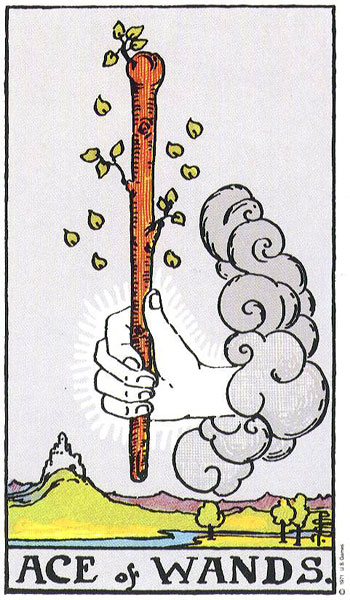
The phrase "ace of wands tarot card meaning" is often reduced in casual conversation to "creativity" or "new ideas." That shorthand leaves out what makes this card specific within the broader system. The card data describes it as "a concentrated beginning or opening expressed through initiative, creative energy, and purposeful action." Three elements matter here: it is concentrated, it is a beginning, and it is directed.
The rank is Ace, the lowest numbered position and the start of the sequence. That rank signals a first move rather than an established pattern. The suit is Wands, whose keywords emphasize initiative, creativity, and action. When these two facts are combined, the card names a particular kind of moment: not creative work in general, but the first small opening where initiative and direction meet.
This is why treating the Ace of Wands as simply "a creativity card" is a misreading. Initiative without direction is just motion. Direction without initiative is just a plan. The card points to a moment when both arrive at once, briefly, in a way that can actually be acted on. That window can be short, which is part of why the card is described as concentrated rather than sustained.
Beginnings vs. the Broader Creative-Action Field
A useful distinction separates "beginnings" from the wider creative-action context. The Wands suit overall deals with how energy is shaped, applied, and carried forward across time. Most cards in the suit describe stages of that process. The Ace describes the moment before the process has lengthened into stages at all.
In practical reading, this matters because a question about "how is my creative project going" will rarely be answered cleanly by the Ace of Wands. The Ace is better read when the question is closer to: is there an opening here, is this a place where starting would actually cost less than waiting, or what does the first step look like. If the situation is already midstream, an Ace pointing at it suggests a restart or a re-beginning, not a confirmation that the current work is on track.
The card's keywords reinforce this: "a concentrated beginning or opening," "initiative," "creativity," "action." Each of these words implies the front edge of something, not its body. A reader who treats the Ace as describing the whole arc of a creative project will find the meaning stretched thin. A reader who treats it as describing the moment a new line of action first becomes available will find it sharply specific.
How the Upright Direction Actually Shows Up
The upright card is described as directing energy "toward work that matters." That phrase does extra work. It is not just "toward work" — it qualifies the work. Initiative without a sense of what the work is for tends to scatter. Creative energy without an object tends to dissipate. Purposeful action, in the card's framing, is the part that holds the other two together.
In real terms, the upright Ace of Wands tends to show up when a person notices a small, doable opening and decides to move through it. The opening might be a conversation that becomes available, a draft that becomes possible to write, a prototype that becomes cheap to test, or a habit that becomes realistic to start. The card does not promise that the opening will become a major project. It names the moment of genuine entry.
Two interpretation choices are worth being honest about. First, the upright card can appear when an opening is available but the reader has not yet recognized it. In that case, the card's job is to point, not to confirm a decision already made. Second, the upright card can appear as a small invitation that the reader is in danger of turning into an over-promise. Not every first step leads to a major arc, and reading the Ace as a guarantee of lasting success is also a stretch.
Reading the Reversed Without Overcorrecting
The reversed description is careful: "the same pattern may be blocked, internalized, or showing its shadow through burnout, impatience, or effort without a stable direction." This is not a simple "bad" reading. It is the same underlying pattern — initiative, creative energy, purposeful action — but with one of three distortions.
Blocked means there is energy but something in the situation is preventing it from moving. This can be external (no time, no space, no support) or internal (not yet ready, not yet clear). Internalized means the energy is present but turned inward rather than expressed. It may show as over-thinking, replaying options without committing, or doing preparatory research that quietly substitutes for starting. The shadow forms — burnout, impatience, effort without stable direction — describe what happens when the pattern is recognized but not handled well.
A useful reader records the reversed card as a question rather than a verdict. Before concluding "this is blocked," it is worth asking what is blocking it, and what evidence supports that reading. Before concluding "this is burnout," it is worth asking whether the situation has actually involved sustained action, or whether the worry about burnout is itself a way of avoiding action. The reversed card tolerates careful interpretation better than quick ones.
It is also worth saying plainly: a reversed Ace does not prove that a beginning is wrong. It can mean that the beginning needs more support, or that the direction is not yet stable enough to sustain the energy. It does not mean the impulse should be abandoned on its own. Disconfirming evidence matters here as much as an apparent match. If the impulse has produced concrete results in the past week, a reversed reading deserves an extra round of checking rather than an immediate conclusion.
A Plausible Misreading to Watch For
The most common misreading of the Ace of Wands is treating any sudden burst of enthusiasm as confirmation that "this is the right thing to start." The card describes a concentrated beginning, but concentration is not the same as correctness. A beginning can be concentrated and still lead somewhere the reader does not want to go.
Another common misreading is the opposite one: ignoring the Ace when the impulse is small. A beginning does not have to be dramatic. Drafting one paragraph, sketching one shape, sending one message to ask one question — these are beginnings. The card does not require a grand opening. A reader who filters out small openings because they "don't feel like enough" is filtering out exactly the kind of move the card describes.
A third misreading, more specific to the reversed position, is reading impatience as a sign to push harder. Impatience in the reversed card is a shadow of initiative, not a recommendation to act faster. Recording impatience as evidence of being on the right track is a category error that the card's own description warns against.
A Low-Stakes Example to Test the Meaning
A realistic low-stakes example might look like this. Someone has been thinking about starting a short weekly writing habit for several months. The Ace of Wands appears in a reading. A grounded response is not to declare that the writing habit is destined to become a book. It is to ask: is there a small, concrete, first move that I could make this week, with low cost and a short feedback loop.
That first move might be writing for fifteen minutes on one morning. It might be drafting a single paragraph. It might be reading one short essay in the genre they want to write in. None of these are guaranteed to lead anywhere. All of them are honest applications of "a concentrated beginning" — small enough to learn from quickly, structured enough to be a beginning rather than just thinking about beginning.
If the same card appears reversed, the same low-stakes question applies with one more layer: is the block external (no time this week), internalized (I keep planning without starting), or a shadow (I am about to overcommit and burn out in two weeks)? Each of those would lead to a different next step, and the card's wording supports all three without forcing the reader to pick. Real evidence — what the reader has actually done, or not done, in the last seven days — is the test that determines which reading fits.
Journal Prompts You Can Verify
A practical reflection prompt asks: "What small beginning would let you learn quickly?" That question is well-built because it asks for something testable. A small beginning produces information within days, not months. The following prompts extend that approach and stay within the card's data.
First, where in the past month did I notice an opening that I either took or let pass, and what did I learn from each? Second, if I imagine the next two weeks, what is the smallest first move that would teach me something real about the situation, and what is the cost of trying it? Third, when I check my current energy, is it more like initiative, like preparation, like burnout, or like impatience, and what evidence supports that?
Fourth, if the reversed pattern were accurate, which of the three — blocked, internalized, or shadow — fits best, and what would I do differently in the next 48 hours if each were true? Fifth, what would I have to give up or postpone in order to actually begin, and is that exchange one I am willing to make?
These prompts share a feature: each one asks for evidence the reader can gather in a notebook. Tarot interpretation here is a reflective practice, not a prediction. None of these prompts claim to know the future. They are designed to help a reader notice what is actually in front of them and decide what to do next with their own information. For decisions involving health, legal matters, finances, safety, or crisis, qualified professionals and direct evidence remain the right sources.
Share this article