What the Card Frames: Growth as a Working Pattern
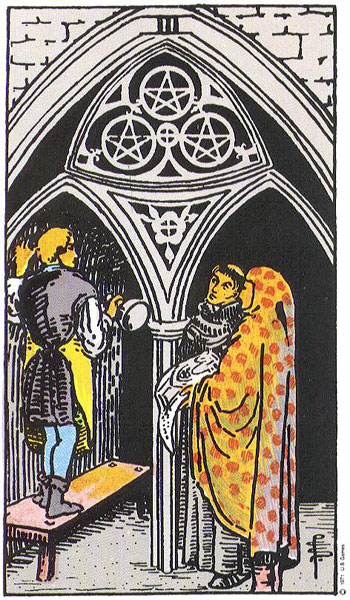
The Three of Pentacles sits inside the Minor Arcana and belongs to the suit of Pentacles, which covers work, resources, the body, routine, and material conditions. As the third card of that suit, it picks up a specific question: what does it look like when something starts to take shape through that Pentacles material? Not whether the work is impressive. Not whether the resources are abundant. The card's upright meaning names a direction of growth through participation, feedback, or expansion, expressed through the practical channels of Pentacles: work, resources, the body, routine, and material conditions.
If you want the simplest three of pentacles tarot card meaning in one sentence, it would be this: steady, observable practice is starting to produce a first useful form, and that form is asking to be refined with help rather than locked into isolation. The keywords you can return to are growth through participation, resources, and material conditions. The posture is open. None of this is a prediction; it is a way of reading a single card as a description of a current pattern.
A useful framing habit is to separate two scales. There is the general context of a Pentacles reading, which might include money, time, energy, physical health, home, or skill-building. And there is the more specific direction of the Three, which is growth through participation, feedback, or expansion. Many readers conflate the two and end up asking the card questions it does not actually answer. The Three of Pentacles is not primarily about whether you have enough money or whether your job is stable in the abstract. Those belong to the wider suit. The Three adds a movement word: growth. And it adds a method word: through participation.
That distinction is the spine of any careful reading of this card.
How to Read the Upright Direction
The upright Three describes a constructive direction: building something useful through steady, observable practice. The phrase "constructive direction" matters. It is not a verdict on how talented you are or how fast you should be moving. It points to the fact that what you are doing has the right shape, even if the first version is rough. You can think of the card as describing the difference between a finished building and a framed wall. The Three describes the framed wall: the layout is correct, the pieces are joined, and it is visible.
The keywords offered with this card are growth through participation, resources, practice, and material conditions. Each one offers a different handle for interpretation.
"Growth through participation" suggests that the next useful step is collaborative rather than solitary. Feedback, co-work, or shared standards of quality are part of what makes the work move from a first form to a more durable one. If your situation has been very private or very stuck in your own thinking, this keyword gently asks whether there is a person, a group, a mentor, or even a structured template that could move it along.
"Resources" and "material conditions" point to what is concrete. What time do you actually have this week? What tools, savings, energy, or health are available? The upright card invites you to take an honest inventory rather than assume resources will appear on their own. Growth through practice, in this card's framing, requires that the material side is realistic.
"Practice" points to repetition that produces observable improvement. Not perfection. Not breakthrough. Just the kind of small, checkable change that another person could notice if they looked at last week and this week.
A reasonable interpretation choice is to ask which of those three handles best matches your situation. A reader dealing with a craft or skill-building question may find practice most useful. A reader dealing with a budget or household question may find resources and material conditions more useful. A reader dealing with a stalled project may find growth through participation most useful. The card is open enough to be used in several contexts, and naming your context out loud is one way to keep the reading honest.
The Reversed Pattern and Its Shadow
The reversed Three is described as the same pattern blocked, internalized, or showing its shadow. The shadow expressions named are scarcity fixation, stagnation, and treating measurable value as the only value. This is more specific than a generic "this card means something bad" reading, and the specificity is worth taking seriously.
"Blocked" suggests the growth-through-participation loop has been interrupted. Perhaps feedback is unavailable, a collaborator has stepped away, or the conditions that made practice possible have changed. The card, reversed, points to that interruption rather than to failure.
"Internalized" is a quieter shadow. The pattern is still active, but the participation part is happening entirely inside your own head. You are rehearsing arguments, drafting, or planning without ever letting the work be seen. That can look like productivity from the outside while the actual feedback loop is starved.
"Scarcity fixation" is the most concrete shadow. It describes a state in which attention has narrowed to what is missing, what might run out, or what cannot be afforded. In a Pentacles context this is a common trap because material conditions are real and worth attending to. But when the entire lens becomes scarcity, growth through practice cannot run, because practice requires a margin of attention beyond the gap.
"Treating measurable value as the only value" is the subtle shadow. It says that only what can be counted, weighed, or priced counts as legitimate. This often appears in work or money questions where slow or unmonetizable work is discounted, including rest, relationship, learning, or care.
A careful reversal reading holds all of these possibilities lightly. Any of them could fit; equally, none of them may fit. The reversed card names the territory of shadow. Which corner of it your situation is in is something you verify against the evidence in front of you.
A Low-Stakes Example
A realistic low-stakes example can make the difference between the upright and reversed readings easier to feel.
Imagine a person who has been learning to make their own sandwich bread for two months. They have a reliable recipe, a steady Saturday routine, and a kitchen that is finally organized enough to support the habit. Friends have asked how it is going and offered to taste-test. Upright, this looks like growth through practice. The bread has a first form: it rises, it holds its shape, it tastes like bread. The next step is participation: bringing a loaf to a friend's dinner, asking for honest notes, watching a baker on video and copying one small technique.
Now imagine the same person, reversed. They have the recipe and the routine, but they have stopped bringing the bread out of the apartment. They tell themselves they will wait until it is good enough. They have started tracking flour prices and have cut back on the nicer butter because it is "not worth it for a hobby." They have also quietly decided that the bread only counts if it is photograph-worthy. This is scarcity fixation (focus on cost), internalized growth (the practice stays hidden), and measurable value treated as the only value (only the picture-perfect loaf counts). The card is the same card. The pattern around it has changed.
A second example in a different register: a person leading a small volunteer project. Upright, they have built a first version of the workflow, asked two teammates for feedback, and adjusted the Sunday shift to match what people could actually do. Reversed, they have the same workflow but are refusing to delegate any part of it, on the grounds that no one else will do it right. Growth has stalled because participation has been removed, even though the materials are present.
These examples are deliberately low-stakes. They do not predict outcomes. They show how the same card can describe a healthy direction or a shadow, depending on what is actually happening.
A Plausible Misreading to Watch For
A common misreading of the Three of Pentacles is to treat it as a card about being recognized, rewarded, or promoted. The card's own phrasing does not say that. It talks about growth through participation, feedback, or expansion expressed through the practical channels of Pentacles. There is no mention of reward, applause, or status. When readers slide from "the work is taking shape" to "the work will be praised," they have added something the card does not contain.
A second misreading is to treat the reversed card as a forecast of job loss or poverty. The reversed description names shadow patterns: blocked, internalized, scarcity fixation, stagnation, treating measurable value as the only value. None of those are the same as a future event. They describe a present condition. Reading them as predictions about an external outcome is a category shift, and it is the kind of shift that turns a reflective tool into a fortune-telling one.
A third misreading is to skip the reflection prompt entirely. The card's own reflection question is: Who or what could help this move beyond its first form? That question is part of what the card offers. Ignoring it in favor of a generic "what does this mean for me" reads past the specific signal the card is offering.
A fourth, more subtle misreading is to use the Three of Pentacles as a substitute for evidence. If a financial decision is on the table, the card can describe the kind of pattern you are in, but it does not tell you whether a particular expense is sound. That question belongs to real numbers, real timelines, and qualified advice. The card can sit alongside that work; it cannot replace it.
Watch for any of these slides, and correct toward what the card actually says.
Questions for Your Own Journal
A practical way to use this card is to pair it with a short written reflection. The questions below are designed to be answered in your own words, in your own notebook, with your own situation visible. They are not prompts for prediction.
1. What is the first useful form this area of life has taken in the last few weeks? Describe it plainly, without rating it.
2. Who or what could help this move beyond its first form? Name at least one specific option, even if it feels small.
3. Where am I currently practicing, and where am I only planning? Name one habit that counts as practice, even if it is brief.
4. What resources are realistically available this week, and what is genuinely missing? Be specific. Avoid both scarcity fixation and cheerful denial.
5. If the reversed pattern were active in this situation, which shadow fits most closely: blocked, internalized, scarcity fixation, or treating measurable value as the only value?
6. What evidence would tell me, in two weeks, that the growth-through-participation loop is actually running?
The card itself is not a prediction. Tarot is not a prediction. It is a structured image and a short text that can help you name a pattern. The patterns the card names are something you test against real evidence in your own life, with qualified help where the stakes are real.
Limits of This Single-Card Read
Any single-card reading is a single sentence about a larger situation. That sentence can be useful, but it has limits that are worth stating out loud.
First, the Three of Pentacles does not include context the card itself does not name. If you draw it next to a card that points to relationship questions, the reading will shift. If you draw it next to a card that points to health, the reading will shift again. Treating it as a complete answer is one of the more common misreadings.
Second, ambiguity is normal. The upright and reversed descriptions both cover a range of situations. An apparent match is not a confirmed match. A missed fit should be reported as carefully as a hit. If you journal over several weeks, you will probably find that some readings land, some miss, and some describe a pattern you only noticed in hindsight. All three of those outcomes are data.
Third, the card does not replace professional input on medical, legal, financial, safety, or crisis decisions. For those, use real evidence, qualified professionals, and the support systems available to you. A reflective reading can sit alongside that work. It cannot do it for you.
The card's posture is open. That openness is an invitation to look carefully, not a permission to invent.
Share this article