Reading the Three of Wands for Growth, Not Prediction
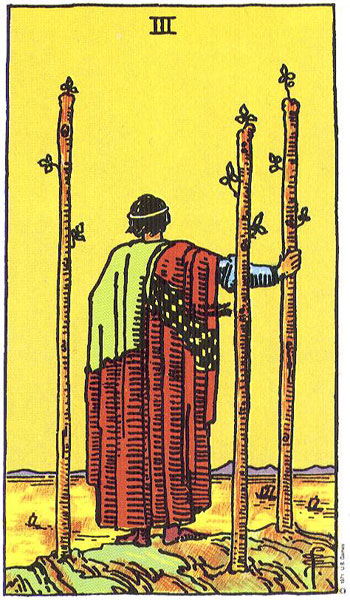
If you have come here looking for the three of wands tarot card meaning, the most useful starting point is to be clear about what the card is and is not. A Minor Arcana card, ranked Three, carries the more modest claim of a pattern in everyday life rather than a sweeping destiny. The Three of Wands describes a specific texture of growth: it appears when a project that began as personal initiative is ready to take in feedback, expand outward, and meet the wider world.
This page is a reflective guide, not a forecast. Tarot, used honestly, is a structured prompt for noticing what is already happening. It does not predict outcomes, and it has no proven power to influence external events. The value of working with a card lies in slowing down enough to look at your own situation with fresh questions. The following sections take the upright meaning, the reversed meaning, and the card's reflective question, and translate them into something you can test against your own day.
What Upright Means: Initiative Meets the Wider Field
The upright Three of Wands describes "growth through participation, feedback, or expansion expressed through initiative, creative energy, and purposeful action." Read that carefully, because it is the whole spine of the card. Three distinct movements sit inside this kind of creative action: something you began, the wider field you are now entering, and the kind of energy you bring to that meeting.
The first movement is initiative. You started something, perhaps quietly, without yet knowing how it would be received. The second movement is participation, feedback, or expansion. Your first version is leaving the room where it was made and entering a space where other people, or larger systems, can respond to it. The third movement is the quality of energy you carry into that wider space. The card suggests it should be purposeful and directed at work that matters to you, rather than scattered.
The constructively worded summary for this orientation is "directing energy toward work that matters." That is a useful filter. It does not ask whether your project is impressive, profitable, or approved by anyone else. It asks whether the effort is genuinely yours and whether it points somewhere that feels meaningful to you. When those two conditions hold, the card's image of growth fits the situation fairly well.
If you are reading this card upright in a spread, the invitation is not to wait. It is to keep moving, but to do so in a way that widens your circle of input. Send the draft. Show the prototype. Ask one person whose taste you respect. Open the door that has been waiting.
What Reversed Means: Blocked Channels and Quiet Burnout
When the same card appears reversed, the underlying pattern is the same, but the direction has been disrupted. The supplied wording notes that "the same pattern may be blocked, internalized, or showing its shadow through burnout, impatience, or effort without a stable direction." That sentence has three quietly different problems inside it, and treating them as one would be a mistake.
Blocked means there is a wall between your initiative and the wider field. You may be willing to act, but the feedback loop is not opening. Internalized means the energy has turned inward; you are doing more thinking and rehearsing than doing, or you are doubting the work before anyone else has seen it. Shadow through burnout or impatience means you have been pushing without the recovery, the support, or the orientation that purposeful action requires. Effort without a stable direction is the most subtle of the three. You are busy, but the busyness has no clear shape.
A useful way to read the reversed card is to ask which of these three textures fits your week. Sometimes the honest answer is two of them at once. Naming the texture is more useful than deciding whether the card is "good" or "bad." Reversed cards are not warnings against action; they are pointers to where the action is misaligned.
If you draw this card reversed and you recognize burnout, the practical question is not whether to push harder. It is what support, rest, or feedback is missing. If you recognize impatience, the question is whether you have allowed enough time for the wider field to respond. If you recognize effort without a stable direction, the question is which single thread you would like to follow for the next two weeks.
A Realistic Example: Sending the First Newsletter
Consider a low-stakes example that fits the upright meaning cleanly. A reader has been drafting a short weekly newsletter about their work for several weeks. They have written four issues in private, polished them, and sent them only to themselves. They feel growing energy for the project but also a quiet sense that nothing is happening with it.
The Three of Wands, read upright, would suggest that growth now lives outside the first form. The first form is the private draft. The wider field is the public send. The act that matches the card is small but specific: send issue one to twenty people, or post it in a forum where readers of the topic already gather. There is no need to predict whether it will succeed. The card is not saying it will. It is saying that the next step is to let it leave the room.
If, instead, the same reader has been sending issues every week for a month but is starting to feel tired and resentful about the practice, the reversed reading is a better fit. The pattern is no longer healthy outward movement. It has slid into effort without a stable direction, or perhaps into burnout. The honest question is what the newsletter is for and whether the time spent on it is being replenished by the responses, the writing itself, or some other quiet reward. If the answer is no, the card's reflection question, asked gently, can be a useful starting point.
A Common Misreading: Confusing Expansion With Success
The most plausible misreading of the Three of Wands, given the supplied facts alone, is to treat growth as a synonym for success. The card speaks of expansion and of growth that arrives through feedback and participation. It does not speak of applause, profit, or endorsement. A reader who is hoping for confirmation that their project is "working" can quietly slip from noticing outward movement into demanding outward validation.
This misreading is worth naming because it shapes what people do next. If the card means success, then a slow or muted response from the wider field reads as failure. If the card means growth, the same slow response reads as useful information. The first reading tends to shut things down. The second reading tends to refine the next step.
Another way this misreading shows up is at the level of pace. The card's keywords, including initiative and action, point to the reader's contribution rather than to the timeline of return. If you find yourself watching for outcomes that have not had time to happen, you may be reading the card as a forecast rather than a prompt. The honest response is to slow your expectations down and notice what is already in motion.
A Short Reflective Practice Using the Card's Question
The supplied reflective question for this card is: "Who or what could help this move beyond its first form?" That is a precise and useful prompt, and it works for both the upright and the reversed orientation, though the answer looks different in each case.
A simple practice is to write the question at the top of a journal page. Below it, write three short lists. The first is names of people, two or three, whose perspective you trust and whose taste is honest rather than merely kind. The second is resources, including time blocks, tools, mentors, or quiet hours, that you currently have but are not yet using. The third is small structural changes, such as a deadline, a public commitment, or a format shift, that could move the work out of its private shape.
Below the lists, write one sentence that names the single next step you could take this week. Keep it small enough that you can actually do it. Below that, write a sentence that names the kind of response you are hoping to avoid optimizing for, since that is often the place where the misreading hides.
If you have drawn the card reversed, replace the lists with a shorter set. Write one sentence about which of the three textures, blocked, internalized, or burnout and effort without direction, fits the past two weeks. Write a second sentence about what support, rest, or clearer scope would help. Write a third sentence about the single thing you can let go of for now.
What the Three of Wands Cannot Decide for You
It is worth saying plainly what this card does not do. It does not predict whether your project will succeed. It does not tell you which person to hire, which offer to take, or whether to stay in a relationship. It does not diagnose medical conditions, settle legal questions, or replace financial advice from a qualified professional. It does not know what another person is thinking.
If the situation you are reflecting on touches any of these areas, the right response is to seek real evidence and qualified help. Use the card to organize your own thinking, then bring the decision to a professional, a trusted friend, or a source of reliable information. The card's usefulness is in clarifying your own posture, not in substituting for outside expertise.
What the Three of Wands can do, when read carefully, is point to a specific kind of moment: the moment when a personal initiative is ready to meet a wider field, and the next step is to widen the circle deliberately. Read as a prompt rather than a forecast, it is honest about what it offers. Read as a verdict, it will mislead you. The choice is yours, and so is the next step.
Share this article