Reading the Card as a Diagnostic Cue
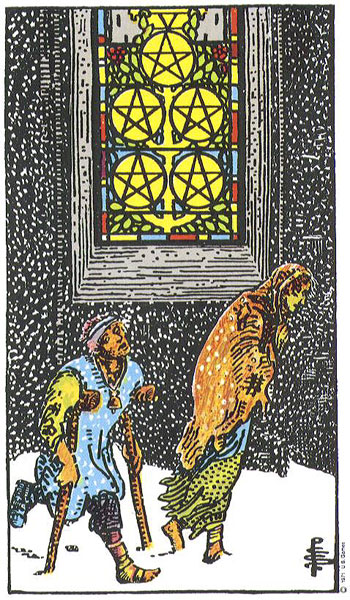
The Five of Pentacles tarot card meaning centers on a specific kind of pressure: friction that exposes a weak assumption or unmet need. That phrasing is worth pausing on, because it changes how the card reads. It is not a verdict on your finances, a forecast of hardship, or a moral judgment about whether you have done enough. The card names a pressure pattern and points at where the pressure is doing diagnostic work — surfacing something that was already quietly off-kilter.
A useful starting frame is to treat this card as a question card rather than an answer card. The card's own reflection prompt is exactly that: "What is the disagreement, loss, or pressure revealing?" When a reading lands on it, the first task is to notice where in daily life friction is loud enough to interrupt autopilot. The friction is the signal. The signal is pointing at an assumption that is no longer holding, or a need that has been unnamed for too long.
It also helps to note what the card is not doing. It is not claiming that material loss is inevitable. It is not diagnosing a person as "behind" or "lesser than." It is not locating meaning in supernatural causation. Tarot is not a prediction. The card is a structured prompt for reflection, and the value of the prompt depends on what you bring to it in honest observation.
Where Friction Tends to Surface: Work, Body, Routine, and Material Conditions
The suit of Pentacles anchors the card in concrete, observable territory: work, resources, the body, routine, and material conditions. So when you sit with it, the diagnostic question is practical rather than abstract. Where, specifically, is the pressure showing up?
In work, the cue might be a recurring bottleneck in a project you have been pushing through. A workflow that used to function now stalls. A deliverable that should be routine begins to take twice as long. Sometimes the pressure is social: a mismatch between how you are being measured and how you are actually contributing. The card invites you to ask what assumption about the work has quietly expired.
In resources, the cue often appears as a thinning of margin. Savings dip, a recurring expense creeps upward, or a household budget loses its slack. None of this needs to be catastrophic to register. A small, persistent shortfall can be more diagnostic than a single dramatic event, because it points at a structural imbalance that has been tolerated.
In the body, the cue can show as fatigue that does not resolve with rest, a recurring tension pattern, or a sense of running on fumes. The card's grounding in material conditions makes the body a legitimate place to look. Pressure is rarely only in the mind.
In routine, friction often appears where structure has eroded. Sleep timing drifts, meals become reactive instead of intentional, or small daily practices get dropped one by one until the day feels unmanaged. None of these by themselves mean anything. Together they can mark the moment when a routine that used to support you is no longer doing so.
The point is not to inventory complaints. The point is to locate where the assumption is weakest, because that is where the diagnostic value of the card lives.
The Pause Before Rebuilding: A Constructive Direction
The card's tone is pause, and its constructive direction is building something useful through steady, observable practice. That sentence does two things at once, and it is worth holding both. The pause is not a withdrawal. It is a deliberate slowing down so that the rebuild is informed by what the pressure just taught you.
A pause, in this sense, looks like stepping back from a workflow long enough to map where it breaks. It looks like reading a bank statement line by line for a single afternoon instead of flinching away from it. It looks like admitting a routine has slipped and choosing one small anchor to restore, rather than redesigning the whole day in a burst of willpower.
The "observable practice" language is also deliberate. The card is steering attention toward what can be checked and measured in ordinary life, not toward what can only be felt or hoped. Observable practice means a habit you can verify with a calendar, a number you can chart, a conversation you can have and follow up on. The constructive direction of this card rewards consistency over intensity. It asks for steady repetition rather than dramatic overhaul.
This is where the card diverges from a more typical reading of "hardship." Even when material conditions are tight, the card's constructive direction points at what can be built now, in this week, with what is actually on hand. The emphasis on the body, routine, and material conditions is also a reminder that reconstruction begins in the concrete, not in the abstract.
Reversed and the Scarcity Loop
The reversed Five of Pentacles describes the same pressure pattern — a weak assumption or unmet need that is now surfacing — but in a different configuration. The pattern may be blocked, internalized, or showing its shadow through scarcity fixation, stagnation, or treating measurable value as the only value.
Three shapes of reversal are worth distinguishing, because each suggests a different reflection move.
First, the blocked reversal: the signal is present but ignored. Someone is feeling the pressure and has arranged their day so they never sit inside it. Busyness becomes the way of not looking. Reflection here is mostly about creating a moment to actually face the data: the bank balance, the calendar, the conversation that has been deferred.
Second, the internalized reversal: the pressure has been turned inward and now reads as personal deficiency. "I should have seen this coming," "I am bad with money," "I am not disciplined enough." The diagnostic value of the card gets lost in self-blame. Reflection here is mostly about separating the pattern from the person. A weak assumption is not a weak person.
Third, the shadow reversal: the pattern has hardened into a scarcity fixation. The card warns that measurable value can become the only value. Money, output, status, and visible progress get treated as the sole yardstick. Rest, relationship, recovery, and unstructured time get coded as waste. Reflection here is mostly about widening the yardstick, deliberately.
The reversed card does not promise relief. It asks you to be precise about how the same pressure is showing up in a subtler form.
A Realistic Low-Stakes Example
Consider a freelance designer who has been billing the same hourly rate for three years. New client work has slowed, and a recurring software subscription has crept up. The pressure is not a crisis. It is a slow thinning: a few weeks of slightly thin months, a project that took longer than expected, a small unexpected expense. Nothing dramatic.
If this person pulls the Five of Pentacles upright, the diagnostic frame fits cleanly. There is a weak assumption — that the rate from three years ago still reflects current value — and an unmet need — that the business model needs a review it has not received. The friction is doing useful work if the designer treats it as data: what is the assumption, and what would a reset actually look like?
If the same card appears reversed, the diagnostic shifts. The pattern is still there, but the designer may be responding by working longer hours without raising rates, by avoiding the bookkeeping, or by treating every quiet week as proof that they should work for less. The scarcity frame has begun to organize decisions.
The verification step is straightforward. Look at last month's invoices and last month's expenses. Count the hours billed. Compare to the same window a year ago. The numbers are the disconfirming evidence if the assumption held, and the confirming evidence if it did not. No intuition required.
This example is deliberately low-stakes. There is no medical, legal, or financial decision embedded in it, and the verification does not require any special knowledge. It is the kind of moment where the card's reflective function can be practiced without stakes.
Misreadings Worth Naming
A plausible misreading of this card is to take it as confirmation of hardship and stop there. The Five of Pentacles can be read as a sympathetic witness to difficulty, and the reader can stop at the witnessing. That is not wrong, but it leaves most of the card's value on the table. The card's own frame is diagnostic: it is asking what the difficulty is revealing, not whether the difficulty is real.
A second plausible misreading is to assume that the card points only at money. The Pentacles suit does include material and financial conditions, but the card's framing also names the body, routine, and work as part of the territory. Reading the card as a money-only signal can lead to missing the cue elsewhere. Sometimes the friction is in a sleep pattern, a workplace relationship, or a household routine. Treating the card as a financial oracle narrows what it can teach.
A third misreading is to convert the reflection prompt into a forecast. "What is the disagreement revealing?" becomes, in the misreading, "Will there be a disagreement, and when?" That conversion strips the card of its reflective function and turns it into a prediction tool that it is not. Tarot is not a prediction, and this card in particular rewards being read as a prompt rather than a forecast.
A fourth misreading is to ignore the disconfirming evidence. If the pressure is loud, it is easy to assume that every related signal confirms the worst. But friction can also expose assumptions that turn out to be solid. The card is asking the reader to look closely, and "closely" includes the possibility that the assumption has been holding, and the pressure is coming from somewhere else.
Journal Questions to Verify in Your Own Life
The following questions are written to be answered with observable evidence rather than interpretation. They are designed to put the friction on paper so it can be examined rather than felt.
What is one specific place in your week where friction has been recurring for at least two weeks? Describe it without interpretation. Who, what, where, and how long.
What assumption about work, resources, the body, or routine was true a year ago and may no longer be accurate? Write the assumption in one sentence.
What unmet need is the friction pointing at? Try to name it without immediately proposing a solution.
If the card landed reversed for you, which of the three shapes — blocked, internalized, or scarcity fixation — fits the most recent two weeks? What would a small, observable experiment look like that tests the assumption instead of reinforcing it?
What measurable value are you currently treating as the only value? What is one alternative you could track for a week alongside it?
What is the smallest steady practice, repeatable this week, that would begin to rebuild the routine the pressure has eroded? Pick one. Schedule it.
For any of these questions, treat a quiet answer as data too. Not every prompt will land. The card's tone is pause, and pause sometimes means the answer is not yet ready. Note the question and return to it in a week.
If a question touches medical, legal, financial, safety, or crisis decisions, this guide is not a substitute for qualified help. Real evidence and professional advice should be the primary inputs in those domains. The card can still function as a reflective prompt in those moments, but the reflective prompt is the second voice in the room, not the first.
Share this article