What the Two of Cups Names
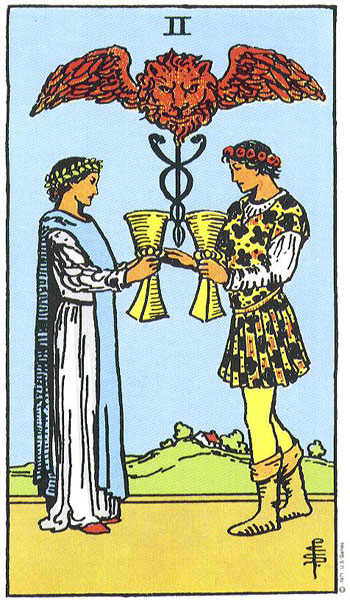
The Two of Cups tarot card meaning centers on a specific kind of situation rather than a broad life theme. Where many cups cards speak to the general terrain of feeling and connection, this card zooms in on the moment when two possibilities, people, or interpretations stand side by side and have not yet been merged. It describes a choice, a pairing, or the active effort to hold two realities at the same time and let them be examined before they are combined.
The keywords associated with this minor arcana card are a choice, feeling, relationship, and imagination. Each of these words marks a different angle on the same act of holding. A choice points to a decision that is not yet made. Feeling points to the emotional response that already exists around that decision. Relationship points to the bond, whether new or long-standing, that the choice is taking place within. Imagination points to the inner pictures the reader is forming about how things could go. The rank is Two, and within the suit of Cups that rank signals the early stage of pairing rather than the resolution that comes later in the suit.
Because the card's tone is described as mixed, the Two of Cups is not a simple positive signal. It carries the constructive direction of recognizing and communicating the emotional reality of a situation, but it also carries the friction that comes with naming two things at once. Readers who treat it as a green light miss the careful comparing the card asks for.
Reading the Card Upright
In its constructive direction, the upright Two of Cups is about noticing what is actually present in an emotional situation and being willing to say so. The constructive pairing is not a fantasy merger; it is a clear-eyed acknowledgment of two realities held in the same breath. That could be two versions of yourself, two priorities in a relationship, or two interpretations of an event that have not yet been reconciled.
The upright reading invites you to ask what you are already feeling and whether that feeling has been voiced. The card rewards the reader who can name what they notice without immediately needing to resolve it. Holding two realities at once is a skill, and this card names that skill as the meaningful step. The constructive direction is not about choosing fast; it is about choosing with emotional information in view.
Because the upright meaning includes imagination, the card also asks you to notice the stories you are telling yourself about the pairing. Imagination is part of feeling, and on the Two of Cups it is named as something to look at rather than something to surrender to. The upright reading is, in this sense, a call to clean perception before any commitment is made.
Reading the Card Reversed
The reversed Two of Cups keeps the same shape as the upright card but turns the energy inward. The pattern of holding two realities at once may be blocked, internalized, or showing its shadow. The shadow can appear as projection, where one reality is placed on someone else, as avoidance, where neither reality is faced, or as being overwhelmed by an untested feeling that has taken the place of actual comparison.
Where the upright card asks you to communicate the emotional reality of a situation, the reversed card suggests that this communication is being delayed or distorted. You may be holding two truths privately and feeling pressure to keep them apart, or you may be aware of only one of the two realities while the other works underneath. The reversed pattern is not a punishment; it is a description of how the same impulse toward pairing can stall when it is not given air.
A useful way to work with the reversed reading is to ask where the pairing is being kept hidden or where the comparison has been skipped. Sometimes the untested feeling is so loud that the second reality never gets attention. Other times the second reality is being protected so carefully that it never has to be weighed. Either way, the reversed Two of Cups is a prompt to bring both into view, gently and without forcing a verdict.
Choices Versus the Wider Emotional Context
A common source of confusion around the Two of Cups tarot card meaning is the slippage between a specific choice and the general backdrop of emotional life. Cups, as a suit, covers feeling, connection, imagination, and the flow of emotional response across many situations. The Two of Cups narrows that broad field down to a particular moment when two things stand in relation and have to be acknowledged side by side.
This distinction matters when the card shows up in a spread. If the question is about a long emotional season, such as a year of growth in a relationship, the Two of Cups is likely pointing to a single hinge moment inside that season rather than describing the whole arc. If the question is about a specific decision, the card is naming the comparing step rather than the eventual outcome. Reading it as a description of everything emotional in your life blurs the precision the card is offering.
The wider emotional context still applies, because feeling and relationship are among the keywords. The difference is one of scale. The Two of Cups names a focused act of holding and comparing within the larger field, while the broader emotional story is shaped by other cards and by real-world evidence. Keeping these layers separate is part of using the card honestly.
A Low-Stakes Example
Consider a realistic low-stakes situation: a friend invites you to a small weekend gathering at the same time a different friend asks for help moving apartments. Both events matter to you in different ways, and neither is urgent enough to force a quick answer. You notice yourself feeling pulled in two directions and quietly beginning to imagine how each day would feel.
The Two of Cups would fit this moment well. It would not predict which weekend plan you should pick. It would point to the act of holding both realities at once and being honest about the feeling attached to each. The constructive direction is to recognize what is emotional in the situation, perhaps loyalty in one direction and a desire for rest in the other, and to communicate that honestly with both friends before deciding. The reflection prompt, asking what needs to be compared instead of prematurely combined, fits here as a reminder to weigh the two honestly rather than collapsing them into a forced compromise.
A reversed reading in the same situation might describe a moment where you say yes to both out of avoidance, or where you quietly resent one friend while agreeing, or where the untested feeling that you should always be available takes the place of actually comparing what you want. The reversed card is not a verdict on either plan; it is a description of how the comparison is being mishandled.
Plausible Misreading to Watch For
A frequent misreading of the Two of Cups is to treat it as a guaranteed sign of romantic partnership or a declaration of love. Because the keywords include relationship and feeling, it is easy to slide from the card's actual focus, which is a choice to hold and compare two realities, into a prediction that a partnership is sealed. The supplied card facts do not support that reading. The card names a pairing effort and a willingness to communicate emotional reality; it does not name a fixed outcome.
Another misreading is to assume that any two-themed card must mean balance, harmony, or a finished merger. The Two of Cups is mixed in tone and explicitly asks what needs to be compared rather than combined. Reading it as a reassurance that everything is already aligned skips the very step the card names.
A third misreading is to use the card to confirm a feeling that has not been tested. If a reader notices a strong attraction and then sees this card, the temptation is to take the appearance as confirmation. The upright meaning actually points the other way: it asks you to recognize and communicate the emotional reality, which means testing the feeling against what is actually present, not against the imagination of what could be.
Journal Questions and Limits
Tarot is not a prediction. The Two of Cups does not tell you which option is right, which relationship will last, or how a feeling will resolve. It offers a structured prompt for reflection that becomes more useful when paired with real-world evidence and the advice of qualified people for medical, legal, financial, safety, or crisis decisions. Use the card as a mirror, not as a forecast.
A short set of journal questions can help you verify the reading in your own words:
- What two realities am I currently holding, and have I named both out loud? - What feeling am I responding to in each, and where did that feeling come from? - Where am I imagining an outcome instead of comparing what is actually present? - If the comparison were reversed, what would I want the other person to communicate to me? - What evidence in my day, not in the card, supports or contradicts the framing I am building?
Record ambiguity as carefully as an apparent match. If a question in your journal does not have a clear answer, that absence is data. The Two of Cups is mixed in tone precisely because holding two things at once is rarely tidy. Treating the discomfort of unresolved comparison as a flaw in the reading, rather than as the reading itself, is a way to lose what the card is offering. Stay with the comparing step, let the feeling be communicated, and let the eventual choice be made with evidence in view.
Share this article