Setting Up the Relationship Communication Tarot Spread
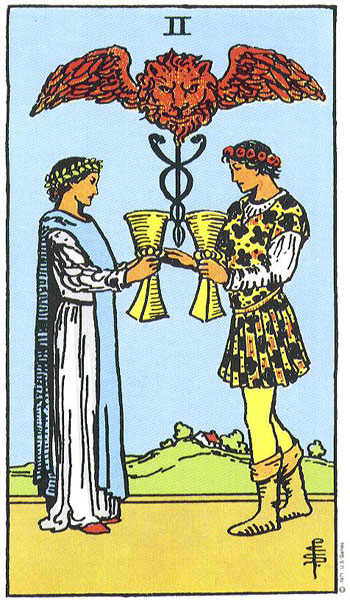
A relationship communication tarot spread works best when it frames a question you can actually take action on. Instead of asking what someone else is thinking or what will happen between you, the spread you build here is organized around three movements: what you are noticing about your own needs, where your boundaries are clear and where they are not, and what would help you enter the next conversation. The Two of Cups and the Queen of Swords are the two focal cards for this practice, each placed in a specific position that shapes how you read them.
Before laying out the cards, write down what you are already observing. What is the specific situation that prompted this question? When did it happen? What did you notice in your own body, your own words, your own reaction? Keep this short and concrete. Tarot works best as reflection rather than as prediction, and the strength of this spread comes from how you pair what the cards suggest with what you can actually verify in your own journal.
The layout we are using has three positions:
- Position 1 (left): Two of Cups, representing the emotional reality of the situation and the needs you are bringing into it. - Position 2 (right): Queen of Swords, representing the boundaries and the communication choices you are making or considering. - Position 3 (center or below): Your integration reading, drawn or written as a synthesis, which we will return to after the two focal cards are read.
For this article, we focus on the two supplied cards. If you draw both in a single sitting, place them as described. If you are working through this article without actual cards, treat the two card descriptions as a structured prompt and write your own response to each position.
Two of Cups in the Needs Position
The Two of Cups describes a choice, pairing, or effort to hold two realities at once, expressed through feeling, relationship, imagination, and emotional response. Its constructive direction is recognizing and communicating what you are actually feeling in a situation. In the needs position of your relationship communication tarot spread, this card is asking you to name what is present for you rather than what you think you should be feeling.
Two of Cups reversed shows the same pattern blocked or showing its shadow: projection, avoidance, or being overwhelmed by an untested feeling. A reversed Two of Cups in this position does not mean your relationship is doomed; it means you may be carrying an emotion you have not yet examined, and the spread is asking you to do that examination yourself before you bring it to another person.
A useful journal entry: write the situation in one sentence, then write three feeling-words that match what is in your body right now. Do not add justifications or context. Just the words. Over time, this small ritual teaches you the difference between describing a feeling and explaining it away.
The reflection question for this card is, "What needs to be compared instead of prematurely combined?" In a relationship context, this is a gentle but firm nudge toward slowing down. Two feelings, two needs, or two versions of a story can sit next to each other on the page before you blend them into one. Premature combination is when you decide, before you have actually felt the second thing, that it must equal the first.
A note on limits: the Two of Cups will not tell you what another person needs. It describes the feeling-side of a situation that you can observe in yourself. If you find yourself writing sentences that begin "they must be feeling," set those aside and return to your own notes.
Queen of Swords in the Boundaries Position
The Queen of Swords describes mature inward command and a capacity held with discernment, expressed through thought, language, decisions, and conflict. Its constructive direction is using clear distinctions and honest communication. In the boundaries position of your relationship communication tarot spread, this card asks what you are willing to say, what you are willing to hear, and where you will hold a line even when it is uncomfortable.
Queen of Swords reversed points to the same pattern blocked or shadowed: overthinking, rigid conclusions, or words used as weapons. When you see or sense this reversal in your reading, the question becomes whether your "clear communication" is actually a way of avoiding vulnerability, or whether your "boundary" has hardened into a verdict. Both are worth noticing, and both are worth recording.
The reflection question for this card is, "How can this quality be practiced without needing external proof?" Boundaries are interesting because we often want the other person to immediately acknowledge them, and we interpret their hesitation as rejection. The Queen of Swords suggests that the practice of holding a line is itself the work; external recognition may come later, or may not, and your position does not depend on that outcome.
Concrete prompts for this position:
- What is one sentence you could say out loud that names the boundary without attacking the person? - What is one sentence you would like to hear, and have you ever actually said that you want to hear it? - Where are you currently confusing a description of yourself with a verdict about the other person?
The Queen of Swords does not need theatrics. A clean, short, honest sentence is usually enough, and usually more durable than a long prepared speech.
Reading the Middle: What the Connection Between the Cards Tells You
Once you have written notes for both positions, read them out loud. This is the integrative step that turns a two-card spread into a relationship communication tarot spread rather than two separate card readings. Listen for what is repeated and what is absent.
The Two of Cups and the Queen of Swords together suggest something specific: feeling needs language, and language needs to be tested against feeling. If your notes under the Two of Cups are full of feeling-words but your notes under the Queen of Swords are full of vague softening ("I just want us to be okay"), you may be skipping the discerning part. If your notes under the Queen of Swords are full of crisp sentences but your feeling entry is empty or stretched, you may be using precision to avoid contact with the emotion.
The middle is also where ambiguity lives. Two of Cups speaks of pairing, holding, and the emotional reality of a situation; Queen of Swords speaks of mature command and the capacity held with discernment. They are not the same register. Some readers will feel them as complementary (warmth clarified by thought). Some will feel them as in tension (feeling versus analysis). Neither reading is wrong on its own; the goal is to notice which one matches your lived experience this week and which one does not.
Record both. If only one interpretation fits, that is useful information. If neither fits, write that down too. An honest "neither matches" is a valid outcome of a Tarot practice, and it often means you need more time, not more cards.
A Realistic Low-Stakes Example
Consider Maya, who has been partners with Sam for several years. Maya notices that she has been the one initiating the conversations about weekend plans, finances, and the small daily logistics that keep a household moving. She does not want to frame this as a complaint, and she is uncertain whether Sam has noticed the pattern or simply defaulted to it.
In the needs position, Maya writes under the Two of Cups: "Tired. Also relieved when Sam does initiate. Confused about why I keep doing the asking. A small grief about being the one who keeps track of everything."
In the boundaries position, under the Queen of Swords, Maya writes: "I want to stop initiating for two weeks and see what happens, but I am already imagining the conversation where Sam is hurt, so I am not sure I can hold this without slipping into either silence or accusation."
The connection between the cards, for Maya, is that her feeling-entry names something real and untested, while her boundary-entry describes a discernment she is not yet sure she can sustain alone. She is not failing the spread; she is discovering what she does not yet know.
Maya decides on one small, verifiable action: she will name the observation once, in a non-accusatory sentence, and then stop. She does not need Sam to agree or to take immediate action. She needs to know that she can hold the observation herself.
Notice what the spread did not do. It did not tell Maya what Sam is thinking. It did not predict whether Sam will respond with openness or with hurt. It did not assign blame. It gave Maya a structure for observing her own emotional reality (Two of Cups) and her own communication choices (Queen of Swords), and a clear place to check whether those two sides match.
Reversed or Stuck Patterns: Recording What Does Not Match
A serious Tarot practice records what does not match as carefully as what does. This is how the spread stays useful over time and how it stays on the right side of evidence rather than drifting into fortune-telling.
For each card, keep a small log of three things:
- Apparent match: a sentence in your journal that the card clarified, sharpened, or named. - Disconfirming evidence: a sentence that the card did not seem to fit, or that you are uncertain about, written the same day. - Ambiguity: a sentence about whether your reading depended on your own mood, sleep, or a specific recent event.
If over several sessions your Two of Cups notes consistently land in the "ambiguity" column, that is a signal worth taking seriously. It might mean you are not yet in contact with your feeling-side of the situation, or it might mean that this particular card-keyword pair is not the most useful frame for you right now. Both are valid pieces of information, and both deserve a line in your journal rather than a rewrite of the card.
The Queen of Swords in this spread can also become a control mechanism if you are not careful. If you find yourself using the "clear, honest communication" idea to draft speeches in your head, that is reversed-pattern territory. Clear communication is what happens when you can say one true sentence and tolerate the silence that follows. It is not what happens when you rehearse the perfect paragraph for a person who is not yet in the room.
Tarot is not a forecast, and these cards in particular describe patterns and ask questions; they do not predict outcomes. When you notice yourself wanting a prediction, write down what you are actually trying to anticipate and notice how little any reflective tool, including this one, can responsibly tell you about another person's choices. For medical, legal, financial, safety, or crisis decisions, use real evidence and qualified professionals rather than a reading.
Journal Questions for the Next Conversation
The final movement of this spread is the next conversation. Not the imagined, fully resolved version, the actual one, which will be messier than your notes predict. Use these prompts to prepare, and then to look back on later.
Before the conversation:
- What is one feeling I can name out loud without rehearsing the explanation? - What is one boundary I can state in one sentence, in a calm voice, without softening or sharpening it? - What am I willing to learn from this conversation, even if the answer is uncomfortable?
During or right after:
- What did I actually say, in one sentence, as close to verbatim as I can write it down? - What did the other person say that I had not predicted? - Where did my body change during the conversation, and what does that suggest about what mattered most?
A few days later:
- What in my journal still feels accurate, and what now looks like projection, overthinking, or untested feeling? - Did my boundary hold, and if not, what was the specific moment it bent? - What would I want to say differently next time, and is that realistic or am I editing for an imagined audience?
This is where the spread becomes a practice rather than a one-time reading. The relationship communication tarot spread is not finished when you put the cards away; it is finished when you have lived with the questions long enough to answer some of them in your own handwriting. The Two of Cups and the Queen of Swords will keep doing this work with you, as long as you return to them honestly, watch for what does not match, and resist the temptation to let the cards speak in place of the next conversation you actually owe yourself.
Tarot is a reflection practice, not a prediction. This guide cannot determine future events or replace direct evidence and qualified help for medical, legal, financial, safety, or crisis decisions.
Share this article