Why a Framework Beats Rote Meanings
A common first encounter with tarot involves scrolling through long lists where each card seems to carry a fixed verdict. That approach is fragile. The same symbol can support very different readings depending on the question, the surrounding cards, and the reader's prior assumptions. A learning framework replaces memorization with a repeatable method you can test and adjust.
The framework described here has three layers:
- **Suit** asks what aspect of life is being examined: action and direction (Wands), feeling and relationship (Cups), thought and communication (Swords), or work and material conditions (Pentacles). - **Number** asks where in a developmental arc the card sits: a beginning, a pairing, a widening, or a stabilization. - **Court rank** asks what role is on the field: Page, Knight, Queen, or King. This is treated as a function, not a personality label.
Treating the cards this way makes the system portable. You can hold a deck you have never studied before and still reason about it, because the layers are consistent even when the artwork changes.
One honest note before we go further. Tarot is not a prediction. It does not forecast events, reveal hidden intentions, or diagnose medical, legal, or financial conditions. What it can do is offer structured prompts for reflection. The value of any reading depends on whether it prompts useful self-questioning, not on whether the future arrives as described. Real decisions should rest on real evidence and qualified advice.
The Four Suits: Four Lenses, Not Four Boxes
The four suits are best understood as four lenses on the same situation. A question about a new project might be read through Wands (energy and direction), Cups (how the idea feels), Swords (how it will be communicated), or Pentacles (what resources it requires). Each lens can return something the others miss.
Within tarot suits and court card meanings discussions, the suits are usually summarized by an elemental association: fire for Wands, water for Cups, air for Swords, earth for Pentacles. Elemental language is a useful shorthand, but it should not be mistaken for a scientific claim. It is a way of remembering which kinds of evidence belong to which suit.
A simple discipline is to ask, when you read any card: *what would I be paying attention to if this were the only lens available?* Then, when you add a second or third card, notice how the lenses begin to talk to each other.
Numbers 1-4: How a Sequence Develops
Numbered cards in the Minor Arcana are often taught as a developmental sequence within each suit. The first four cards move from a spark of intention through pairing, expansion, and consolidation. The sequence is a model, not a law. A real situation can jump around.
### The Ace as a concentrated beginning
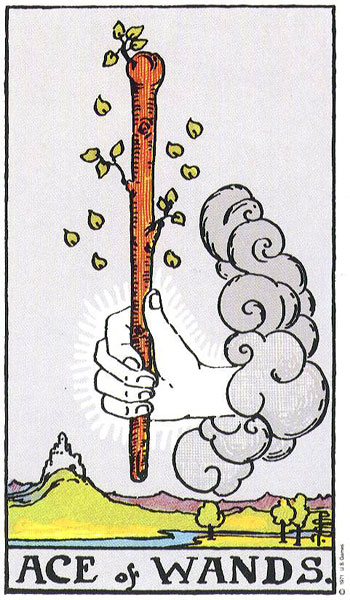
Aces mark openings rather than outcomes. The **Ace of Wands** describes a concentrated beginning or opening expressed through initiative, creative energy, and purposeful action, with a constructive direction of directing energy toward work that matters. Imagery worth noting: many traditional decks show a hand emerging from clouds, offering a sprouting wand. The gesture is open and outward; nothing is gripped or hidden. That posture supports the upright meaning and signals where reversed or shadow readings might look: an opening that feels blocked, internalized, or burned out, shown through impatience or effort without a stable direction. A useful journal question is *what small beginning would let me learn quickly?*
### The Two as a pairing
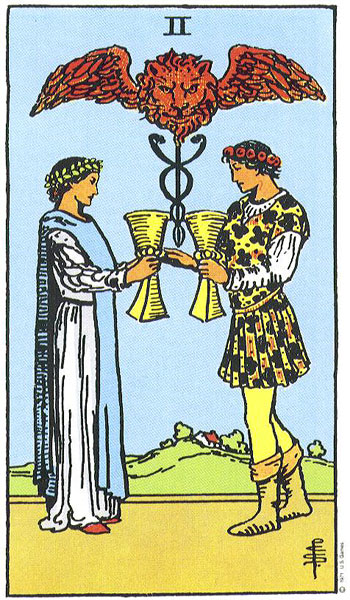
Twos introduce comparison and the effort to hold two realities at once. The **Two of Cups** describes a choice, pairing, or effort to hold two realities at once expressed through feeling, relationship, imagination, and emotional response. Its constructive direction is recognizing and communicating the emotional reality of a situation. Common imagery shows two figures raising matched cups toward each other, often above a caduceus or lion's head. The matched posture suggests reciprocity, but reciprocity is an ideal rather than a guarantee. Reversed or shadow readings point to projection, avoidance, or becoming overwhelmed by an untested feeling. A useful journal question is *what needs to be compared instead of prematurely combined?*
### The Three as growth through participation
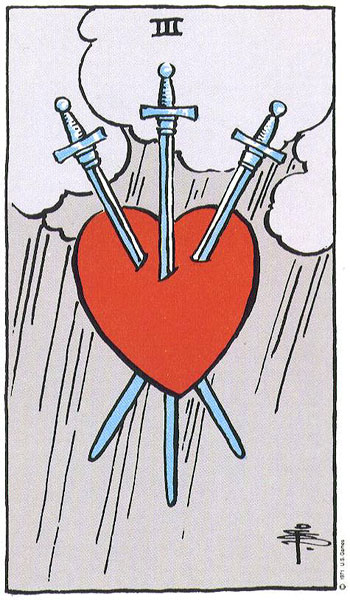
Threes are where a pattern begins to be tested in the open. The **Three of Swords** describes growth through participation, feedback, or expansion expressed through thought, language, decisions, and conflict, with a constructive direction of using clear distinctions and honest communication. Traditional artwork shows a heart pierced by three swords, often under rain. The image is striking, but it is worth recording how often a single symbol has been used to mean heartbreak. Conflict and growth are linked here, not identical: the card is about how clear distinctions and honest communication can do useful work even when the subject matter is painful. Reversed or shadow readings include overthinking, rigid conclusions, or words used as weapons. A useful journal question is *who or what could help this move beyond its first form?*
### The Four as stability and containment
Fours are where the system tries to settle. The **Four of Pentacles** describes stability, containment, and the consequences of holding a position expressed through work, resources, the body, routine, and material conditions. Its constructive direction is building something useful through steady, observable practice. Imagery often shows a seated figure holding or guarding four coins, sometimes crowned with a fifth, with feet planted on the ground. The closed posture supports a reading about defense and holding. The same posture, viewed differently, also describes conservation, thrift, or a needed pause. Reversed or shadow readings include scarcity fixation, stagnation, or treating measurable value as the only value. A useful journal question is *is the current structure providing rest or preventing movement?*
Court Cards as Roles, Not Personality Types
Court cards are often the most misunderstood layer of the framework. They are sometimes taught as personalities: the Page is a curious child, the Queen is a nurturing woman, and so on. That reading is reductive and tends to flatten real people into fixed labels.
A more defensible approach is to treat each rank as a role that can appear in any reading, regardless of who is involved.
- **Page** carries a message, a sample, or a first attempt. The Page's contribution is often small but instructive. - **Knight** describes movement, pursuit, or the energy of action without yet arriving. - **Queen** describes a settled capacity within the suit's domain: someone or something that has integrated the suit's skill and can hold steady. - **King** describes governance, accountability, and the responsibility to act on behalf of the whole.
When you see a court card, ask: *what role is showing up in this situation right now?* The answer may be a part of you, a part of someone else, a dynamic in a group, or an abstract force. Recording the role you assigned makes it easier to revise later if the reading does not match what actually unfolds.
A Worked Example Using the Supplied Cards
Imagine a low-stakes situation: you have been invited to give a short talk at a local meetup, and you are deciding whether to accept. You draw three cards: the **Ace of Wands**, the **Two of Cups**, and the **Four of Pentacles**, in that order.
Reading through the framework:
1. **Suit mix.** Two Wands or Wands-adjacent cards are not present here; the Ace stands alone as the only fire card. The reading leans toward feeling and material conditions. Energy is available, but the decision is being shaped more by emotional and practical considerations than by raw initiative. 2. **Number flow.** Ace, Two, Four skips Three. Skips are normal. Notice that the missing Three, often about growth through feedback, is not currently named in the spread. Recording the absence is part of the method. 3. **Imagery cues.** The open hand of the Ace and the matched posture of the Two both suggest reciprocity and outward gesture. The closed posture of the Four suggests holding. A reasonable first-pass reading is that an opening is available, that it requires some kind of pairing or exchange with the audience, and that holding back too tightly is the most likely failure mode.
A plausible interpretation: accepting the invitation could be a healthy opening if you are willing to compare your idea with what the audience already knows, and if you do not over-protect the talk by rehearsing it into silence. A plausible disconfirming reading: the same three cards in a different context might describe a partnership that needs to be re-opened and a savings plan that is too rigid.
Both readings are consistent with the cards. Neither is the cards.
Recording Ambiguity and Disconfirming Evidence
A reading is only as useful as the record that follows it. Before and after the situation you read about, write a short note covering three items:
- **What you saw in the cards, in plain language.** Resist translating too quickly into advice. - **What you expected to happen.** Note hopes and fears separately, because they bias interpretation. - **What actually happened, even if it contradicts the reading.** Disconfirming evidence is more valuable than confirming evidence, because it is rarer and easier to forget.
A small but disciplined habit is to score your reading on a simple scale: did any single card match what unfolded closely, partially, or not at all? Cards that do not match deserve as much attention as cards that do. If you find that one suit always seems to land and another never does, that pattern is information about your reading habits, not about the world.
A few journal prompts you can verify:
- Which card did I remember most clearly, and why? - Which card did I skip or minimize, and what might I have missed? - What did I expect to happen that did not? - What happened that I had no language for during the reading? - If I redraw the same three cards a year from now, what will I have learned?
These prompts are not predictions. They are ways of turning a reading into a record you can return to, revise, and learn from.
Closing Notes on Use and Limits
A framework is a tool, and like any tool it has limits. The suits, numbers, and court cards in this tradition describe patterns that many readers find useful for reflection, but they do not determine outcomes. Treat any reading as one input among several. For decisions involving health, safety, law, or finance, rely on qualified professionals and on evidence you can verify.
If you are learning tarot suits and court card meanings for the first time, the most useful early practice is to read a small spread, write down your interpretation, then wait. The patience of waiting is what turns a list of meanings into a working framework.
Share this article