Why a Two-Path Spread Works for Real Decisions
Most card layouts ask what is happening or what is coming. A two path tarot spread for decisions instead asks something more useful: what would I have to believe, and what would I have to give up, in order to choose A or B? The frame is comparative rather than prophetic. It treats the cards as a structured prompt for thinking, not as a forecast that bypasses thought.
When two options feel stuck, the cause is rarely a lack of intuition. It is usually an asymmetry in the evidence we have gathered, a reluctance to name costs, or a hidden assumption that one path must be obviously correct. A comparison layout gives each option its own column and forces the costs, evidence, and unknowns into the open.
This spread is best suited to reversible, low-stakes choices where a small real-world test is possible. It is not a tool for medical, legal, financial, or safety decisions that need qualified help. Tarot is not a prediction. It does not know which job you will be offered, whether a relationship will last, or which route is objectively safer in a storm. What it can do, when used as designed, is help you notice what you have already half-decided and what you have not yet examined.
The Two of Swords in a Comparison Layout
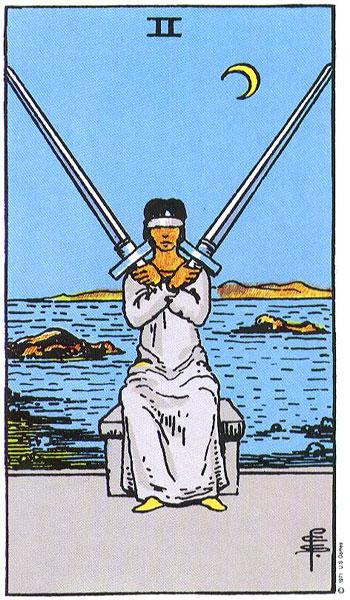
The Two of Swords describes a choice held in thought, where two realities are kept side by side rather than prematurely merged. In a two path tarot spread for decisions, this card often lands in the center, marking the act of comparison itself. Its constructive expression is clear distinctions and honest communication. Its reversed form signals that the choice has stalled: overthinking, rigid conclusions, or words used as weapons, including self-talk that frames one option as foolish before it has been tested.
When the Two appears upright, the work of the spread is mostly intact. You can name both paths, and you are willing to keep them distinct long enough to learn something. A useful prompt at this card: What needs to be compared instead of prematurely combined? This is rarely the obvious comparison. It is often the comparison you sense will be uncomfortable, because it asks you to give up a comforting story about one of the options.
When the Two lands reversed, treat it as a signal that the comparison has been quietly avoided. You may be using silence, vague language, or a general sense that things will work out, instead of writing down the actual costs. Note this as ambiguity to record, not as an answer about which path is correct.
Justice as the Weighing Function
Justice is the Major Arcana card for evidence, accountability, proportion, and a decision that can withstand careful examination. Placed at the foot of a comparison layout, it asks the most important question of any decision: What facts and consequences should be placed side by side before deciding? Upright, Justice calls for weighing what is actually known and what is owed. Reversed, it warns that relevant information may be missing, that responsibility has been displaced, or that a standard is being applied unevenly between the two paths.
In a two path tarot spread for decisions, Justice is where the temptation to favor a favorite option gets tested. People often weigh path A against an idealized version of path B, or compare present discomfort on path A against a hypothetical future benefit on path B. Justice insists on proportion: the same kinds of facts, at the same level of detail, on both sides.
A useful discipline at this card is to ask, for each option: what would change my mind? If the answer is nothing, you are not weighing, you are justifying. If the answer is clear, you have a real test for a decision.
Building the Spread: Positions and Prompts
A workable two-path layout has six positions, three for each option. The center can be the Two of Swords; the foot can be Justice.
Option A, top: The case for A. What looks attractive, affordable, or aligned with your values, stated honestly. Option A, middle: The cost of A. Time, money, energy, relationships, reputation, opportunity cost. Option A, bottom: The evidence for A. What you actually know, from observation, conversation, or past experience. Mark inferences separately from facts.
Option B, top, middle, and bottom mirror the same three categories. Center: Two of Swords. The honest comparison, naming where the options cannot be combined. Foot: Justice. The weighing. What facts and consequences should be placed side by side before deciding.
The prompts are not fortune-telling questions. They are investigative ones. For each position, write down your first answer, then write what would be needed to falsify it. This is how a reflective spread becomes a decision tool rather than an affirmation ritual.
When you draw, treat near-misses and surprises as information about your own framing, not as messages from the cards. If the layout produces an obvious answer you already wanted, write it down and then deliberately look for the disconfirming evidence. Record ambiguity and disconfirming evidence as carefully as an apparent match.
A Low-Stakes Example: Two Commute Options
Suppose someone is weighing two commute options for a new job. Path A is a 25-minute drive with predictable traffic. Path B is a 45-minute train ride with a transfer and time to read. Neither is urgent, both are reversible within a month, and the difference in pay is small enough that other factors matter.
Top of A: predictable schedule, no transfers, door to door. Top of B: time to read, no driving stress, slightly better sleep on commute mornings.
Middle of A: gas, parking fees, wear on the car, less reading time, fatigue on long days. Middle of B: longer total time, weather delays, the cost of the monthly pass, a transfer that occasionally misses.
Bottom of A: you have driven this route for years and know the traffic patterns. Bottom of B: you have ridden this line twice and liked it, but you have not ridden it in winter or during a sick day.
In this example, the Two of Swords would mark the genuine trade-off: time at the wheel versus time with a book. Justice, at the foot, would push back on the natural temptation to idealize B as more pleasant, by asking what you would learn from a one-week reversible test. The card does not say which commute is better. It says, run the test and weigh the evidence on both sides.
This kind of small reversible test is the heart of a two path tarot spread for decisions. It uses the cards to surface assumptions, then it sends you out to gather the evidence those assumptions were hiding.
Reversed Cards and Shadow Signals
A reversed card in a comparison layout is not automatically a warning. It is a signal that the upright meaning is blocked, internalized, or expressing its shadow. The Two of Swords reversed asks whether the choice has become overthinking, rigid conclusions, or words used as weapons. Justice reversed asks whether relevant information may be missing, responsibility is being displaced, or a standard is being applied unevenly.
In a low-stakes commute decision, a reversed Two of Swords might show up if you have been telling yourself that the choice is silly because it does not matter much, while also avoiding the actual numbers. A reversed Justice might show up if you are weighing A against an imagined best-case version of B, instead of against B as it actually is on a rainy Tuesday.
Shadow signals deserve the same rigor as apparent matches. The temptation is to use a reversed card as an excuse to dismiss an option. The discipline is to ask what the card is pointing at in your thinking, then to verify it with a small piece of evidence. If the verification supports the signal, you have something to write down. If it does not, you have learned that the signal was a bias in your framing, which is also worth writing down.
The summary of the journal entries, not the cards, is what becomes useful later. A two-path spread leaves you with a record of what you assumed, what you checked, what you missed, and what you would need to learn next.
Moving from the Table to a Reversible Step
The last step of a two path tarot spread for decisions is the one that the cards cannot do alone. They design the questions. You run the test. A reversible step is a small action that gives you new evidence and can be undone if it turns out wrong. A one-week commute trial is reversible. A two-week trial of a new morning routine is reversible. A weekend trip to test a city before a longer move is reversible.
When you come back from the test, you do not need to redraw. You can reread your journal entries and weigh what you learned against the original assumptions. This is where Justice, the weighing function, does its real work, after the evidence has arrived.
If the decision still feels unclear after a real test, that is also information. It often means the options are closer than the story you have been telling about them, or that a third option exists that the comparison itself was hiding. Naming that openly is more useful than pretending the cards have already answered.
Tarot is not a prediction. The two-path layout is a reflective tool, not an oracle. For medical, legal, financial, safety, or crisis decisions, use real evidence and qualified help, not the cards. The cards can help you notice what you have been assuming. They cannot tell you what is true.
Share this article