What the Strength Card Shows: A Look at the Imagery
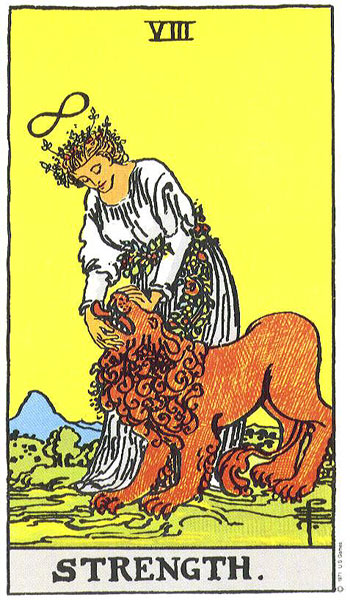
The Strength card is the eighth card of the Major Arcana. In most traditional decks that use classical Rider-Waite-Smith-style imagery, the picture shows a calm figure, often depicted as a woman, standing beside or gently holding open the jaws of a lion. Above the figure there is often a lemniscate, the figure-eight shape that resembles a horizontal infinity symbol. The setting is usually a green landscape or garden, and the figure is sometimes dressed in white with a blue mantle or in a flowing gown. The figure is not wrestling the lion or striking it. There is no weapon visible. Instead, the figure's hands rest on the lion's head or mouth, and the lion appears subdued but intact, not injured.
These visual choices are the foundation of the strength tarot card meaning. They are the part of the card a reader can describe without making claims about the querent's life. The image itself shows three things consistently across major traditional decks: the pairing of two unequal beings, the calmness of the figure doing the handling, and the use of touch rather than force.
The pairing of a human with a powerful animal suggests something that ordinary pressure cannot subdue. The calmness of the figure suggests that influence does not require loudness or physical domination. The open-handed contact rather than a chain or weapon suggests that influence over a strong force can be a relationship rather than a victory.
When you look at the card, it is reasonable to note what you see and what is missing. The figure is not exhausted. The lion is not diminished. The scene is open, often with a landscape that extends into the distance. These details matter because any interpretation you build from the card is interpretation, not discovery. You are choosing what to emphasize, and that choice deserves to be visible to you.
What Strength Can Mean in an Upright Reading
The traditional upright meaning of Strength is steady courage, self-regulation, and influence exercised without unnecessary force. This is a specific combination, and the words matter. "Steady" is not the same as loud. "Self-regulation" is not the same as control of others. "Influence without unnecessary force" leaves open the possibility that some force is, at times, necessary, but it is not the first tool.
The keywords associated with the upright card are courage, patience, and self-regulation. Patience is the most distinctive. Many decks pair Strength with Mars-like imagery in other contexts, but this card consistently points toward the slow approach rather than the dramatic one. The reflection prompt that often appears with the upright card is, "How could patience accomplish what pressure has not?"
In practical terms, an upright Strength in a reflective reading can invite you to consider where in your life you have been pressing harder than the situation actually requires. Pressing is a habit many people develop when they feel unheard or when a previous gentle approach failed. The card does not promise that the gentle approach will work this time. It simply notes that patience and steady presence are still available as tools.
You can also read the upright meaning as a question rather than an instruction. The figure in the card is calm, but the card does not tell you how she got there. It is reasonable to ask what the figure has already practiced to be calm in the presence of something powerful. A reading that suggests you "should" be calm is not a complete reading. A reading that asks how you have built calm in the past, and whether those practices are still working, is more honest and more useful.
What a Reversed Strength Can Suggest
The reversed meaning of Strength points toward a brittle confidence, depleted reserves, or a kind of self-regulation that depends on suppressing a feeling that needs attention. The reversal is not the opposite of the upright meaning. The opposite of courage would be cowardice, but the reversed card is more often described as courage under strain. You may still be showing up, but the showing up has begun to cost more than you can quietly afford.
A common reading of the reversed Strength is that the person has been managing a difficult situation by tightening rather than by softening. The lion in the image is still present in the reversed card; what changes is whether the figure is in contact with the lion, or whether the figure is avoiding it. When a reading lands on reversed Strength, the work is often to identify what feeling has been set aside so that calm could be maintained.
Reversed Strength can also describe over-control of self, which can look like competence on the outside and depletion on the inside. The card at this angle often appears when someone has been praised for being steady for too long and has not been asked how they are doing. It can also appear when someone is using self-control as a substitute for boundaries, holding themselves still in situations that actually need a different response.
It is worth being careful with reversed cards. Reversal is an interpretive choice, and different decks treat it differently. A reader may choose to read reversed cards as blocked, internalized, or simply as the same energy turned toward the reader rather than away. Whatever the reader does, the question to bring to a journal is the same: what is the practical cost of how I have been managing this, and is that cost visible to anyone besides me?
A Grounded Example: Strength at Work in a Small Decision
A realistic example can be drawn from a low-stakes situation. Imagine someone who has been asked to take on a project at work that they do not want to do, and who has said yes three times in the last month out of habit. The upright Strength in this situation is not a guarantee that the fourth yes will succeed. It is a question about whether a slower, clearer response could serve better than another quick yes.
In this example, the lion is the discomfort of saying no and of risking a small relational friction. The figure with the lion is the part of the person that has been managing that discomfort by being agreeable. The upright card, read reflectively, suggests that another kind of response is available. The reversed card suggests that the agreeable pattern is starting to have a cost, perhaps in sleep, perhaps in irritation at home, perhaps in the slow feeling of being unseen.
A practical version of working with this card in this situation is to notice, over a week, what happens when the person responds more slowly. They do not need to refuse the project. They can ask a question, request time, or simply delay. The strength tarot card meaning becomes useful not because it predicts an outcome but because it offers a frame for paying attention. If the slow approach yields more useful information than the fast one, that is evidence the reading was pointing toward something real. If it yields the same friction either way, that is also evidence, and it should be recorded rather than ignored.
This is what tarot reflection looks like at its best. The card does not decide. The card names a pattern. You test the pattern against a week of small actions and write down what you observe, including the parts that do not fit.
Reflection Prompts to Test the Interpretation
Tarot is not a prediction. The card does not know what will happen, and no honest reader can tell you that a card has caused or will cause an outcome. What a card can do is suggest a focus, and what you do with that focus is your work. The prompts below are designed to help you test a Strength reading against real evidence rather than against wishful thinking. Record ambiguity and disconfirming evidence as carefully as you record an apparent match.
**1. Where am I pressing harder than the situation requires?** Write down the answer in one sentence, then write down one place where pressing harder has actually worked recently. If you cannot find a recent example, that is also useful information and worth noting rather than smoothing over.
**2. What feeling am I managing by staying calm?** Naming the feeling reduces its grip. If you cannot name it, describe the bodily sensation of holding yourself still. The body often knows what the mind is avoiding.
**3. How have I built calm in the past, and is that practice still working?** Practices are not static. A practice that helped two years ago can become a habit that no longer serves. Note when you last checked whether it still does what it used to do.
**4. What would patience look like as a specific action tomorrow?** Write a single sentence that begins, "Tomorrow I will..." The sentence should be small enough that you could do it without anyone else knowing, and specific enough that you can tell whether it happened.
**5. What would I observe if the reversed meaning were the truer reading?** Consider what evidence in the last two weeks supports the brittle or depleted version of the card. Record it. Disconfirming evidence is as important as confirming evidence, and a journal without it will quietly bias you toward the reading you wanted.
**6. If I ask three people who know me well, what would they say?** This is a verification step. You do not have to act on what they say. You can write their answers without responding to them. The point is to test your self-narrative against an outside view, even an imperfect one.
When you write these prompts down, write the date, the question, and your immediate answer. Then return in a week and add a second entry. Patterns become visible across entries. So do single observations that did not repeat. Both are evidence, and both belong in the record.
Limits of Tarot and When to Seek Real Evidence
It is important to record ambiguity as carefully as you record an apparent match. A reading that feels true in the moment may not survive a week of testing. A reading that feels flat may simply need more time or a better question. The honest practice of tarot reflection includes writing down readings that did not seem to fit at all and asking what was actually going on instead. That record, kept over time, becomes more useful than any single reading, because it lets you see your own pattern of attention.
For decisions about medical symptoms, mental health crises, legal questions, financial risk, or safety in a relationship or at work, a tarot reading is not an appropriate basis for action. Use qualified professionals, current evidence, and direct conversations with people who know the situation. If you are in immediate danger or in crisis, contact local emergency services or a crisis line. Tarot can be a complement to reflection, but it is not a substitute for help that is grounded in training and current information.
A useful frame for working with Strength, or with any card, is that the card is a mirror rather than a window. It reflects what you bring to it, and what you bring is shaped by your day, your week, and your worries. That is not a flaw of the practice. It is a feature. The card gives you a quiet place to ask a question. The answers, and the actions, are still yours.
Share this article