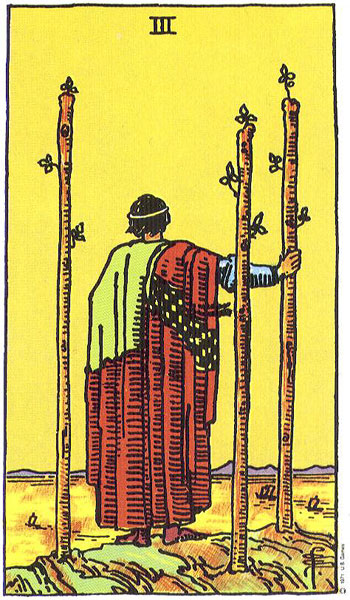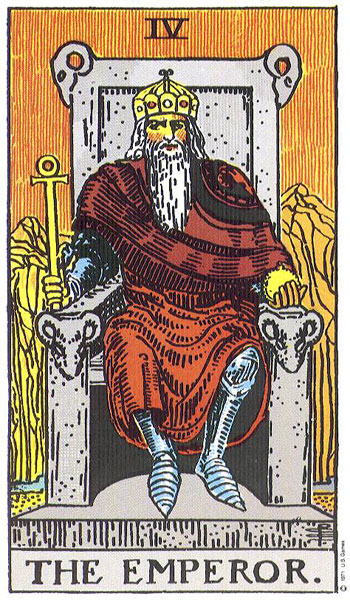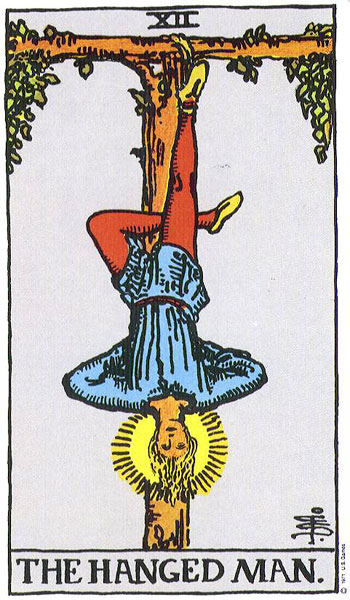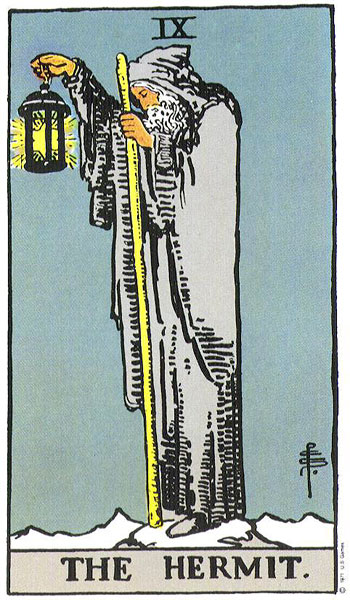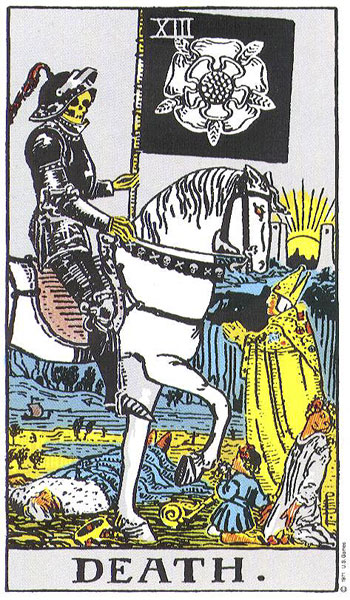
What the Card Shows: Observable Imagery
The Death card is part of the Major Arcana and carries the number 13. When you look at the card, you see a mounted skeletal figure in dark armor, often read as an impersonal force rather than a personal threat. The rider carries a banner or flag as it moves forward, and in front of the horse typically lie figures — a king, a bishop or pope, a child or woman, and sometimes a craftsman or laborer. These figures come from different stations, ages, and roles in life, suggesting that whatever the rider touches is indiscriminate in scope. The ground itself often shows a river or a sunken landscape, hinting at a wider change in environment rather than a single localized event. The sun sometimes rises in the background, a small but consistent detail that pairs the ending with light or dawn imagery.
For a reader using this card for reflection, the imagery matters less as decoration and more as a set of prompts: a mounted rider implies forward motion, not stillness; a banner implies announcement or visibility; figures of varied status imply a wide reach; dawn light implies that something follows the change. None of this is mystical by itself — it is a picture designed to nudge your attention toward what is already in motion around you.
Card Profile at a Glance
- Card: Death - Number: 13 - Arcana: Major Arcana - Upright meaning: an ending, transition, or release that makes a different structure possible - Reversed meaning: a necessary ending may be resisted, prolonged, or repeatedly renegotiated - Keywords: ending, transition, release - Tone: mixed — neither wholly bleak nor wholly hopeful
The Major Arcana in most Tarot decks is treated as a set of themes or life chapters rather than a daily forecast. Card 13 sits between restraint (12) and temperance (14) in the traditional ordering, which is itself a useful cue: an ending sits between a period of suspension and a period of measured integration. Treat that ordering as a prompt for your own reflection, not as a prediction.
Upright Reflection: Endings That Make Room
When the Death card appears upright in a spread, the upright meaning is an ending, a transition, or a release that makes a different structure possible. This is the part of the death tarot card meaning that is most often misread as doom. The supplied card data is careful on this point. The figure on the card is impersonal, the figures on the ground come from every walk of life, and the language is "makes a different structure possible" — a phrasing that emphasizes the space after, not the loss itself.
Practical reflection prompts when you read the card upright:
1. What has already stopped, even if you have not yet named it? 2. Where in your life has the structure quietly changed: a job description, a household routine, a friendship rhythm, a belief you no longer defend? 3. What small, practical thing can you do this week that acknowledges the ending — returning a key, updating a document, telling a friend, revising a plan? 4. What new structure becomes possible because the old one is no longer taking up the room?
The card does not say what you should feel about any of this. Feelings are something only you can verify, usually with your own words in a journal or in conversation with someone you trust. If you are using the card to mark a transition, give yourself permission to feel mixed; endings are usually mixed, and the card's tone is listed as mixed for that reason.
Reversed Reflection: Prolonged or Renegotiated Endings
The reversed meaning shifts the focus without changing the underlying situation. According to the supplied card data, when the Death card appears reversed, a necessary ending may be resisted, prolonged, or repeatedly renegotiated. This is not a description of failure; it is a description of delay. The ending is still implied. The question is whether you are meeting it, postponing it, or going over the same ground again.
Reflection prompts for the reversed card:
1. Where am I re-deciding something that is already decided in practice? 2. What conversations or negotiations keep circling back without moving forward? 3. What is the cost of the postponement — in time, attention, money, or trust? 4. What would "finishing well" look like, even if I cannot yet finish cleanly?
The reversed card is also a fair prompt to ask whether you are misreading an upright reading. Tarot is not a prediction, and reversals are a convention of some decks and readers rather than a universal rule. If you do not use reversals, treat the reversed description here as a separate cue you can still reflect on: where in your life right now is something you already know is over being kept alive through habit, ceremony, or fear.
A Grounded, Low-Stakes Example
To make the death tarot card meaning useful rather than abstract, consider a low-stakes scenario.
Priya has been part of a weekly volunteer group for two years. Attendance has been dropping, and the chair has announced a vote on whether the group should fold or restructure. Priya keeps saying she will "figure out her schedule next week." When she draws the Death card upright in a one-card reflection pull, she pauses.
Looking at the imagery, she notices that the figures on the ground come from different stations. This prompts her to think about who, specifically, has already drifted away — a retiree who moved, a parent with a new baby, two members who got new jobs. The ending is not a personal failure. It is already underway.
Using the upright prompts, she writes in her journal:
- "What has finished: my weekly attendance, the feeling of belonging I had there, the version of the group that was run by three specific people." - "What new structure is possible: a smaller monthly meetup, a project-based collaboration, or stepping back entirely."
She decides to support the restructure vote and offer to help plan the smaller group, instead of pretending she will resume her old role.
If Priya had drawn the card reversed, her prompts would shift:
- "What am I renegotiating that is already over?" — for her, this might be the hope that the old group will simply resume if she shows up. - "What is the cost of postponement?" — for her, this might be the time she spends mentally rehearsing the schedule every Sunday evening. - "What would finishing well mean?" — for her, this might mean sending one honest note to the chair before the vote, rather than three more "let me think" replies.
This example is intentionally small. The card is not telling Priya what to do. She is using the prompts to organize her own observations.
How to Test an Interpretation Against Real Evidence
A reflection guide is most useful when it pushes you to test what you think you have seen against what is actually true. Tarot is not a prediction, and even a well-matched interpretation can be wrong. Treat apparent matches and disconfirming evidence with equal care. This simple protocol turns the card into a set of journal prompts rather than a verdict.
A simple protocol for a journal entry after a reading:
1. State the card, its position, and the question you asked. 2. Write the interpretation in your own words in two or three sentences. 3. List three pieces of evidence that fit, and three pieces that do not. 4. Note what would have to be true in the next two weeks for the reading to hold up, and what would have to be true for it to be wrong. 5. Revisit the entry in a month and update it. This step matters more than the reading itself.
For the Death card specifically, look for evidence of:
- An actual ending already in motion, such as a signed document, a moved possession, a changed routine, or a conversation that already happened. - A transition that is observable to other people, not only to you. - A release that has created measurable space, such as reclaimed hours, a smaller inbox, a freed-up budget, or a calmer week.
Look for disconfirming evidence just as carefully:
- The situation has not actually changed; you are only imagining it has. - The change is cosmetic — a new label, a new room, a new title — with no real shift in behavior. - The "ending" is one you are hoping for rather than one you have observed. - Other people in the situation do not recognize the change at all.
If your reading survives both checks, treat it as a working hypothesis. If it does not, treat the disconfirming evidence as the real data and revise.
Limits of This Reflection
This page is a reflection guide, not a forecast. Tarot imagery is symbolic, and the death tarot card meaning varies across traditions, decks, and readers. Nothing here is a prediction about what will happen to you, when it will happen, or what another person thinks or intends. If you are using Tarot during a period of grief, sudden job loss, the end of a relationship, a medical decision, a financial crisis, or any safety concern, please rely on qualified professionals — a clinician, a lawyer, a financial advisor, a crisis line, or someone you trust in person — alongside any symbolic reflection. Tarot can be a way to slow down and name what you are already noticing; it is not a substitute for evidence or for expert help when the stakes are real.
Share this article