The Shared Pattern Among the Threes
The four Threes in the Minor Arcana share more than a number. Each one describes a moment when something that began alone or in idea is asked to grow through other people, feedback, or a wider environment. The supplied card data frames this consistently: every Three names "growth through participation, feedback, or expansion" and asks the same reflection question, "Who or what could help this move beyond its first form?" That shared spine is what makes comparing the threes in tarot across suits useful. Without it, a reader would only have four unrelated keywords. With it, the suits become variables that color the same developmental moment.
The Three is not a finished state. It sits between the spark of an Ace and the structure of a Four. Where a Two often describes a pairing or a choice held in tension, a Three asks the situation to step outward. The number is a gentle test: can what you have started now hold up when other eyes, other hands, or other conditions meet it? When a card reader sees a Three, the practical question is usually about how something is being received, not just what it is.
So before the suit matters, the pattern is the same. Once you accept that, the suit tells you which part of life is being asked to grow.
What Each Suit Brings to the Number
The suit acts like a filter on the shared Three pattern. The same words, "growth through participation," land differently on a person depending on whether the area of life is action, feeling, thought, or material work.
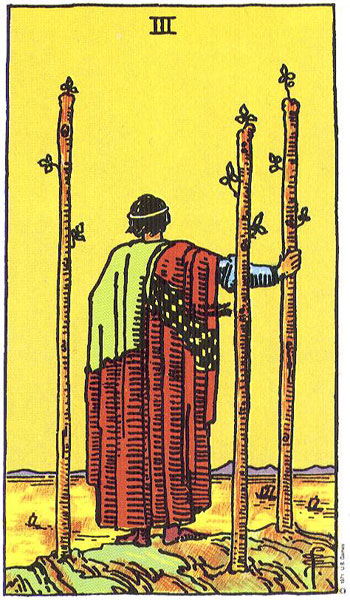
Three of Wands places the pattern in the field of initiative, creativity, and action. The constructive direction here is directing energy toward work that matters. When the pattern is healthy, a reader might see someone whose creative projects are starting to circulate beyond their own notebook or studio, and who is now listening to what returns. The shadow side, when the card appears reversed, looks like burnout, impatience, or effort without a stable direction: the project is moving, but no one, including the person driving it, can say where it is going.
Three of Cups moves the pattern into feeling, relationship, and imagination. The constructive direction is recognizing and communicating the emotional reality of a situation. The upright reading tends to describe moments of shared celebration or mutual support, where the emotional register of an event is being met and held by more than one person. Reversed, the same pattern can show as projection, avoidance, or being overwhelmed by an untested feeling, where the imagined bond outruns the actual relationship.
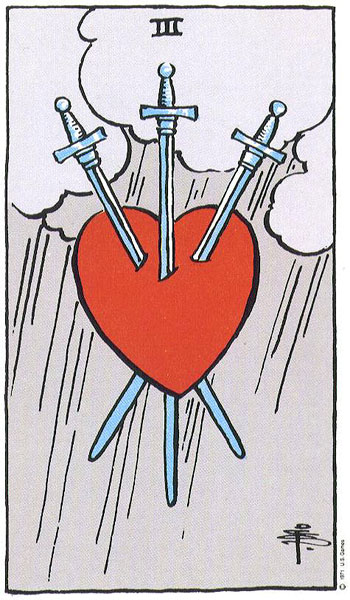
Three of Swords puts the pattern into thought, language, decisions, and conflict. The constructive direction is using clear distinctions and honest communication. Upright, the card often shows up when a difficult truth needs to be named, and the gift of the moment is the relief that comes from precise language. Reversed, the same energy can become overthinking, rigid conclusions, or words used as weapons, where the distinctions being drawn are sharper than the situation requires.
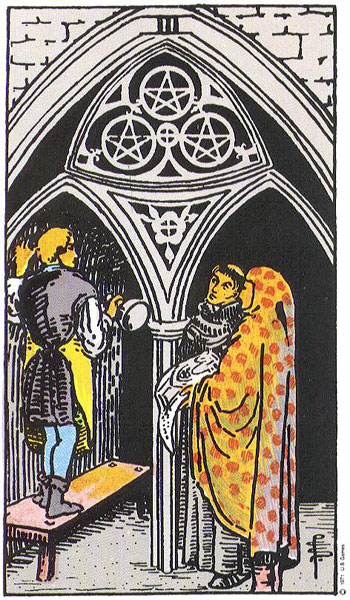
Three of Pentacles grounds the pattern in work, resources, the body, routine, and material conditions. The constructive direction is building something useful through steady, observable practice. Upright, this is the meeting of craft, role, and recognition: a person can see their work being used. Reversed, the same setup can tip into scarcity fixation, stagnation, or treating measurable value as the only value, where what cannot be measured is treated as if it does not count.
The shared pattern stays. The suit changes the texture, the body it lives in, and the kind of help the situation is asking for.
Where Competing Readings Pull Apart
Because all four Threes share a pattern, disagreement between readers usually comes from where they place the emphasis. Some readers read the Threes as a turning point from solo effort to group effort. Others read them as a moment of feedback in any form, including feedback from a book, a coach, or a financial report. The supplied card data is permissive on this point: participation, feedback, or expansion are listed together, and the reflection prompt does not require another person, only "who or what could help this move beyond its first form?"
A second place readings can split is in the role of conflict and pain. The Three of Swords is the card most often associated with grief or heartbreak in popular decks, but the supplied data does not include that visual tradition; it only names thought, decision, communication, and conflict. A reader who leans on classic imagery will read the card as heartache; a reader who stays close to the supplied keywords will read it as honest, possibly painful, intellectual clarity. Neither reading is wrong on its own, but only one is supported by the facts in front of you. When a deck or source you are using adds symbols, colors, or figures that are not in the supplied data, treat those additions as a separate tradition, not as a confirmed interpretation.
A third split is how strictly to read reversed cards. The supplied data describes reversals as the same pattern blocked, internalized, or showing its shadow. A reader can take "shadow" in a moral direction (this is a fault to fix) or in a structural direction (this is a feature of the system that needs redesign). Both framings can be useful; both can also be overclaimed. The honest move is to notice which framing the situation is actually asking for, rather than reaching for the one that sounds more decisive.
A Low-Stakes Example: Planning a Community Workshop
Imagine a person who has been quietly running a small repair clinic from their garage for two years. They decide to invite a few neighbors, a local librarian, and a representative from a hardware store to plan a larger monthly session. They draw the Three of Wands, the Three of Cups, the Three of Swords, and the Three of Pentacles in a single spread, one from each suit.
A first reading might treat the Wands card as about the project going public, the Cups card as the warmth of the planning group, the Swords card as the hard conversation about what is and is not in scope, and the Pentacles card as the logistics and shared tools. That reading holds together because each card is named in its own suit's frame, and the shared Three pattern of "growth through participation" is honored in each line. It is also testable: the person can ask, after the meeting, whether the project really did expand through other people, whether feelings were named, whether the conversation was honest, and whether the practical setup held.
A second reading might collapse the spread into one message: a general call to "open up and let others in." That reading is more pleasant and less useful. It loses the suit-level distinctions and gives the person no guidance on which part of the plan to trust and which to revise. The card data supports the first reading, because each card specifies a different area of life, and the first reading uses those specifications.
A third reading might claim the spread predicts the workshop will succeed or fail. That goes beyond what the cards describe. The supplied data does not include prediction. It describes a pattern and a question. Whether the workshop works depends on real decisions, real turnout, and real materials, not on the cards. Tarot is not a prediction, and a spread of Threes does not become a forecast because the numbers match.
Disconfirming Evidence: When the Pattern Doesn't Fit
A good reading leaves room to be wrong. The Threes are easy to misread because the shared pattern is appealing. If you draw a Three and your life is, in fact, very contained, very solo, and not yet asking for input, the card can still be meaningful, but only as a forecast of a coming phase, not a description of the present. That is a real interpretive choice, and it should be named as one.
It is also worth noticing when the suit does not match. If you draw the Three of Swords during a moment of warm social connection, and your honest read of the situation is that communication is easy and the group is getting along, the suit may be pointing to a different layer. Maybe a different kind of thinking or a different kind of conflict is present, perhaps an internal one, perhaps one in a meeting that has not happened yet. Record that gap in your journal rather than smoothing it over. A reading that cannot be surprised is not a reading worth keeping.
Material conditions can also push back on the pattern. The Three of Pentacles, in particular, can show up when recognition is delayed, when the work is solid but no one is noticing yet, or when a group project is being undervalued by the people who benefit from it. In those cases, the "growth through participation" can feel stalled. The supplied data includes "scarcity fixation" and "treating measurable value as the only value" as shadow aspects, which are useful labels here, but they are still interpretations. The honest move is to ask whether the situation matches the description or the diagnosis, and to write down which one you chose.
Journal Questions to Test Your Reading
A useful journal entry after drawing any Three starts with the suit, then the situation, then the gap between them. The following questions are written to be answered in writing, not in your head, because writing slows the reading down enough to notice when a phrase is doing more work than the card can support.
1. Which suit did I draw, and which area of life does that suit name in the supplied keywords? Write the area in your own words, not the card's. 2. What in my current situation matches "growth through participation, feedback, or expansion"? Name one specific thing, not a mood. 3. What in my current situation does not match that pattern? This is the disconfirming evidence. It belongs in the entry. 4. Who or what could help this move beyond its first form? Write at least one name, role, or resource, and one reason that person or thing fits. 5. If the card were reversed in this reading, which of the shadow keywords fits, and which does not? Note both. 6. What real-world evidence, in the next week, would change my reading? Be specific. A feeling is not evidence. A conversation, a number, or a decision is.
When you can answer those six questions, the Three has done its work: it has pointed to a part of your life that is ready to grow through contact with something outside itself, and it has asked you to take that contact seriously enough to test it in the real world. That is the limit and the gift of the card, and it is the same limit and gift across all four Threes.
Share this article