What the Card Shows: An Imagery Walk-Through
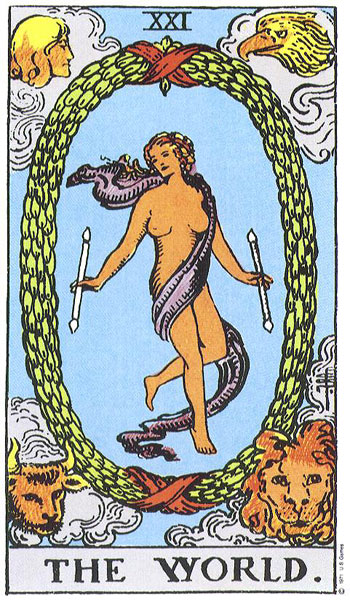
Before interpreting any tarot card, it helps to slow down and notice what is actually in the picture. The World is the twenty-first numbered card of the Major Arcana in most traditional decks, and the image most readers encounter is a calm, finished-feeling scene rather than a dramatic one.
The central figure is typically shown inside a large oval wreath. The wreath is not random ornament. It is a closed shape — a circle pulled into an oval — which is itself a piece of visual information: cycles, returning, the boundary of a chapter. Four figures or symbols are usually placed at the four corners or cardinal points around the wreath. In the most familiar traditional deck, these are a winged lion, a winged ox, a winged eagle, and a human or angel-like figure. Readers sometimes associate them with the four classical elements, the four fixed zodiac signs, or simply with "four corners of a whole." Whatever the symbolism you bring to it, the visual point is the same: four distinct things placed at the edges of one closed frame.
The central figure is often shown moving — dancing, leaping, or suspended — rather than sitting still. That detail matters, because it suggests an integration of motion and completion. The cycle has reached its end, but the body in the picture is still alive in it. There is rarely a sense of exhaustion in the image. There is a sense of having arrived somewhere and being willing to look around.
A small practical exercise: when you look at the card, ask yourself what you notice first, what you notice second, and what sits in the background. The order in which the imagery arrives in your attention is itself a piece of information about what your mind is working on right now. For this guide to the world tarot card meaning, that order is part of the reflection, not just decoration.
Upright Meaning: Completion and Integration
The upright World is most commonly described in three words: completion, integration, and closure. The card data for this reflection describes it as "recognizing how separate efforts have formed a coherent whole." That phrase is worth sitting with, because it is gentler than "you have arrived." Completion does not always mean triumph. It can mean: the loose ends I was carrying have started to fit together, even if some of them were messier than I expected.
A useful way to read the upright card is as a question rather than a verdict. What is ready to be acknowledged as finished in my life right now? That could be a project at work, a stage of study, a season of recovery from illness, a long conversation that has finally wound down, or a personal practice you have finally made routine. The card invites you to notice the whole rather than the most recent fragment. It also asks you to be honest about what "whole" means — sometimes a coherent whole still has rough edges.
Two interpretation choices are worth keeping separate, because they lead to different reflections. Some readers treat The World as a culminating achievement — the end of a long arc that began with The Fool, card zero, and ran through the rest of the Major Arcana. Others treat it as a quieter recognition: you are looking at a chapter that is mostly complete, and the work of this moment is simply to see it whole. Both readings are consistent with the imagery and the keywords. Choosing between them is a matter of what your own evidence supports, not which reading sounds more dramatic.
Reversed Meaning: A Cycle That Still Needs One More Step
The reversed World, as described in the supplied card data, points to a cycle that may be almost complete but still needs closure, documentation, or one final connection. Reversed cards are often read as the opposite of the upright meaning, and that can be a useful first pass. A more careful reading treats reversal as an indication of direction or emphasis: the same theme is present, but the energy is pointing inward rather than outward, or pointing toward what is unfinished rather than what is done.
In practice, a reversed World can invite one of three reflection moves.
First, closure work that has not yet happened. You may believe a chapter is over, but there is a missing piece — a thank-you note not sent, a document not filed, a learning not captured in writing, a small ritual of marking the end that you have skipped. Reversal here is a gentle prompt to ask what that missing piece is.
Second, premature closure. You may have declared something finished before it actually was. Reversal here is a prompt to ask whether you are rushing past a real loose end because stopping feels harder than continuing.
Third, integration work that is incomplete. You can see the parts but not yet how they fit. The reversed card asks you to slow down and look at the connections between them. What links these two efforts? What links this season to that one?
The reversed card is not a warning of failure. It is a hint that the same theme of completion is present, with one more careful step still to take.
A Grounded, Low-Stakes Example
Because tarot reflection is most useful when it is tied to concrete experience, here is a small example you can mentally test against your own life. None of the people in it are real; the example is intentionally ordinary.
Imagine someone who has spent the past several months learning a new skill — say, basic bookkeeping for a small side project. They have watched tutorials, kept receipts in a folder, written a few notes about what they did not understand, and recently sat down and reconciled their first month-end numbers. The result was imperfect: a few categories were miscategorized, and one transaction was duplicated.
If this person draws The World upright, a useful reflection is not "you are now an expert." A useful reflection is: "What did I learn this month that I did not know a month ago, and how do those pieces fit together?" The bookkeeping is not finished. The capability, however, has reached a recognizable shape. That is what completion means here — not perfection, but visible structure.
If they draw The World reversed, the same reflection changes shape: "What is the one thing I have not yet closed out — the duplicated transaction, the missing category note, the documentation I keep meaning to write?" Reversal narrows the question rather than negating the upright meaning.
Neither reading predicts what will happen next month. Both invite a specific, observable piece of evidence the reader can write down and check. That is the difference between a reflection prompt and a fortune.
Testing Your Interpretation Against Real Evidence
A useful tarot reflection is one you can test. Treat the card the way you would treat any other reflective prompt: write down what you noticed, write down what you think it means for your situation, and then look for evidence on both sides.
Three habits make this easier.
First, record an apparent match. Write one sentence that connects the card to your situation. This is your hypothesis. For The World, it might be: "I can name three projects from the last year that have reached a clear shape." Keep the sentence short enough that you can argue with it.
Second, record ambiguity. Write one sentence about what is unclear, even after reflecting. For The World upright, that might be: "I am not sure whether this completion is real or whether I am just tired of the project and want it to be over." That sentence is not a failure of the reading. It is part of the reading. A reflection that only notices confirmations is a reflection that has stopped thinking.
Third, record disconfirming evidence as carefully as an apparent match. Disconfirming evidence is anything that does not fit the interpretation. For The World upright, disconfirming evidence might be: "I keep saying the project is finished, but I have not actually told anyone it is finished, and there is one deliverable I keep avoiding." If the disconfirming evidence is stronger than the confirming evidence, the honest move is to slow down and treat the cycle as still in progress. If the confirming evidence is stronger, the honest move is to name what is actually complete without inflating it.
This habit improves any reflective practice, not just tarot. It is also why tarot is not a prediction. A drawn card does not know the future. It is a structured prompt that returns whatever you and your situation bring to it. The card is the prompt; the evidence is in your own records, your own conversations, and your own body of work.
Questions You Can Verify in a Journal
The most useful tarot reflections are the ones you can return to later and check. Here are several questions that work well with The World. Write the answers in a dated entry, then revisit them in a month or two to see what changed.
- What chapter of my life, large or small, am I willing to call complete right now? - What were the separate parts of that chapter, and how do they connect to one another? - What is the one piece of closure I have been postponing — the smallest one I keep skipping? - What evidence would tell me, in six months, that this reading was accurate? What evidence would tell me it was off? - If a friend described my situation, what would they say about whether this cycle is really finished? - What would make this chapter complete enough to carry its learning forward?
Each of these questions has an answer that lives outside the card. The card is the prompt. The evidence is in your own records. That separation is what keeps the reflection honest.
When to Use Qualified Help Instead
Tarot is a reflective tool, not a substitute for professional advice. If the question you are bringing to the card is about a medical symptom, a legal decision, a financial commitment, a safety concern, or a moment of crisis, please bring it to a qualified person — a clinician, a lawyer, a financial advisor, a crisis line, or someone specifically trained in the relevant field. A reflective prompt can still be useful alongside that help, but it should not be the only input on a high-stakes decision.
For everyday reflections — what to close out, what to acknowledge, what loose end to tie off — The World is a calm and steady prompt. Use it slowly, write down what you notice, and let the evidence lead.
Share this article