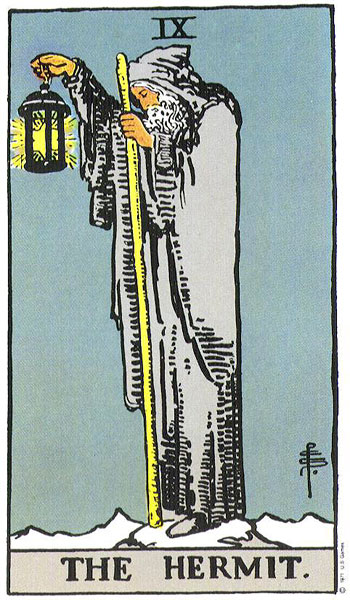
What the Image Shows
When you sit with The Hermit, the first useful move is to describe what is actually in front of you. The card, numbered nine in the Major Arcana, shows a solitary figure standing on a height, often robed, holding a lantern lifted ahead of them. Mountains or a winter landscape typically form the background, and a small star is usually visible above or inside the lantern.
These elements are observable, not symbolic guesses. A lantern throws light a short distance, not a flood. A mountain is a place from which to look down at a wider area, and cold scenery suggests stillness rather than movement. A star suggests a long way to travel. None of this requires belief in anything supernatural to notice.
The card invites a particular posture: stand somewhere quiet, hold a small light, and look out across something larger than your immediate task. That posture is the seed of any interpretation you build from the image. When you read the hermit tarot card meaning in a deck, you are reading that posture, not a prediction about tomorrow.
The Hermit Upright: What the Card Can Invite
Upright, the editorial brief associated with this card points to deliberate withdrawal, careful inquiry, and creating enough quiet to identify your own position. In plain language, the upright card often fits moments when you need to slow down and find your actual view before acting.
That can apply in many ordinary situations. You might be weighing whether to change jobs, deciding how to respond to a family conflict, or considering whether a creative project is worth the next six months. In each case, the upright Hermit pairs well with a pause that is structured rather than evasive: a walk without a phone, an hour of writing before you check email, a weekend of reading rather than scrolling.
Three tones tend to show up when the upright card genuinely fits.
First, a sense that the noise of other people's opinions has become loud. Second, a feeling that you have not had uninterrupted time with your own question. Third, an intuition that if you had even an hour of clear thought, you would already know what to do next.
If those tones match your situation, the card can serve as a reminder that the answer is probably already half-formed, and that quiet is the way to let it finish forming.
The Hermit Reversed: When Withdrawal Tips Into Avoidance
Reversed, the card often points to a different problem. The editorial language here is that solitude may have become isolation, or that reflection may be delaying a necessary conversation. Reversals in Tarot are not warnings of doom. They are prompts to look at the same archetype from its shadow side.
The shadow of withdrawal is hiding. A pause becomes avoidance when it lets you skip a hard talk you owe someone, when it lets you avoid returning an email that requires an honest answer, or when it lets you call "research" what is actually procrastination.
It is also worth noticing that a reversed Hermit does not always mean you are hiding. It can mean the world around you has gone too quiet. If you have been on your own so long that you have lost contact with friends, or that you cannot remember the last time someone challenged a view you hold, the reversed card can point at isolation rather than reflection.
Both readings are possible. The card does not choose for you. Your job is to ask which one fits the evidence.
A Realistic, Low-Stakes Example
Consider a small, ordinary decision. Maya has been asked to lead a project at work. She is tempted, but she is also exhausted. She pulls The Hermit upright.
She looks at the image and notices the lantern, not a floodlight. She writes two sentences in her notebook: "What would I do with one uninterrupted hour on this?" and "What is the smallest decision I could make this week?"
She does not, on day one, accept or decline. She takes a Saturday morning with her phone in another room and walks for ninety minutes. During that walk, two things surface. First, she realizes the reason she is tired is that her last three months have been one meeting after another, and she has not had time to read in her own field. Second, she notices that the project would actually let her do more reading, because part of the work is research.
A tarot reader might call that "the card working." A more careful description is that the card cued a posture, and the posture gave her access to information she already had. She accepts the role the following Monday, and on Friday she sets aside an hour for reading.
Now the same card in the same hand, in a slightly different scenario. Sam pulls The Hermit reversed the week before telling his sister he cannot attend her wedding. He has been telling himself he needs more time to decide. In fact, he has already decided. He just does not want the conversation.
Here the reversed card fits the shadow reading cleanly: reflection has become the cover for avoidance. The useful move is not more quiet. It is a phone call.
The two stories are similar in shape and opposite in meaning. The card image does not tell them apart. The context does.
Testing an Interpretation Against Real Evidence
Any interpretation you build from the hermit tarot card meaning can be tested. A reading is a hypothesis, not a fact. The hypothesis gets stronger when several kinds of evidence line up, and weaker when they do not.
Three checks are useful.
First, check your body. Does the upright reading match how you actually feel? If the card says you need quiet, and you are already exhausted by silence, the fit is poor. If the reversed reading says you are avoiding, and you actually feel eager to talk, the fit is also poor. The body is one source of evidence, and it often knows things the thinking mind has not caught up to.
Second, check other people. Sometimes the people who know you well have already noticed what the card points to. A friend might say, "You have been hard to reach lately," or "You keep saying you will think about it." That kind of remark is data. Write it down rather than dismissing it.
Third, check the calendar. If you have been withdrawing, there will be a pattern in your week. Fewer messages, fewer calls, more solo activities, more skipped plans. If the reversed reading says you are isolated, look for evidence of isolation. If the upright reading says you need quiet, look for evidence that your time has actually been crowded.
Ambiguity is part of the process. A card can point at two things at once, and only your context can pick one. Disconfirming evidence matters as much as confirming evidence. If three checks contradict the reading, the reading was probably off. That is not failure. It is how honest reflection works.
Questions to Keep Your Reading Honest
A tarot reading is most useful when it produces questions you can answer with a notebook, a friend, or a week of attention. Below are some prompts that pair well with The Hermit. They are designed to be tested against real evidence rather than taken on faith.
- What question deserves uninterrupted thought, and when should that thought return to the world? Write down the question, then write down a date by which you want an answer.
- What is the smallest thing you could do this week to gather evidence on the question? Keep it small enough that you will actually do it.
- Whose voices have been loudest in your head lately? Are those the voices you want shaping a decision this size?
- If a trusted friend watched your last two weeks, would they say you were pausing thoughtfully, or quietly hiding?
- What conversation, if any, are you postponing under the label of "needing more time"?
- When did you last have an hour with no input from screens, other people, or notifications?
- What would a clearly disconfirming piece of evidence look like for the reading you are building?
That last question is the most important. If you cannot describe what would prove your reading wrong, you are not testing it. You are defending it.
When to Use the Card, and When to Ask a Person
Tarot is not a prediction. It is a structured prompt that uses an image to focus attention. The Hermit is a good prompt for situations where you suspect the answer is in you and you have not had the conditions to hear it. It is a poor prompt for decisions that need information only a doctor, a lawyer, a financial advisor, or someone with direct knowledge of your situation can provide.
For medical, legal, financial, safety, or crisis decisions, use qualified professionals and real evidence. A card is a companion to that work, never a substitute.
Used carefully, the hermit tarot card meaning is simply a reminder to find a quiet hour, hold a small light, and look at what is in front of you with steady eyes. If the image helps you do that, the reading has done its job.
Share this article