The Empress at a Glance: Upright and Reversed
The Empress is the third card of the Major Arcana in most traditional decks. In the upright position, it points toward care, growth, and creativity, and toward the conditions that allow something living to develop over time. The reversed meaning is not the opposite of the upright. It is a warning that care may have turned into overextension, that you may be neglecting your own needs while tending to something else, or that growth has been happening without enough structure to support it.
Before going further, an important framing note: this card is a reflection prompt, not a forecast. Tarot is not a prediction. No card can tell you what will happen tomorrow, what another person is thinking, or whether a specific decision will succeed. What it can do is offer a language for what you may already be noticing in your own life, and that language only becomes useful when you test it against real evidence.
If you arrived here searching for the empress tarot card meaning, or you already know the card and want a more structured way to work with it, the goal is the same: to spend a slow, careful hour with one image and walk away with one or two useful questions, not a list of certainties.
The Empress is associated with an open tone rather than a closed one. That matters because the prompts in this guide assume you have room to ask questions, not that you must reach a single fixed conclusion. Ambiguity is part of the process. So is the willingness to change your mind.
Because The Empress is part of the Major Arcana, it is also part of a longer story. Major Arcana cards tend to describe large life themes rather than small daily events. When you encounter one in a reading, you can ask whether the theme it names is showing up in a small situation, a medium one, or a large one. The size is less important than the fact of the theme itself.
What the Image Can Show You
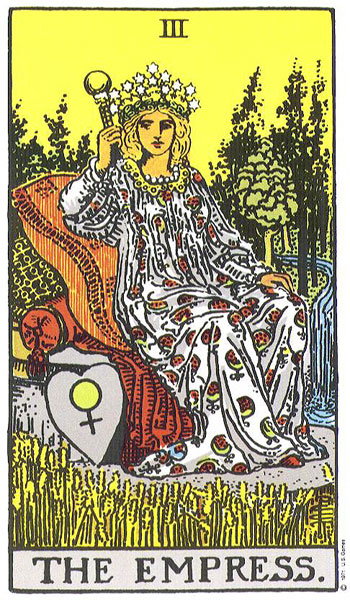
Looking at the image of The Empress is the first step in interpreting it, because the image is doing part of the meaning's work. In standard depictions you will typically see a seated figure, often wearing a crown or decorated headdress, situated in a setting that suggests a garden, a field, or another space associated with natural abundance. Common visual cues include ripe fruit, flowing water, lush vegetation, and a posture that suggests rest rather than action. You do not need art history training to read these cues. You can simply notice what draws your eye first.
Does the figure look settled or restless? Is the natural setting orderly or wild? Are the symbols of abundance gathered or scattered? Are there details that look neglected or details that look tended? These observations are a starting point, not a verdict. Different decks render The Empress in very different ways, and your own eye is part of the reading.
The Empress is Major Arcana card number 3. In a Major Arcana sequence, number 3 typically follows a foundational pair and sits at the start of a longer arc, which is a useful reminder that the energy of this card is about early development rather than harvest. Growth here is the kind that takes seasons, not the kind that arrives in a weekend.
When you describe what you see, try to write it down in plain language. For example: a figure seated in a green place, surrounded by what looks like ripe produce. That description is more useful for reflection than a vague impression of abundance, because it gives you specific things to work with later and a clearer record to revisit.
A Grounded Example: Tending a Small Project
To make this less abstract, consider a low-stakes example that many readers will recognize. Suppose you have started a small creative project on the side, perhaps a writing practice, a kitchen garden, a hand-lettered card habit, or a weekly sketch. You are doing it because you enjoy it, not because anyone is grading you, and you have been at it long enough that the early excitement has worn off.
If you draw The Empress upright in a quiet moment of reflection, the card is not telling you that the project will succeed or that you will become famous for it. It is asking whether you are giving it the kind of attention that supports steady development. Are you showing up for it on a schedule that respects how slow real growth is, or are you waiting for a burst of inspiration that never quite arrives? Are the conditions around it warm enough, quiet enough, and protected enough to let it put down roots?
If you draw The Empress reversed, the question changes. The card is asking whether the project, or your care for it, has started to cost you more than it returns. Are you skipping meals to fit in writing time? Are you watering the plants until your wrists ache? Have you taken on a third creative commitment before the first two have roots? Are you growing so fast in public that you have no quiet structure to hold what you have made?
In either case, the card is doing the same job: it is pointing at the relationship between care, conditions, and outcomes, and asking you to look honestly at that relationship. Notice that nothing in this example requires you to know the future. Everything you need to look at is already on your calendar.
Reflection Prompts for the Upright Meaning
When The Empress shows up upright, the work is often about tending rather than pushing. These prompts are designed to be written in a journal, ideally on paper, so you can come back to them later.
What is one area of your life that is quietly growing right now, without much fanfare? What conditions seem to be supporting that growth, and which of those conditions are within your control to maintain? Where could consistent, modest attention replace a heroic burst of effort? What does care look like for you when it is sustainable, not performative? Whose care have you received recently that you might acknowledge, in your own small way?
The card's own reflection prompt is included here because it is the simplest and often the most useful: what needs consistent nourishment rather than another burst of effort? You can write that sentence at the top of a page and answer it slowly. If you want to go further, you can pair each upright prompt with a small action you could take this week. The action does not need to be impressive. Showing up on time, watering something, sending a kind message, finishing one small task: these are exactly the kinds of actions The Empress points toward. The card is not impressed by drama. It is interested in repetition.
Reflection Prompts for the Reversed Meaning
A reversed Empress is not a sentence. It is an invitation to look at what may be out of balance. The prompts below are framed to help you notice patterns without turning the notice into self-criticism. In the last two weeks, where have you given more than you had available to give? What is one need of your own that has been quietly postponed? Is there a project, relationship, or commitment that has been growing without any clear structure around it? What would enough look like in the area you are most worried about right now? If a friend described your situation to you, what would you gently suggest they change?
Reversed meanings are also a place to notice the absence of something. Growth without structure often feels like motion without progress. Overextension often feels like busy rather than effective. Neglect of your own needs often looks, from the outside, like being very responsible. Naming the pattern is the first step; changing it is a separate step, and usually a slower one. Reversed cards often invite you to slow down rather than speed up, which can feel counterintuitive in a culture that treats warning signs as instructions to act immediately.
A useful reframe: a reversed Empress is not telling you that something is wrong with you. It is telling you that the conditions in a specific area have drifted away from what supports growth. Conditions can usually be adjusted, sometimes by you, sometimes with help, sometimes simply by waiting out a season.
Testing Your Interpretation Against Real Evidence
A reflection is only useful if you are willing to look for what does not fit. Tarot readers and reflective writers sometimes fall into the habit of recording apparent matches and ignoring everything else. That makes the cards feel prophetic when they are not, and it robs you of the more interesting question, which is whether your interpretation is accurate.
Here is a simple protocol you can use in a journal. Write the date and the question you asked the card. Write your first reaction, even if it is vague. Wait at least twenty-four hours before rereading your entry. List at least one piece of evidence that supports your reading. List at least one piece of evidence that complicates or contradicts it. Note any emotion that showed up while you were looking for the second list, because that emotion is data too. Revisit the entry in two weeks and see which column grew.
You can also bring an outsider's question to your own entry. Ask yourself: if a friend read this journal page without knowing me, what would they push back on? What would they ask me to clarify? Where would they say I was being a little too poetic? Outsider questions catch the small inflation that happens when you are trying to make sense of your own life and would rather not see something uncomfortable. The cards do not benefit from that inflation, and neither do you.
The Empress is a particularly good card to practice this with, because its themes are slow. Growth is something you can usually observe over weeks and months, which gives you time to see whether your reflection was on target. If the evidence over time does not support the reading, you can let the reading go. That is a success, not a failure, because a discarded interpretation is more useful than a kept one that is wrong.
Record ambiguity and disconfirming evidence as carefully as an apparent match. If after a few weeks the evidence is mixed, that is a real result too. The Empress often points at slow processes, and slow processes are rarely all good or all bad at any given moment. Mixed evidence is the honest answer, and an honest answer is more useful for the next decision than a tidy one.
The Limits of Tarot for Decisions
It is worth being direct about what The Empress, and tarot in general, cannot do. The cards are not a substitute for medical advice, legal counsel, financial planning, safety planning, or crisis support. If a question involves your health, your legal rights, your money, your physical safety, or an emotional crisis, please use qualified professionals and real evidence first. The Empress can be a companion to that process, but it should never be the only tool you reach for.
Within its proper scope, The Empress can help you notice what you may already know. It can give you a clean phrase for a pattern, a number in a sequence, a single image to look at for a minute before you decide what to do next. The value of the card is in the conversation you have with it, and in your willingness to keep that conversation honest.
When you sit with The Empress, you are not waiting for a verdict. You are practicing the slower skill of paying attention to what is growing, what is being neglected, and what conditions you can actually change. That skill will be useful long after you have put the cards away.
If you are in any kind of immediate danger, distress, or crisis, please reach out to local emergency services, a crisis hotline, or a trusted person in your life before turning back to a deck. Cards are a fine companion in calm hours. They are not the right companion for emergencies, and pretending otherwise does a disservice to the gravity of real situations.
Share this article