The Emperor Tarot Card Meaning: What the Imagery Suggests
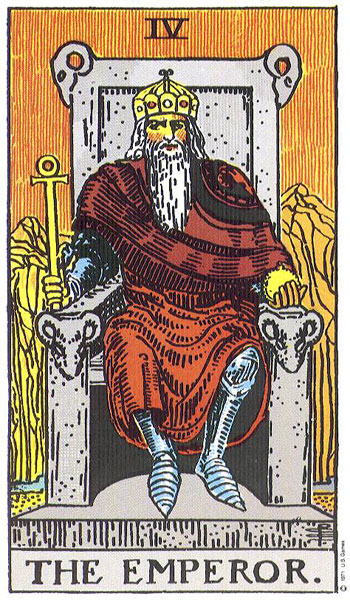
When you first look at The Emperor, the eye tends to land on a few steady details before any words arrive. A seated figure on a stone throne suggests permanence more than movement. The posture is upright rather than leaning forward, which often signals a measured, considered stance rather than a reactive one. Stone or carved ornament beneath the figure implies weight and durability; the seat is not improvised. If the imagery shows regalia such as a crown or an orb, those elements usually carry associations of authority and stewardship rather than personal triumph. The Emperor is the fourth card of the Major Arcana, and the numerical position itself invites a reader to consider foundations, structure, and the early scaffolding of a project or commitment.
Before drawing conclusions, it helps to separate what is plainly visible from what is interpreted. The throne is observable. The claim that the figure "represents" discipline is interpretive. Holding that distinction in mind protects the reflection from drifting into a story the card never actually told.
Some readers bring in symbolic associations, such as ram heads, mountains, or four corners, that may or may not be present in the version you are looking at. If a symbol is not visible in your specific card, it is reasonable to leave it out of your notes. Interpretation grows more reliable when it is anchored to what you can actually see and to the meaning the deck itself attaches to the card.
Upright Interpretation: Structure, Responsibility, and Boundaries
In its upright position, The Emperor is commonly read as a prompt to look at structure, responsibility, boundaries, and a framework sturdy enough to support action. None of those words is the same as a prediction. They describe themes you can examine in a situation you already have.
"Structure" here is the question of whether a plan has clear steps. "Responsibility" is the question of who owns the next decision. "Boundaries" are the question of where one commitment ends and another begins. The phrasing "sturdy enough to support action" is a useful caution: a structure is only valuable if it actually carries the weight you need to place on it. Many people find that their routines look disciplined on paper but collapse under a busy week; this card can be a prompt to test, rather than assume, that the framework holds.
In a reflection practice, you do not need to claim that The Emperor "means" you should be more disciplined. A more careful move is to ask what structure, if added, would make the next two weeks easier rather than more crowded. The upright reading points toward scaffolding, not toward a moral verdict about whether you are disciplined enough today.
Reversed Interpretation: When a Rule Has Outlived Its Purpose
Reversed, the card shifts attention from building structure to questioning it. The reflection prompt offered with the card is worth taking literally: which boundary would create useful stability, and which rule has outlived its purpose?
A reversal is not automatically a warning. Sometimes it simply highlights that a rule made sense three years ago and does not match the situation now. Other times it points to authority that is too rigid, poorly justified, or unable to adapt. The card does not tell you which case applies. The evidence in your own life does.
A grounded reader will often write down the rule or boundary in question, when it was set, what it was meant to solve at that time, and what it is costing now. If the costs are larger than the original problem, that is data. If you cannot remember why a rule exists, that is also data, and a different kind. The reversal does not demand that you tear the rule down immediately; it invites you to look at it with fresh eyes and to be willing to revise it when revision is warranted.
A Grounded Example: The Weekly Team Meeting
Consider a low-stakes example that almost anyone can recognize. A small team has held a sixty-minute Monday meeting for two years. Attendance has drifted, agenda items are sometimes skipped, and one member has started sending status updates by email instead. The manager pulls The Emperor upright during a reflection and wonders whether the meeting is "the structure" or "the rigidity."
The reasonable move is to test, not to assume. Look at the meeting: does it produce a decision, a clear status, or a coordination outcome that email cannot? If yes, the structure is earning its keep. If no, the rule may have outlived its purpose. Notice that neither conclusion is a verdict on the manager's competence; it is a check on whether a specific practice matches a specific need.
A reversed Emperor might push the question further: who set the sixty-minute length, and why? Was it because the work required that depth, or because it matched a default? A reflection note might say, "Try thirty minutes for two weeks, with a written agenda, and see whether decisions still land." That note is testable. It produces evidence. The card did not give the answer; it pointed toward the kind of question worth asking.
Questions to Test Your Interpretation Against Real Evidence
Reflection only earns its keep if it connects to something you can verify. The following questions are designed to be written down and answered in a journal or notebook rather than answered in your head. Where possible, give a date and a small, concrete piece of evidence for each answer.
1. Which boundary in my week is genuinely load-bearing, and which one exists mostly because I have not reviewed it lately? 2. What is the smallest structure I could add this week that would make a recurring task easier next month? 3. Where am I applying a rule from an old situation to a situation that has changed? 4. Who actually owns the next decision in this matter, and is that clear to everyone involved? 5. What would I be doing differently tomorrow if I treated this card as an invitation to revise rather than as a directive? 6. What evidence would change my mind about the interpretation I just made?
The last question is the one most often skipped, and it is the most useful. A reflection that names what would disprove it is far less likely to harden into a story you tell yourself without checking.
Tarot as Reflection, Not Prediction
It is important to be clear about what a Tarot reflection can and cannot do. The Emperor does not predict that a project will succeed, that an authority figure will behave a certain way, or that a relationship will take a specific turn. Cards do not have access to that information, and treating them as if they do leads to decisions made on shaky ground.
What a card can offer is a structured prompt. It can name a theme, such as structure or boundaries, that you then investigate with the same care you would bring to any other thinking tool. The value is in the question, not in any supposed answer from the card itself. A reader who treats the draw as a conversation starter tends to get more from the practice than a reader who treats it as an oracle.
This is also why the editorial tone around The Emperor is best described as mixed. The card can point toward steadiness, which is welcome in chaotic weeks. It can also point toward rigidity, which is unwelcome when flexibility is what a situation actually needs. Either reading is a starting point for thought, not an instruction.
How to Record Ambiguity and Disconfirming Evidence
A common failure mode in reflective practice is to record the moments that fit the interpretation and quietly skip the ones that do not. The Emperor rewards the opposite habit. When you note structure as a theme, also note the small ways structure failed today. When you write down a rigid rule you want to revise, also write down a case where that rule genuinely saved time or prevented a mistake.
A simple format that helps is a four-line entry:
- What the card seemed to point to. - What evidence in the next 48 hours supported it. - What evidence in the next 48 hours complicated or contradicted it. - What I would update in my thinking because of those notes.
Treat ambiguity as useful information. If the card's meaning is unclear in your situation, that is not a failure of the practice; it is a signal that the situation is more complex than a single theme can capture. Record that complexity honestly. Over weeks, the pattern of entries tends to reveal more about how you actually make decisions than any single draw ever could, and that pattern is grounded in your real life rather than in a wish for the cards to settle things for you.
For decisions involving medical, legal, financial, safety, or crisis matters, use qualified professionals and direct evidence rather than a card draw. A reflection practice is a complement to clear thinking, not a substitute for it.
Share this article