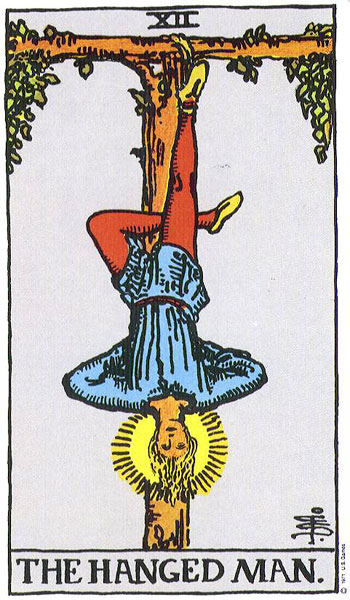
Reading the Image Before Reading the Meaning
When readers look up the hanged man tarot card meaning, the most useful first move is to slow down and describe what is actually visible on the card. The figure is suspended upside down, often from a wooden beam or a living branch. The arms are usually folded behind the back rather than bound with rope. The face, in traditional decks, is calm or contemplative, not panicked. There is no executioner, no crowd, no struggle. The position is voluntary, and that single visual choice carries most of the card's interpretive weight.
Notice what is not there as well as what is. The Hanged Man is not in chains. The ground is not shown as unreachable. The figure is alone with the situation, and that solitude is part of the meaning. Without external pressure, the central question becomes: what is actually gained by staying here?
The Hanged Man belongs to the Major Arcana, the twenty-two cards that traditionally describe large life themes rather than daily events. Knowing this helps set expectations. A Major Arcana card is usually read as pointing to a pattern that is already visible in your situation, not as a forecast of something brand new. Treat the card as a mirror for attention. Treat it as one possible lens. It is not the only lens.
Before assigning any meaning, take a moment to write down three details you noticed on the card. This small habit prevents you from skipping straight to someone else's interpretation and missing what the image is actually showing you.
Upright Meaning: A Purposeful Pause
The upright meaning of the Hanged Man is described as a purposeful pause that changes perspective and makes a different interpretation possible. Three keywords anchor this description: pause, perspective, and release. Each does specific work, and it helps to take them one at a time.
Pause refers to a deliberate stopping of the usual problem-solving approach. It is not laziness, and it is not avoidance dressed up as rest. It is the decision to stop pushing for an answer so that a different answer has room to appear. Many everyday situations call for this kind of pause: a stalled project, a recurring argument, a job search that has become mechanical, a decision you have been chewing on for weeks. The card does not say what you should do instead. It says the doing itself may need to change shape.
Perspective is the visible result of that pause. When you stop wrestling with a question, the framing of the question often shifts. What looked like a binary choice can become a spectrum. What looked like a personal failing can reveal itself as a structural problem. What looked like a betrayal can sometimes look, in time, like a clumsy attempt at help. The card suggests this shift is the gift of the pause, not a side effect. The pause is not the obstacle to the insight. The pause is how the insight arrives.
Release points to the sacrifice element of the imagery. Something has to be given up for the perspective to arrive. Often, that something is the comfortable story you have been telling about the situation, or the identity you have been defending. The card does not promise the release will be painless, only that it may be necessary. A release without a clear reason is a different matter, and the reversed meaning addresses that directly.
A useful way to read the upright meaning is as an invitation to ask: what am I trying to solve in the usual way, and what would it look like to stop, for a defined period, and observe?
Reversed Meaning: When Waiting Stops Working
The reversed meaning of the Hanged Man is that waiting may no longer be producing insight, or that sacrifice may be occurring without a clear reason. This is a more cautionary note, and it deserves as much care as the upright reading.
Reversals in Tarot are not automatically negative. They are signals that the energy described in the upright meaning has drifted off course in some way. For this card, two off-course patterns show up most often.
The first is stalled pause. The pause has stretched so long that it has become its own obstacle. You are no longer gathering perspective; you are just stuck. The card, reversed, suggests that the stillness has lost its purpose and is now blocking movement. Naming this honestly can be a relief. A pause with no end date is not a pause; it is avoidance.
The second is empty sacrifice. Something is being given up, but without a clear reason and without the payoff of new perspective. This pattern can show up as martyrdom in relationships, as unpaid work that no longer serves anyone, as quiet self-erasure in a family system, or as habits kept out of guilt rather than meaning. The reversed card does not say the sacrifice is wrong in every case. It says the sacrifice is not connected to insight, and that disconnection is the warning.
A grounded reader holds both possibilities at once. If you have drawn the card reversed, ask which of these fits your situation, and ask what evidence you have for the answer. Do not pick the one that sounds nicer. Pick the one your journal entries actually support.
A Realistic, Low-Stakes Example
To make this less abstract, consider a low-stakes example that many readers will recognize.
Suppose you have been trying to choose between two weekend plans: a social gathering and a quiet day at home. You have gone back and forth for several days, asked friends, made pro-con lists, and still feel undecided. You draw the Hanged Man.
If you read the card as a prediction, you might search for a hidden clue that points to one event or the other. That is not what the card is for. Instead, take the card as a prompt for reflection. The upright meaning of pause suggests that the usual method of deciding has run out of useful returns. The lists are no longer helping. The opinions of friends are not resolving the inner tension. The card invites you to stop trying to decide in the usual way and see what is actually going on underneath the question.
When you pause and look, you might notice that the real issue is not which plan is better but that you have been tired all week, and your body is asking for rest, regardless of which option you pick. That observation reframes the question. The choice is no longer between two events. It is between listening to your exhaustion or overriding it. The Hanged Man's perspective shift just happened in a small, practical way, and it did not require any claim about the future.
Now suppose you draw the card reversed in the same situation. That might point to stalled pause: you have already been sitting with the question for days, and the pause has stopped producing insight. Or it might point to empty sacrifice: you keep cancelling the quiet day to please other people, even though you know you need it. Either way, the card points to something specific to notice, and the noticing is the practice.
This example is deliberately ordinary. Tarot does not need a crisis to be useful, and practicing on small decisions builds the habit of testing interpretations against real evidence before the stakes are higher.
How to Test an Interpretation Against Real Evidence
A reflection is only useful if you can check it. The Hanged Man, like every Tarot card, is not a prediction. It does not know what will happen. It cannot tell you what another person is thinking. Treating it as a source of evidence about the future overstates what a picture on a card can do. Treating it as a prompt for reflection is closer to what the imagery can actually support.
To test an interpretation, follow a few steps.
First, write the interpretation down in plain language. "I think the card is suggesting that I pause and stop trying to solve X in my usual way." Avoid poetic or vague phrasings, because vagueness makes verification impossible.
Second, ask what observable change would confirm the interpretation. If the interpretation is that a pause will shift your perspective, what would the shift look like in your behavior, your mood, or your understanding of the question within a week? Pick something you can actually see.
Third, ask what would disconfirm it. A disconfirming observation is just as important as a confirming one. If you pause and nothing changes, or if the pause produces more confusion rather than clarity, that is information. Record it. Do not explain it away.
Fourth, ask what alternative interpretations fit the same card. The Hanged Man upright can suggest acceptance, surrender, willing vulnerability, or a spiritual retreat, depending on the deck and the tradition. Holding more than one reading in mind keeps you honest about the card's ambiguity.
Fifth, check for wishful thinking. If the interpretation gives you exactly what you wanted to hear, that is a flag to slow down. Real reflection often feels uncomfortable. Clean, comfortable readings deserve a second look.
Record ambiguity and disconfirming evidence as carefully as an apparent match. A reading that survives this kind of scrutiny is more trustworthy than one that does not.
Questions You Can Verify in a Journal
A journal is the simplest tool for testing a Tarot interpretation over time. The questions below are written so that yes, no, or a short descriptive answer is possible. Bring the same questions back a week or a month later and see whether your answers have changed.
1. What question was I holding when this card appeared, and what was my usual way of trying to answer it? 2. What did I notice on the card before I looked up any meaning? 3. What would a successful pause look like in this situation? Be specific. 4. What would a stalled pause or an empty sacrifice look like in this situation? Be specific. 5. What is one small thing I can stop doing this week to test whether the pause is producing perspective? 6. What evidence, if any, would show that the pause is not working? 7. If the same situation arose a month from now, what would I want the answer to be, and why?
These questions are designed to be revisited. Tarot reflection is iterative. The first pass rarely captures the full meaning, and that is not a failure of the practice. It is how careful thinking actually works.
The Limits of This Reflection
A practical reflection guide should be honest about what it cannot do. The Hanged Man, like every Tarot card, cannot diagnose a medical condition, predict financial markets, resolve a legal question, or speak for another person. If a reading surfaces something serious, such as ongoing distress, a safety concern, a financial decision with major consequences, or a legal question, the appropriate next step is a qualified professional: a doctor, a financial advisor, a lawyer, a crisis line, or a licensed counselor. Tarot can sit alongside that help. It should not replace it.
It is also worth saying that no Tarot interpretation is complete. Even a careful reading is one possible lens, and the meaning you assign today may look different in a week. The Hanged Man, in particular, asks you to hold a question loosely. If you find yourself gripping the card's meaning as if it were a fact, that itself may be the stuckness the card is pointing to.
The Hanged Man teaches, above all, the discipline of the pause. A pause that is purposeful, time-limited, and observed honestly is more useful than an interpretation delivered with false certainty. Treat the card as a mirror for attention, not as an oracle, and the practice has a chance of being genuinely helpful.
Share this article