Documented Playing-Card History Before the Tarot
Any responsible account of the **history of tarot cards** must begin with what can actually be documented in archives and surviving decks, not with the more colorful stories that circulated later. Tarot emerged from a longer European and Mediterranean tradition of hand-painted playing cards that became fashionable among the wealthy in the fourteenth and fifteenth centuries. The earliest decks brought into Europe, including those associated with Mamluk Egypt, already contained four suits, numbered cards, and court figures, but they did not contain a separate "trump" sequence. Documented Mamluk decks and surviving Italian examples from the 1420s and 1430s support this picture.
Italian cardmakers in cities such as Milan, Ferrara, and Bologna added an extra set of picture cards above the four suits. These were called *trionfi*, the source of our word "trump." Surviving evidence includes roughly contemporaneous accounts from courtly patrons and later Cary Sheet prints from around 1500, which depict the early iconography of figures that would eventually be standardized as the Major Arcana. No contemporary document from this period frames these cards as tools of divination. The dominant documented use was gaming, especially a trick-taking game whose specific rules evolved over the following century.
By the sixteenth and seventeenth centuries, the tarot's seventy-eight-card structure (fourteen trumps in a typical northern Italian pattern, growing toward the twenty-two of the modern Major Arcana, plus fifty-six suit cards) was largely established, and decks were mass-produced by woodcut for a wider audience. This playing-card history is the foundation; everything that came later sits on top of it.
How Divinatory Use Entered the Conversation
Divinatory and esoteric use of the tarot is a much later development, and it is important to keep it separate from the playing-card origins. The earliest well-documented tarot readers in the divinatory sense appear in late eighteenth-century Paris, where Antoine Court de Gébelin published a multi-volume history of religion and symbolism in which he argued that the tarot was an ancient Egyptian book of wisdom, smuggled west through the Romani people. Court de Gébelin offered no archival evidence for this claim. It is the most influential unsupported origin myth in the field, and it shaped how many later writers thought about the cards.
What we can document is that divinatory practice with the tarot spread through French occult salons in the late 1700s and early 1800s. Etteilla, whose real name was Jean-Baptiste Alliette, is often credited as the first professional tarot reader and published a specialized deck and guide in the 1780s and 1790s. Eliphas Lévi and later writers associated with the Theosophical movement and the Hermetic Order of the Golden Dawn added layers of Kabbalistic, astrological, and Christian symbolism onto the cards through the nineteenth century. These uses were not the original purpose, and the symbolic systems added during this period are interpretations, not recoveries of ancient meaning.
A. E. Waite's Direction and Pamela Colman Smith's Visual Authorship
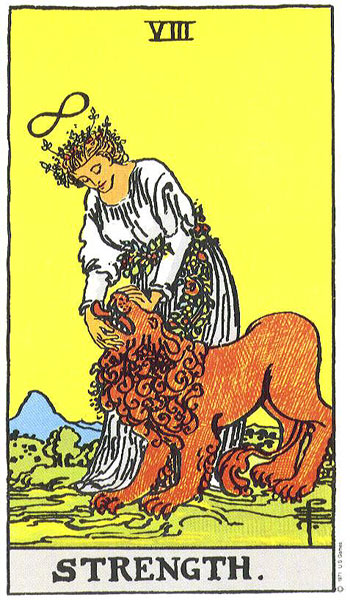
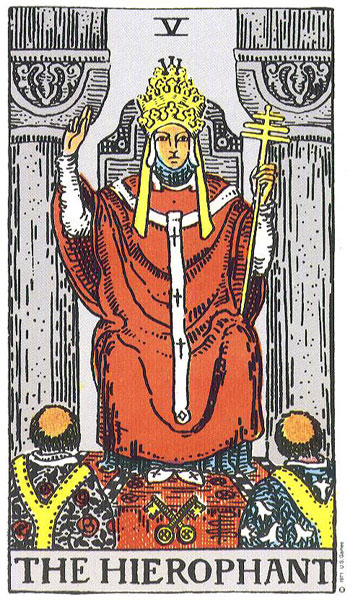
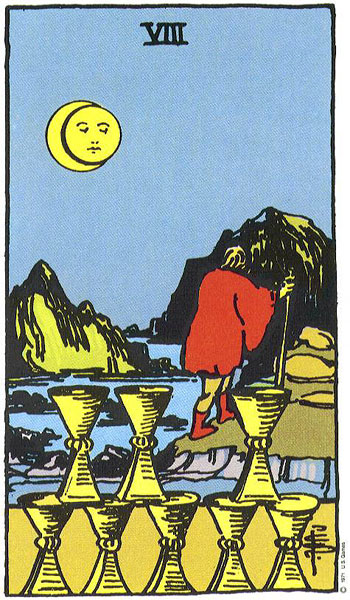
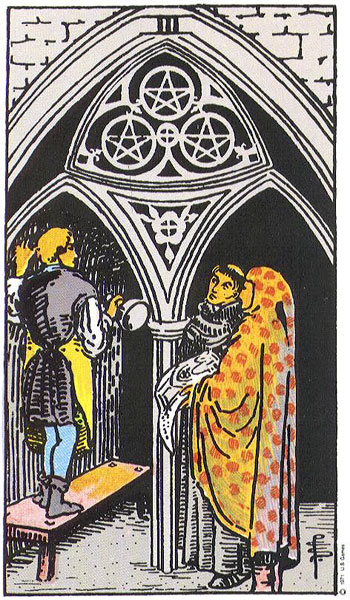
The Rider–Waite–Smith deck, sometimes shortened to "Rider–Waite," was first published by the London publisher Rider in 1909. It was conceived by Arthur Edward Waite, a former Golden Dawn member who wrote the accompanying book *The Pictorial Key to the Tarot* in 1910. Waite contributed the concepts, the overall symbolism he wanted preserved, and the editorial direction. The artist who executed the seventy-eight images was Pamela Colman Smith, an Anglo-Jamaican illustrator and designer who had previously collaborated on theatre projects, book illustrations, and folklore collections.
Colman Smith's visual authorship is sometimes under-cited, but it is central to what makes the deck distinctive. Her task went beyond the standard medieval revival illustrations of the trumps that had dominated earlier decks. Waite asked her to give every one of the fifty-six Minor Arcana cards a full scene with figures, rather than the arrangement of objects that earlier tarot decks such as the Marseille pattern had used. This expanded pictorial brief is the main reason the Rider–Waite–Smith deck became a template for most modern English-language tarot decks. The deck's reputation rests on a collaboration: Waite's theosophical, Christian-mystical, and Kabbalistic program carried out in Colman Smith's hand.
Waite himself was clear that his meanings were his own interpretive choices, not historical recoveries. This is a useful model for any reader today: meanings are assigned, sometimes consciously, sometimes through traditions that grew up later.
Two Cards as a Lens: The Fool and The World
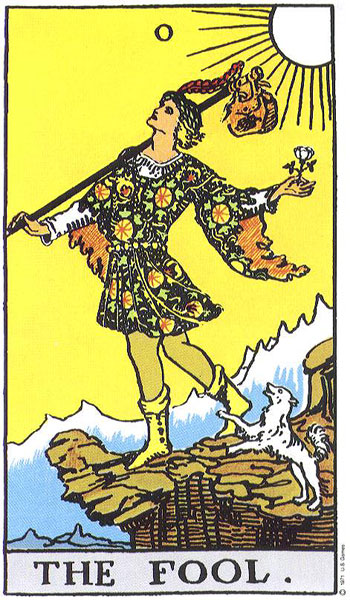
Looking at the imagery of two specific cards can illustrate how interpretation choices are made. The Fool, numbered 0 in the Major Arcana, is conventionally shown in the Rider–Waite–Smith deck as a traveler at the edge of a cliff, with a small dog, a sun rising behind the shoulders, a knapsack on a stick, and a white rose. None of those details is mandated by the playing-card history; they were assembled by earlier writers and then crystallized in Colman Smith's drawing. The grounded interpretive note for this card treats the image as a beginning, an experiment, or a step into unfamiliar territory, with a reversed note that the beginning may need more preparation, boundaries, or awareness of consequences. The image of stepping toward a cliff edge is what licenses that ambiguity: it can be read as bold or as reckless.
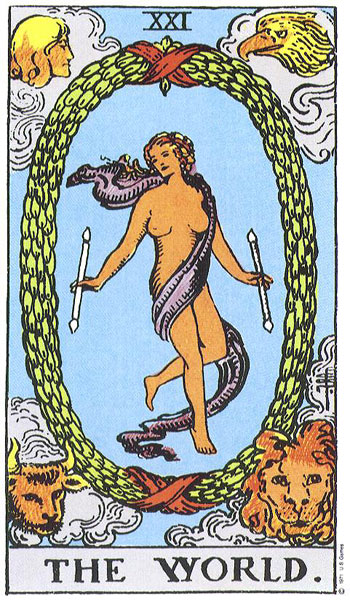
The World, numbered 21, shows a figure framed within an oval wreath, sometimes accompanied by the four living creatures drawn from Christian and Ezekiel iconography. The interpretive note frames the upright meaning as completion, integration, and recognition of how separate efforts have formed a coherent whole, and the reversed note as a cycle that may be almost complete but still needs closure, documentation, or one final connection. Again, this is one of several possible readings; some writers treat the card as primarily spiritual transcendence, others as a literal travel card.
These interpretive choices are useful precisely because they are explicit. Anyone using them should feel free to adjust them and to ask whether the scene on the card actually supports the meaning assigned.
A Realistic Low-Stakes Example: Reading Without Predicting
Suppose a reader who has been thinking about trying a new evening hobby pulls The Fool upright and The World reversed in a simple two-card reflection. A predictive frame might say, "a new beginning will end in completion." That framing is not justified, because the cards do not contain information about future outcomes. The honest reflection is closer to this: "The Fool describes my current mood of curiosity about something new, and The World reversed asks what loose end I would need to close before I have room for it."
A realistic low-stakes way to test this might be to commit to two sessions of the new hobby, then write down what felt open, what felt unfinished, and what had to be cleared first. The journal entries might or might not "match" the cards. Either outcome is informative. If the entries match, it is worth noting that two cards chosen at random can often be made to fit a familiar situation through a process known as confirmation bias. If they do not match, that is equally worth recording, because it would weaken the case that the cards function as predictions. This is how disconfirming evidence is treated with the same care as an apparent match.
Separating Evidence From Origin Myths
A short list of common unsupported claims about the tarot can help calibrate what counts as evidence. First, the Egyptian origin claim popularized by Court de Gébelin is not supported by any archival evidence linking tarot iconography to Egyptian sources. Second, the Romani origin story, sometimes told as fact, is a product of nineteenth-century European imagination rather than documented migration of cards from India. Third, claims that the cards preserve "ancient mystery school" teachings from Atlantis or pre-Columbian America similarly lack documentation. They are stories that eighteenth- and nineteenth-century writers told to lend prestige to their own systems.
What we do have evidence for includes the gaming use of the cards from the 1400s onward, the documented production of woodcut and engraved decks in the sixteenth and seventeenth centuries, the rise of divinatory practice in late eighteenth-century France, the publication history of the Rider–Waite–Smith deck in 1909, and the documented artistic output of Pamela Colman Smith. Working from this evidence is more useful for reflection than working from myth.
A Journal Method for Verifying Your Own Readings
If you want to use these cards as a tool for reflection rather than prediction, a short journal method can help you keep your interpretations honest.
Before drawing, write down what question you are actually thinking about, in plain language. After drawing The Fool and The World as a pair, write what each card's image literally shows and what meaning you are assigning to it. Note any other reading you have seen for the same card, including ones that disagree with yours. Note what would count as a result that does not fit the meaning you assigned. Revisit the entry a week later and mark which predictions of your own thinking actually came true, which did not, and which were too vague to count either way.
A few questions the reader can verify in a journal:
- For The Fool: what could you test on a small scale before making a larger commitment? - For The World: what would make this chapter complete enough to carry its learning forward? - Did the meanings I assigned to the cards feel obvious in hindsight, or would the opposite meanings have fit just as well? - What would a friend who had never seen the cards say about the same situation?
It is worth saying clearly that the tarot is not a prediction tool. It is a structured set of images that can be used for reflection, much as one might use a piece of music or a poem. For decisions involving medical, legal, financial, safety, or crisis concerns, the right sources are qualified professionals and real evidence, not card layouts. Tarot can prompt useful questions, but it should not be used to substitute for those resources, and any apparent match between a reading and an outcome should be recorded with the same care as disconfirming evidence.
Share this article