The Hierophant Tarot Card Meaning at a Glance
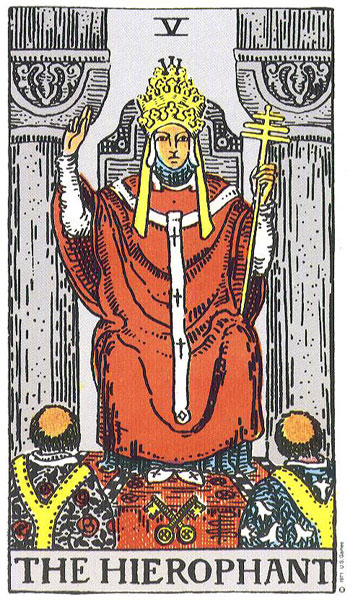
The Hierophant is the fifth card of the Major Arcana. In many traditional decks, the figure is depicted as a religious teacher or elder seated between two columns, often raising a hand in blessing while holding a key or staff. Two acolytes kneel before him. The card is widely associated with tradition, teaching, shared practice, and learning the logic of an established system.
If you are looking up the hierophant tarot card meaning for reflection, you are not the first. People have turned to this image for centuries as a prompt for thinking about institutions, mentors, and the difference between a belief you have tested and a belief you have inherited. This guide offers a practical way to work with those prompts without confusing the card for a forecast.
Tarot is not a prediction. No card can tell you what will happen tomorrow, who will call, or whether a decision is "correct" in any absolute sense. The value of The Hierophant, as we will use it here, is that it asks you to be honest about what you have learned, from whom, and whether that learning still holds up.
What the Imagery Invites You to Notice
Before reaching for interpretations, slow down and look. The Hierophant is rich with symbolic furniture: pillars, keys, a triple crown, the kneeling students, sometimes the two figures known as the two acolytes, or the keys said to open heaven and earth. Each element can be read as a question rather than a fact.
The seated posture suggests authority that has been granted or accumulated. The raised hand suggests blessing, certification, or the act of teaching. The acolytes suggest that knowledge is being transmitted, not discovered alone. The key suggests that tradition holds something valuable, perhaps access to a body of practice that took generations to refine.
You do not need to know what every symbol officially means. The practice is to notice which details attract your attention and why. A reader who spent years in a religious school may notice the crown; a reader who taught themselves a craft may notice the kneeling students; a reader who values freedom may notice the locked gate the keys imply. None of these reactions is the right reading. Each is data about what you bring to the card.
Upright Reflection: Tradition, Teaching, and Shared Practice
When The Hierophant appears upright in a reflective reading, the card data describes it as pointing toward tradition, teaching, shared practice, and learning the logic of an established system. In practical terms, this is a prompt to ask where you are currently a student, where you are a teacher, and where you are borrowing a framework that you have not yet tested.
Consider tradition in the smallest sense. A morning routine, a recipe, a weekly meeting, a coding style guide, a religious observance, and a professional standard are all traditions. Each can be a scaffold or a cage. The upright Hierophant asks you to identify which scaffold is currently supporting your work and whether you are using it consciously.
Teaching is the second strand. You may be teaching formally, through a job, or informally, through example. The card invites you to notice what you are communicating when you are not trying to communicate anything. Shared practice is the third strand: the idea that some skills are learned in company, not in isolation. Joining a study group, a class, a guild, or a working group may be more useful now than another hour of independent reading.
The reflection prompt paired with this card is direct: which tradition helps you learn, and where do you need to think independently? Hold both halves of that question at once. The card does not ask you to choose between obedience and rebellion. It asks you to be specific about which inherited framework is serving your current question and which is not.
Reversed Reflection: When a Convention Warrants Examination
The reversed Hierophant is described in the card data as a signal that a convention may deserve examination, or that a borrowed belief may not fit the present question. Reversal does not mean the upright meaning is now false. It means the balance has shifted, and the default trust in tradition may need to be re-examined.
A useful starting point is to name the belief. Avoid vague phrases like "the system." Try to state the convention in one sentence: "I am supposed to complete a graduate degree before entering my field," or "Our family handles grief by not talking about it," or "Open-source contributors should not charge for their work." Once the convention is named, you can ask whether it fits the present question.
Borrowed beliefs deserve particular attention, because they often arrive without a receipt. You may have absorbed a rule about money, work, marriage, or friendship from a parent, a teacher, a forum, or a popular book, and you may not remember testing it. The reversed Hierophant does not command you to reject the belief. It asks you to examine it. Does it still describe the situation in front of you? Does it serve a goal you currently hold? If you cannot say yes to either, the card is inviting you to set it aside for the moment and reason from the evidence you actually have.
This is also where the card's mixed tone shows up. Examination is not rebellion, and it is not always comfortable. You may find that a convention you enjoy defending is, on inspection, mostly ornamental. You may also find that a convention you resented is, on inspection, doing real work. The reversal simply insists that you look.
A Grounded Example: Choosing a Course of Study
Imagine you have been working in a field for several years and are considering whether to pursue a formal certification. You pull The Hierophant upright, surrounded by practical cards. The upright reading invites you to ask whether the certification's tradition and teaching structure would actually accelerate your learning, or whether you are drawn to it mainly because it is the path you have seen others walk.
The grounded decision is not made by the card. It is made by you, looking at concrete data. What does the certification cover? What do recent graduates say, in their own words, about whether it helped? What does it cost in time and money, and what is the realistic change in your work after completion? The Hierophant upright prompts you to take the question of tradition seriously, but it does not settle it for you.
Now imagine the same question, with The Hierophant reversed. The reversal does not mean "don't do the certification." It might mean that a particular borrowed belief, such as "I am not legitimate in my field without this credential," deserves examination. You could test that belief by asking whether the people you most respect in the field hold the credential, by listing the work you have already done that demonstrates competence, and by asking whether the certification moves you toward a specific goal or away from a specific insecurity. Both readings point to the same action: gather information, name the belief, and decide.
Testing Your Interpretation Against Real Evidence
A reflection is only useful if you can check it. Tarots are tools for prompting thought, not for delivering verdicts, and any reading you do should be tested against the world in front of you. Here is a simple journaling practice that works well with The Hierophant.
First, write down the interpretation you arrived at in one sentence. "I have been following a tradition that no longer fits my current question about X." Second, list two or three pieces of evidence that would support this interpretation. "I have felt relief when I imagine quitting, and I have noticed I can no longer explain why I follow the routine to a friend." Third, list two or three pieces of disconfirming evidence. "When I do skip the routine, I feel worse, and my work quality drops for a week." Fourth, write a single next step you can take in the next seven days to gather more evidence. "I will ask three people in the field who don't hold the certification how they think about it."
Record ambiguity as carefully as you record a match. If the card's message feels partly true and partly off, write that down. The aim is not to confirm your reading; it is to sharpen your question. A reading that survives disconfirming evidence is more useful than one that never had to face any. The reflection prompt for this card is a good general check: which tradition helps you learn, and where do you need to think independently? If you cannot answer the second half, you have not yet found the convention that needs examining. If you cannot answer the first half, you may be ready to study, not to strike out alone.
Limits of Interpretation and When to Seek Other Help
Tarot reflection is a contemplative practice. It is not a substitute for medical advice, legal counsel, financial planning, or safety planning. If you are facing a decision about your health, your rights, your money, or your physical safety, the appropriate next step is a conversation with a qualified professional and a careful look at the evidence in front of you. A card drawn at a kitchen table will not diagnose a condition, draft a contract, or protect you from a dangerous situation. Treat any reading that tries to do those things as a signal to step back and consult a person whose work is grounded in training and accountability.
This is especially important to remember when a reading feels emotionally overwhelming. A card that names a clear fact about your life in a single sentence is doing more than a deck of illustrated cards can do. Real questions deserve real evidence and, when stakes are high, real help.
The Hierophant itself, in its upright form, is an invitation to slow down enough to learn the system you are working inside. The motion of this guide is the same: take the time to learn the limits of the tool, name the tradition you are using, and decide, with evidence, whether it serves the question you actually have.
Share this article