What Actually Changes Between the Two Arcana
When readers compare major arcana vs minor arcana, the most accurate framing is to describe two different scales of attention rather than a fixed ranking. The Major Arcana, in the tradition most often used today, contains twenty-two cards that move through a long arc of life themes, while the Minor Arcana contains fifty-six cards organized by suit and rank. Some practitioners treat the Major as more important, but that hierarchy is interpretive, not structural. What changes in a reading is the lens, not the weight.
A visual cue often supports this. Major Arcana cards tend to depict wider scenes with multiple figures or symbolic landscapes, while Minor Arcana cards tend to focus on a smaller vignette, often a hand, a pair of figures, or a handful of objects. The Major image reads like a landscape; the Minor image reads like a vignette. Reading either as if it were the other flattens what each does best.
A useful starting rule is to ask whether the situation in front of you feels like a season or a moment. A season invites Major Arcana attention: long-running questions about direction, identity, or closure. A moment invites Minor Arcana attention: a specific choice, conversation, or piece of work. The rule is a habit, not a law, and readers who reverse it often produce meaningful readings as well.
Scale and Suits: Reading Across the Difference
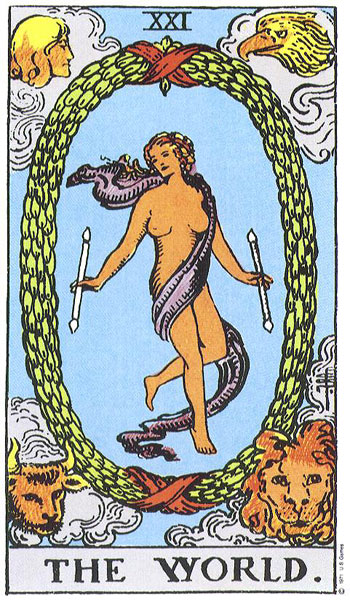
Major Arcana cards describe larger frames. The World, in its upright sense in the cards supplied here, points to completion, integration, and the recognition that separate efforts have formed a coherent whole. Reversed, it suggests that a cycle is almost complete but still needs closure, documentation, or one final connection. Either way, the card invites the reader to think about chapters rather than tasks.
Minor Arcana cards describe situations through one of four suits. Each suit carries a domain of life, though different traditions assign the domains differently:
- **Wands** are often associated with initiative, creative energy, and purposeful action. - **Cups** are often associated with feeling, relationship, imagination, and emotional response. - **Swords** are often associated with thought, language, decisions, and conflict. - **Pentacles** are often associated with work, resources, the body, routine, and material conditions.
Because these domains are interpretive, two readers may reasonably place a card differently. Recording which suit you assign to which domain, and revisiting those assignments over time, is one way to keep your readings consistent.
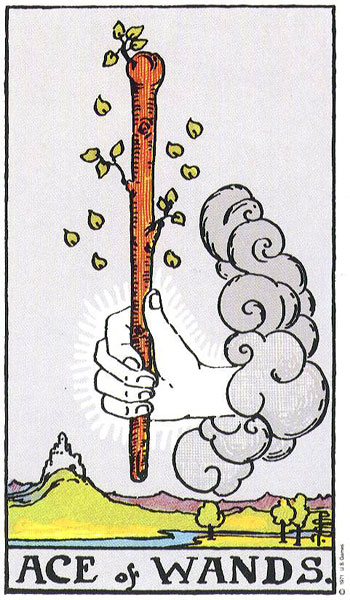
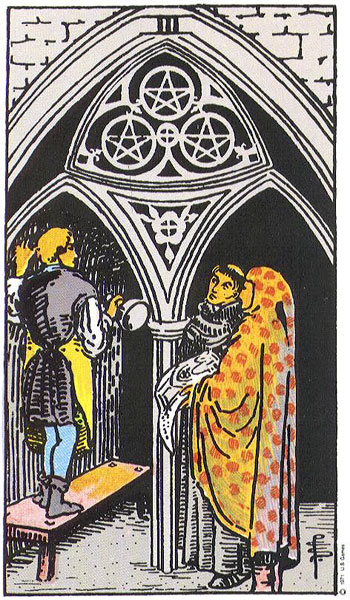
The cards supplied for this article give a small sample. The Ace of Wands, in its upright form, points to a concentrated beginning expressed through initiative and creativity. The Two of Cups points to a pairing or an effort to hold two realities at once through feeling and relationship. The Three of Swords points to growth through honest distinctions and clear communication. The Four of Pentacles points to stability, containment, and the consequences of holding a position. None of these reach as broadly as The World, and that contrast is part of how the two arcana work together.
Ranks Inside the Minor Arcana
Within each suit, the Minor Arcana moves through ranks. In the cards supplied here, the pattern is visible. The Ace is an opening (the Ace of Wands as a concentrated beginning). The Two introduces pairing or comparison (the Two of Cups as holding two realities at once). The Three brings participation or feedback (the Three of Swords as growth through honest distinctions). The Four brings stability and structure (the Four of Pentacles as containment and steady practice).
Some decks extend these ranks through Ten and include Court cards, which can introduce qualities of learning, action, embodiment, and stewardship. The tone shifts across ranks in ways that matter for reading. The supplied dataset tags cards as open, mixed, or pause. An open tone invites initiative, a mixed tone signals friction or untested feeling, and a pause tone signals rest or something unresolved. The Two of Cups is tagged as mixed, suggesting that pairing two things is rarely clean. The Four of Pentacles is tagged as pause, suggesting that stability can also be a kind of stop.
When comparing major arcana vs minor arcana in a single spread, look for whether Major cards tend to fall in positions that frame the situation and Minor cards tend to fill in the specifics. This is a common pattern, not a law, and it can easily reverse in a given reading.
A Low-Stakes Example Using Five Cards
Imagine someone learning to play the guitar in their thirties. The question is small, the stakes are small, and there is no decision that cannot wait a week. A five-card reading might lay out the shape of the next few months:
- The World upright. A reminder that the year is not just about arriving somewhere but about integrating what has already been practiced. The reflection prompt is direct: what would make this chapter complete enough to carry its learning forward? - Ace of Wands upright. A small beginning in the direction of initiative and creativity. The reflection prompt asks what small beginning would let the learner move quickly. - Two of Cups upright or mixed. Pairing the practice with another person, or holding two realities at once, the musical self and the everyday self. The reflection prompt is about comparison rather than premature fusion. - Three of Swords upright. Growth through honest distinctions and clear communication. The reflection prompt invites feedback that moves the practice beyond its first form. - Four of Pentacles upright. Stability and steady practice. The reflection prompt asks whether the current structure is providing rest or preventing movement.
This is not a forecast. It is a set of attention points. If the learner keeps a journal, they can check two months later whether the framework they chose helped them practice more consistently, or whether the structure kept them stuck. Both outcomes count, and the missing cards in the spread are as informative as the cards that appeared. A reading that ignores what was not drawn is only half a reading.
How Interpretation Choices Shift
Every reader brings a lens, and the same card can read differently depending on the question and the surrounding cards. A few choices matter more than others.
Reversed cards are usually read as blocked, internalized, or shadow forms of the upright meaning, but some readers read reversals simply as a slower or quieter version of the same theme. Neither reading is wrong; both should be tested against the reader's experience over time. The reversed Four of Pentacles, for instance, can be read as scarcity fixation or as a softening of structure, and the difference matters in practice.
Tone tags, when a deck provides them, can shape pacing. An open tone invites initiative, while a pause tone invites restraint. Using these tags consistently across a journal helps the reader notice when the same card keeps appearing in the same tone, which often says more about the situation than about the deck.
Adjacency matters. The World next to the Ace of Wands reads differently from The World next to the Four of Pentacles. The first pairing suggests finishing one cycle and opening another; the second suggests integration that may be holding back motion. Both are legitimate readings, and recording which one felt truer is more useful than choosing one in advance.
Keeping a Journal of Disconfirming Evidence
A reading is a hypothesis, not a result. Treat it the way you would treat a weather forecast, useful as one input, never the only one. To learn from readings rather than to be confirmed by them, note three things after each session:
1. The cards drawn and your first interpretation. 2. The actual outcome or development a few weeks later. 3. Anything that did not match, including cards that seemed irrelevant or warnings that did not materialize.
Disconfirming evidence is more useful than confirming evidence, because a single fit can be coincidence, while a pattern of misses tells you the lens is off. Some readers keep a simple spreadsheet; others keep a notebook page per spread. The format matters less than the habit. If the Three of Swords appeared and no painful conversation followed, that is worth recording. If the Ace of Wands appeared and the new beginning stalled, that is worth recording too.
When the same card keeps appearing across weeks, ask whether the situation is repeating or whether the reader is drawn to that image for personal reasons. Either answer is interesting, and either is worth recording. Ambiguity is data, not failure.
A Few Honest Limits
Tarot is not a prediction. It does not know the future, it does not diagnose illness, and it does not speak for other people. It is a structured reflective tool, and the meaning it carries comes from the reader's attention, not from the cards themselves. For decisions involving medical care, legal questions, financial commitments, safety, or crisis, use qualified professionals and direct evidence.
The hierarchy between Major and Minor Arcana is also not universal. Some traditions use the Major sparingly, others treat every card as equally weighted, and some rotate the entire deck through different positions. The framework offered here, that Major cards often frame larger themes while Minor cards fill in the specifics, is one useful lens, not a rule. Readers who work primarily with Major Arcana report different results from readers who use both, and both communities have produced meaningful reflection for centuries.
A final note. Tarot imagery is symbolic, not literal. The World is not telling anyone the world is ending or beginning. The Four of Pentacles is not diagnosing financial caution. The cards work by inviting attention, and attention is most useful when paired with the reader's own evidence, judgment, and care. A spread that prompts a single honest question is worth more than a spread that produces a confident answer.
Share this article