What "Tarot and Numerology" Actually Means Together
The phrase "tarot and numerology" covers two distinct symbol systems that practitioners have, over time, mapped onto one another. The tarot provides 78 cards with pictures and text. Numerology provides a way of assigning meaning to numbers, often through the reduction of larger numbers to single digits. When the two are joined, the result is not a science. It is a study tool, a mnemonic scaffold that helps a reader remember patterns and ask better questions of themselves.
This article treats that scaffold as cultural material. The goal is to understand how numbering works inside a deck, how reduction rules connect one card to another, and how the so-called birth card is calculated. None of this is a forecast. A number does not determine a personality. A card does not predict an outcome. What a number can do, when used honestly, is help you organize attention across time and notice what you have been ignoring.
If you remember one thing from this piece, remember this: the value of tarot and numerology, used well, lies in the quality of the question it prompts you to sit with, not in any verdict it delivers. Treat the system as a quiet mirror, not a window into a fixed future.
The Two Numbering Layers: Major and Minor Arcana
A traditional tarot deck has two numbering layers. The Major Arcana contains 22 trump cards, often numbered 0 through 21. These are the large symbolic scenes: figures, journeys, stations along a path. The Minor Arcana contains 56 cards divided into four suits, commonly Cups, Pentacles, Swords, and Wands, with each suit carrying numbered cards Ace through Ten plus four Court cards.
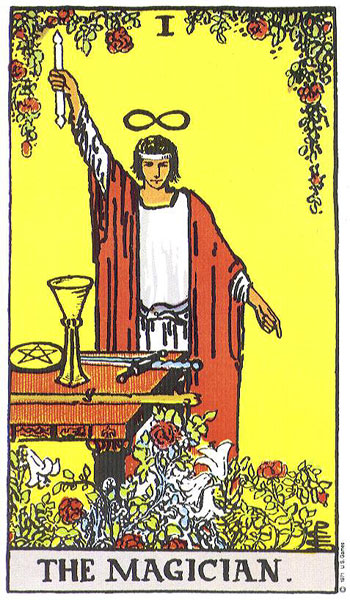
The Major Arcana numbers are the spine of the system. Number 1, The Magician, sits at the beginning of the sequence of work, even though 0, The Fool, precedes it. Number 3, The Empress, belongs to the early growth band of the sequence. Number 9, The Hermit, sits closer to the reflective middle of a 22-step path. The numbers themselves are not the meaning; they are addresses that help a reader locate where on the path a particular quality belongs.
In the Minor Arcana, numbers behave differently. A Three of Cups is not the same archetype as The Empress, also number 3. It carries the same numerical position but lives inside a suit, and the suit shapes the meaning: Cups concerns feeling and relationship, so the Three of Cups tends to mark small gatherings of affection. When readers blur Major and Minor numbers, the system loses its texture. Keeping the two layers distinct is the first habit of accurate work with tarot and numerology.
Reduction: How Big Numbers Become Single Digits
Numerological reduction is the rule that links the higher Major Arcana cards back to the single digits. Take The Hermit, number 9. Reduce 9 and you stay at 9. Now consider a higher card, say number 15 (in some decks, The Devil). Add the digits: 1 + 5 = 6. The card at position 6 in the Major Arcana is The Lovers. Under this rule, the 15 card shares a numerical address with the 6 card. A reader can then ask what a 6-quality looks like when it is being distorted or pressured.
Reduction works on birth dates too. If you were born on the 14th of a month, you reduce: 1 + 4 = 5. If you were born in March (the 3rd month) of 1990, you can reduce 1 + 9 + 9 + 0 to 19, then 1 + 9 to 10, then 1 + 0 to 1. Some traditions stop at a single digit, others stop at the Major Arcana range of 1 to 22 because the deck has only 22 numbered trumps.
A practical warning: different schools do this differently. Some include 0 as a possible birth card. Some exclude it. Some treat 11, 22, and 33 as Master numbers that are not reduced further. None of these choices is provably correct. They are conventions that affect what answer you reach. Recording which convention you used is part of treating the system as a study tool rather than an oracle.
Birth Cards and the Imagery Behind Them
A birth card is the Major Arcana card assigned to a birth date using the reduction rules just described. It functions, in the cultural sense, like a coat check ticket: a short label that lets a reader find the rest of the pattern. Used carefully, it can be a way to focus a year's reflection. Used carelessly, it becomes a personality label that flattens a person into a brand.
Three sample cards from a traditional Major Arcana illustrate the range, and the imagery behind each number is part of what gives it weight.
Number 1, The Magician, traditionally shows a single figure at a table with tools laid out: a cup, a sword, a pentacle, a wand. The composition mirrors the number: one center, four resources, no crowd. The upright meaning in this deck is focused agency: bringing available skills, tools, and attention into one deliberate act. As a study prompt, it asks which resource is already within reach, and what specific action could put it to work. The reversed meaning flags when effort is scattered, performative, or disconnected from the resources actually available.
Number 3, The Empress, often shows a figure in a lush, cultivated landscape. The 3 sits in the early growth band of the Major Arcana. Threeness appears in the layered foreground, middle ground, and background, and in clusters of detail that suggest conditions rather than events. The upright meaning is care, growth, creativity, and the conditions that allow something living to develop. As a prompt, it asks what needs consistent nourishment rather than another burst of effort. The reversed meaning names overextension, neglect of your own needs, or growth without structure.
Number 9, The Hermit, traditionally shows a cloaked figure holding a lantern up rather than forward, often at a distance from other figures. The 9 sits in the reflective middle band. Ninenness shows up in the small number of companions and in the wide empty ground around the figure. The upright meaning is deliberate withdrawal, careful inquiry, and creating enough quiet to identify your own position. As a prompt, it asks what question deserves uninterrupted thought, and when that thought should return to the world. The reversed meaning warns that solitude may have become isolation, or that reflection may be delaying a necessary conversation.
Each of these is a pattern, not a destiny. A person whose birth card reduces to 9 is not required to become a hermit. A person whose card is 1 is not guaranteed to be effective. The cards describe qualities that can be cultivated or neglected; the human being holding them remains the author.
A Low-Stakes Example: Three Cards Across a Week
Suppose you draw three cards for a week of low-stakes reflection: Magician (1) on Monday, Empress (3) on Wednesday, Hermit (9) on Friday. Treat the numbers as a path: 1, 3, 9. Monday's prompt asks which resource is already within reach and what specific action could use it. Wednesday's prompt asks what needs consistent nourishment rather than another burst. Friday's prompt asks what question deserves uninterrupted thought.
A realistic application might look like this. On Monday, you notice that you have been saying you have no time to write, but a half-hour slot is visible on your calendar that you have been using to reread email. The Magician prompt turns that half-hour into a deliberate act: write one paragraph. On Wednesday, you realize the writing has not grown into anything because you have been caring for it in bursts and abandoning it for three days. The Empress prompt asks for steady watering: twenty minutes a day for the rest of the week. On Friday, you sit with the question of whether you are writing for the right reader, or whether you are still writing for a reader who no longer exists. The Hermit prompt asks you to hold that question without answering it on Friday evening.
Notice what did not happen. Nothing was predicted. The week did not turn into a destiny. The numbers organized the sequence of attention. The cards gave each day a particular shape of question. The interpretation choices belonged to you.
Journal Questions to Verify What You Notice
A study tool only earns its keep if it can be checked. Use these prompts in a journal over two weeks. Treat any apparent match as tentative and any miss as equally valuable data. Record ambiguity and disconfirming evidence as carefully as an apparent match.
1. When you draw a card, do you describe the image before you read the keywords? What do you see that the keywords do not name? 2. When you reduce a birth date, do you record which reduction convention you used? Would a different convention change the card you land on? 3. After a week of applying one card's prompt, what disconfirming evidence do you notice? Where did the card's meaning not fit your day? 4. Where did you treat the card as a verdict rather than a question? What would change if you rewrote your notes in question form? 5. Which interpretation choice felt like your own, and which felt borrowed from a book? Can you tell the difference?
The fifth question is the most important. A long list of hits tells you less about the cards than about how eager you were to find hits. Disconfirming evidence, recorded honestly, is the part that builds real reflective skill.
Limits of the Map
The map has limits. Numbers do not cause events. Cards do not speak. The system has no measurable effect on outcomes, and no study has established that birth cards predict personality traits, relationships, or health. People who use these tools well treat them as scaffolding for attention. People who use them poorly treat them as substitutes for evidence, qualified advice, or direct conversation.
If you are facing a decision about medical care, legal rights, money, safety, or crisis, do not consult a tarot deck. Consult a qualified professional, and bring the cards only as a way to organize the questions you want to ask that professional. Tarot is not a prediction, and treating it as one risks real harm when the stakes are real.
Used inside its proper scope, tarot and numerology is a way to sit with a question longer than you usually would. That is a small thing, and it is enough.
Share this article